
History and social studies
Great Fire sources: compare two viewpoints
For Year 5 pupils, use two classroom summaries and source labels to compare a private diary with an official newspaper report about the Great Fire.
Read the material
For Year 5 pupils, use two classroom summaries and source labels to compare a private diary with an official newspaper report about the Great Fire.
Pupil worksheet. Use the preview for diagrams and layout.
Page 1
Great Fire sources: compare two viewpoints
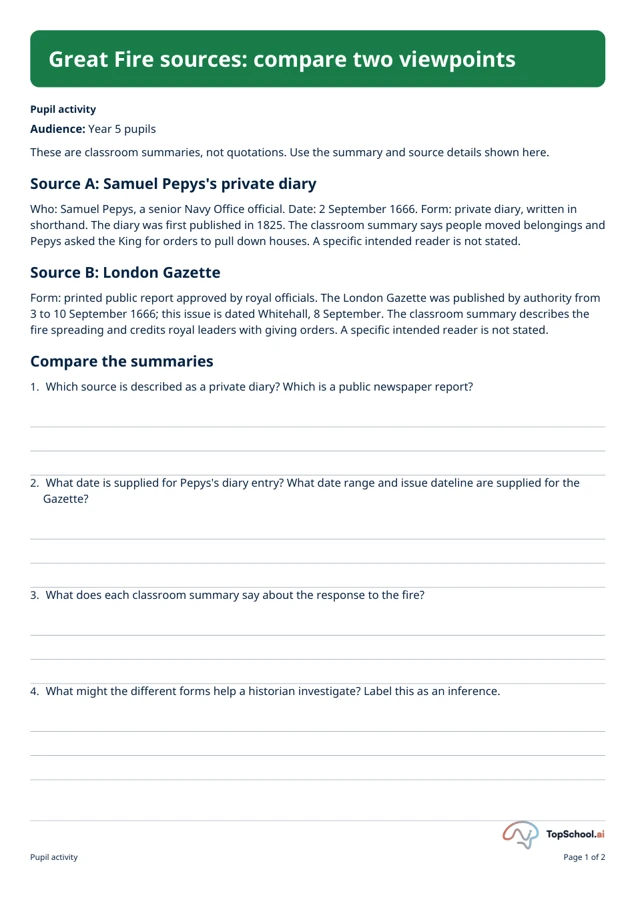
Pupil activity
Audience: Year 5 pupils
These are classroom summaries, not quotations. Use the summary and source details shown here.
Source A: Samuel Pepys's private diary
Who: Samuel Pepys, a senior Navy Office official. Date: 2 September 1666. Form: private diary, written in
shorthand. The diary was first published in 1825. The classroom summary says people moved belongings and
Pepys asked the King for orders to pull down houses. A specific intended reader is not stated.
Source B: London Gazette
Form: printed public report approved by royal officials. The London Gazette was published by authority from
3 to 10 September 1666; this issue is dated Whitehall, 8 September. The classroom summary describes the
fire spreading and credits royal leaders with giving orders. A specific intended reader is not stated.
Compare the summaries
1. Which source is described as a private diary? Which is a public newspaper report?
2. What date is supplied for Pepys's diary entry? What date range and issue dateline are supplied for the
Gazette?
3. What does each classroom summary say about the response to the fire?
4. What might the different forms help a historian investigate? Label this as an inference.
Pupil activity
Page 1 of 2
Page 2
Great Fire sources: compare two viewpoints
5. What can neither short summary tell you about every person's experience?
Write: “The summary of Source __ says __. Its form may help show __. It cannot establish __.”
Pupil activity
Page 2 of 2
A teaching sequence
Use source labels, dates and short classroom summaries to compare what a private diary and an official newspaper report can show, while identifying what remains unknown.
Identify form and dates
Identify who made each source, its date and its form.
Which source is a private diary and which is a public report?
Compare supplied summaries
Use the source metadata and summary to compare the kind of account each provides.
What response to the fire does each summary describe?
Label an inference clearly
Separate a supplied fact from an inference about purpose or audience.
Is your claim about audience or purpose stated, or only inferred?
Name the summaries' limits
Name one thing the summaries cannot establish.
What can these short accounts not establish about every person's experience?
Before you teach
Look for the thinking behind an answer, choose the support your class needs and leave room for an independent response.
What to look for
Supported answers distinguish a private diary dated 2 September 1666 from the London Gazette report published by authority from 3 to 10 September, with issue dateline Whitehall, 8 September. A specific intended reader for either item is not stated in the supplied summary.
Give a little support
Read aloud and use “This source was made by __, so it can tell me __.”
Take the idea further
Ask what a diary cannot show about every household and what an official report might emphasise.
Things to keep in mind
No exact diary or newspaper wording is supplied. Pupils can evaluate the source labels and summaries only; they must not claim to analyse wording, verify quotations or establish the full event from these short accounts.
Keep the idea. Make it yours.
Bring your topic, learning goal and class context to PLAI™, then review what you create.
Ideas to try with your class
Sample teaching perspectives on what to try, what to adapt and what to watch for.
Meet The Creators
Meet a creator whose teaching interests connect with this template.

Book and Biscuit
The five numbered questions move from the diary and Gazette dates to what each classroom summary says and what the two short accounts leave unknown. Pupils distinguish source form from the evidence they have actually been given.
Pencil Case Pal
The Year 5 cards offer a compact comparison of a private diary and a public report through labels and classroom summaries. They suit a lesson on identifying origin, date and form before pupils infer what each account might show.
Clear Example
The final sentence starter separates what a summary says from what its form may show and what it cannot establish. Pupils can use it to mark the difference between supplied information and an inference.
Bright Idea Break
These cards do not reproduce Pepys’s wording or the Gazette article, and neither source has a stated intended reader here. Ask what additional evidence would be needed before making claims about the fire’s full response or every household.