
Music and performing arts
From the stalls: observe a performance and explain its effect
For Years 9 and 11 Drama pupils, describe an observed performance choice, support an interpretation with evidence and explain its possible effect on an audience.
Read the material
For Years 9 and 11 Drama pupils, describe an observed performance choice, support an interpretation with evidence and explain its possible effect on an audience.
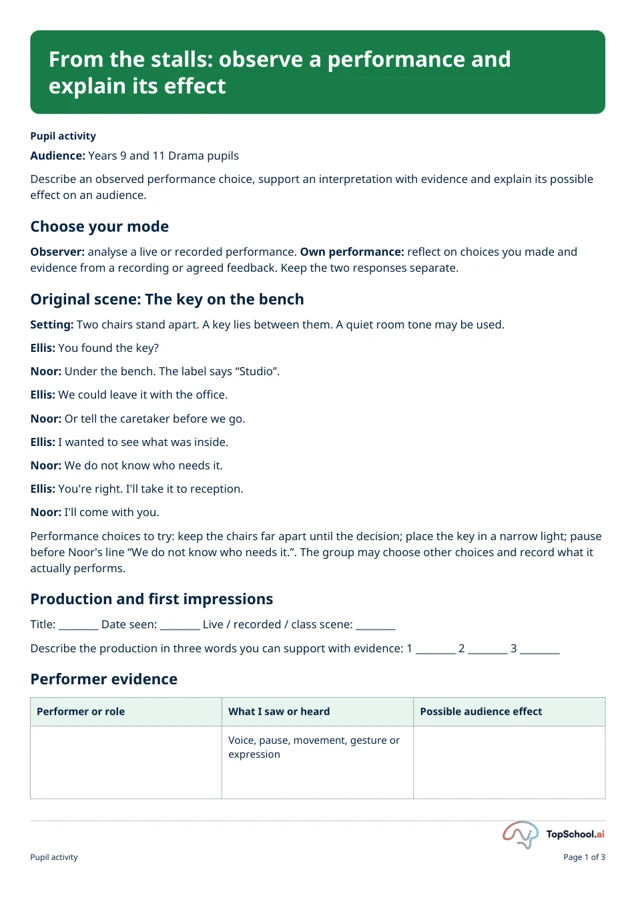
Pupil worksheet. Use the preview for diagrams and layout.
Page 1
From the stalls: observe a performance and
explain its effect
Pupil activity
Audience: Years 9 and 11 Drama pupils
Describe an observed performance choice, support an interpretation with evidence and explain its possible
effect on an audience.
Choose your mode
Observer: analyse a live or recorded performance. Own performance: reflect on choices you made and
evidence from a recording or agreed feedback. Keep the two responses separate.
Original scene: The key on the bench
Setting: Two chairs stand apart. A key lies between them. A quiet room tone may be used.
Ellis: You found the key?
Noor: Under the bench. The label says “Studio”.
Ellis: We could leave it with the office.
Noor: Or tell the caretaker before we go.
Ellis: I wanted to see what was inside.
Noor: We do not know who needs it.
Ellis: You're right. I'll take it to reception.
Noor: I'll come with you.
Performance choices to try: keep the chairs far apart until the decision; place the key in a narrow light; pause
before Noor's line “We do not know who needs it.”. The group may choose other choices and record what it
actually performs.
Production and first impressions
Title: ________ Date seen: ________ Live / recorded / class scene: ________
Describe the production in three words you can support with evidence: 1 ________ 2 ________ 3 ________
Performer evidence
Performer or role
What I saw or heard
Possible audience effect
Voice, pause, movement, gesture or
expression
Pupil activity
Page 1 of 3
Page 2
From the stalls: observe a performance and explain its effect
Design evidence
Element
Specific detail seen or heard
Possible audience effect
Set
Lighting
Sound
Costume
Props
Key moment: point, evidence, explain
Point: ________ Evidence from what was performed: ________ Explain the possible audience effect: ________
Pupil activity
Page 2 of 3
Page 3
From the stalls: observe a performance and explain its effect
Own-performance reflection, if selected
My intention: ________ What the audience or recording showed: ________ One choice I would adjust next time:
________
Pupil activity
Page 3 of 3
A teaching sequence
Describe an observed performance choice, support an interpretation with evidence and explain its possible effect on an audience.
Identify the observed performance
Record the production and whether it was live or recorded.
Are you analysing a watched production or your own performed choices?
Support first impressions
Note three first impressions that can be supported with detail.
What seen or heard detail supports each describing word?
Describe a performer action
Choose one performer action and describe exactly what was seen or heard.
What exactly happened before you infer an audience effect?
Link design evidence to effect
Analyse one design choice and write a point, evidence and explanation paragraph.
Does the paragraph label the audience effect as a possible interpretation?
Before you teach
Look for the thinking behind an answer, choose the support your class needs and leave room for an independent response.
What to look for
For example, a pause before “We do not know who needs it” may create hesitation because it delays the decision. Ask, “What did the performer do that supports your interpretation?”
Give a little support
Offer the observation table and the sentence frame “I saw or heard __; this may make the audience __ because __.”
Take the idea further
Compare two interpretations of the same moment and evaluate which is better supported by performance evidence.
Things to keep in mind
The scene is an original classroom script. It does not stand in for a production the pupil has not watched or performed.
Keep the idea. Make it yours.
Bring your topic, learning goal and class context to PLAI™, then review what you create.
Ideas to try with your class
Sample teaching perspectives on what to try, what to adapt and what to watch for.
Meet The Creators
Meet a creator whose teaching interests connect with this template.
Gentle Reminder
The three-page resource for Years 9 to 11 offers two modes (observe a live or recorded work, or reflect on one’s own performance) and says to keep the responses separate. Its original key-on-the-bench scene supplies choices to test.
Pocketful of Stories
The scene asks whether Ellis should take a found key to the office and includes possible staging choices: distance between chairs, a narrow light and a pause before Noor’s line. Pupils record what was actually performed.
Reread Reminder
Performer and design tables separate evidence from possible audience effect, while the PEE prompt structures the key moment. The own-performance page asks for intention, what a recording or agreed feedback showed and one adjustment.
Five More Minutes
The staging ideas are suggestions, not a required interpretation, and the scene is original fiction. Keep observer analysis separate from self-reflection and describe only choices actually seen or performed.