
Languages and literacy
French register: choisir entre tu et vous
Read six French register terms and their meanings, then use supplied fictional situations to compare familiar singular, polite singular and plural-group requests.
Read the material
Read six French register terms and their meanings, then use supplied fictional situations to compare familiar singular, polite singular and plural-group requests.
Pupil activity and after-attempt self-check. Use the preview for diagrams and layout.
Page 1
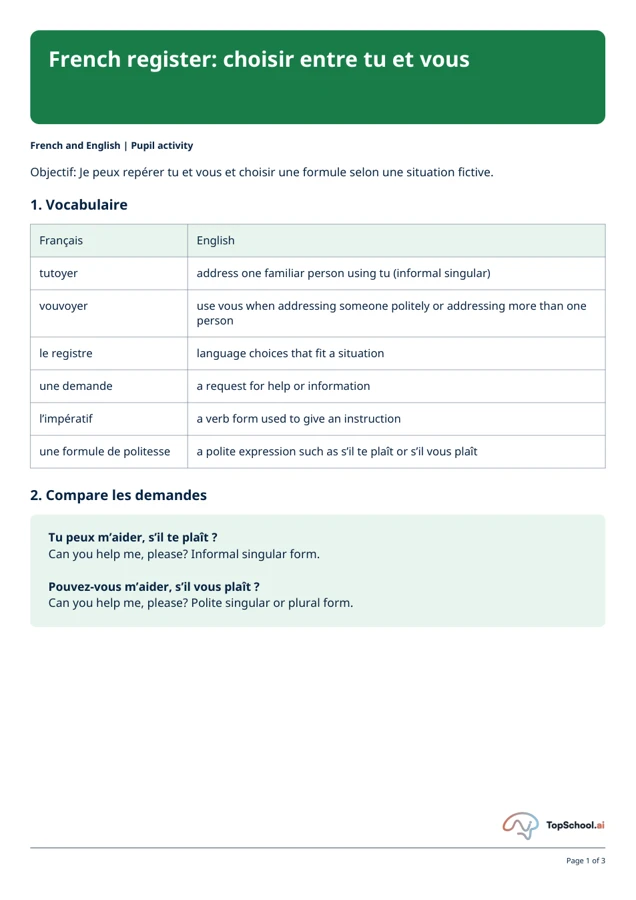
French register: choisir entre tu et vous
French and English | Pupil activity
Objectif: Je peux repérer tu et vous et choisir une formule selon une situation fictive.
1. Vocabulaire
Français
English
tutoyer
address one familiar person using tu (informal singular)
vouvoyer
use vous when addressing someone politely or addressing more than one
person
le registre
language choices that fit a situation
une demande
a request for help or information
l’impératif
a verb form used to give an instruction
une formule de politesse
a polite expression such as s’il te plaît or s’il vous plaît
2. Compare les demandes
Tu peux m’aider, s’il te plaît ?
Can you help me, please? Informal singular form.
Pouvez-vous m’aider, s’il vous plaît ?
Can you help me, please? Polite singular or plural form.
Page 1 of 3
Page 2
French register: situations et analyse
French and English | Pupil activity
3. Situations fictives
1. You ask a classmate you know well for help with a group poster. Choose the request you would use in your
class.
2. You ask one adult visitor you have not met before for help finding the library. Choose the request you
would use in your class.
3. You ask a group of classmates to help carry books. Choose the request you would use in your class.
Try the situations first. Then use the suggested choices on page 3. Use the convention taught in your class.
4. Analyse
Underline tu or vous. Circle the verb form: peux or pouvez. Choose one situation and explain which detail
guided your choice.
Remember that vous can address one person politely or a group; context and local conventions matter.
5. Compare les consignes
Ferme ton cahier. Informal singular: one familiar pupil.
Fermez votre cahier. Polite singular: one person addressed with vous.
Fermez vos cahiers. Plural group: several pupils.
Page 2 of 3
Page 3
Self-check: use after trying the situations
French and English | Learner self-check | Page 3
6. Suggested choices
Situation 1 can use “Tu peux m’aider, s’il te plaît ?”.
Situation 2 can use the polite singular “Pouvez-vous m’aider, s’il vous plaît ?”.
Situation 3 can use “Pouvez-vous m’aider, s’il vous plaît ?” addressed to the group.
Use the convention taught in your class. Remember that vous can address one person politely or
a group; context and local conventions matter.
Page 3 of 3
Page 1
French register: teacher guidance
Teacher guidance | Supports the three-page pupil pack
Suggested choices are learner feedback on pupil page 3, to use after attempting the three situations.
Print pupil pages 1 and 2 for the activity stage. The complete pupil pack includes the self-check page.
1. Teacher check
In the supplied examples, tutoyer means addressing one familiar person with tu. “Tu peux m’aider, s’il te
plaît ?” is informal singular; “Pouvez-vous m’aider, s’il vous plaît ?” can address one person politely or a
group. The situations are fictional practice. Use the convention taught in class rather than presenting
the examples as a universal rule.
Page 1 of 1
A teaching sequence
Identify tu and vous verb forms and choose a taught request form for a fictional situation, distinguishing polite singular vous from plural vous where relevant.
Read the register terms
Read tutoyer, vouvoyer, registre, demande, impératif and formule de politesse with their definitions.
How can vous address one person politely or more than one person?
Inspect pronoun and verb forms
Underline tu or vous and circle peux or pouvez in each request.
Which verb form belongs with the underlined pronoun?
Choose for the situation
Read the fictional situations. Choose the matching form and explain which detail in the situation helped you decide.
What detail and class convention guided your choice?
Compare the three instructions
Compare “Ferme ton cahier”, “Fermez votre cahier” and “Fermez vos cahiers”. Identify informal singular, polite singular and plural-group forms.
Which instruction addresses one familiar pupil and which addresses a group?
Before you teach
Look for the thinking behind an answer, choose the support your class needs and leave room for an independent response.
What to look for
Expected: tutoyer means addressing one familiar person using tu; “Tu peux m’aider, s’il te plaît ?” uses informal singular tu/peux. “Pouvez-vous m’aider, s’il vous plaît ?” uses vous/pouvez for one person addressed politely or for a group. Follow up: match each supplied fictional situation to a request and label “Fermez votre cahier” as polite singular.
Give a little support
Compare the requests side by side and colour-code the pronoun and verb. Ask pupils to rehearse one phrase before explaining the choice in English or French.
Take the idea further
Change “Ferme ton cahier” to “Fermez votre cahier” when addressing one person politely, then to “Fermez vos cahiers” when addressing a group. Explain the changes in the verb ending and possessive.
Things to keep in mind
The examples compare tu peux with pouvez-vous. Vous can address one person politely or a group, so choose the form that fits the scenario and the convention taught in class.
Keep the idea. Make it yours.
Bring your topic, learning goal and class context to PLAI™, then review what you create.
Ideas to try with your class
Sample teaching perspectives on what to try, what to adapt and what to watch for.
Meet The Creators
Meet a creator whose teaching interests connect with this template.

Chalk & Chai
This three-page French-English activity defines tutoyer and vouvoyer, then compares “Tu peux m’aider” with “Pouvez-vous m’aider” and uses fictional situations to choose between familiar singular, polite singular and plural-group requests.
Notes Between Bells
The examples show that vous can address one person politely or a group. Comparing “Ferme ton cahier,” “Fermez votre cahier” and “Fermez vos cahiers” brings verb and possessive changes into the discussion.
Little Lightbulbs
Underline the pronoun and verb in each phrase, then identify the listener in the fictional situation. Rehearse one request before explaining the choice in French or English.
After the Bell
Register conventions depend on the taught context and listener. Use the task's fictional situations and check the form against the course convention rather than treating vous as always plural.