
Languages and literacy
Francophone files: explore two French-speaking places
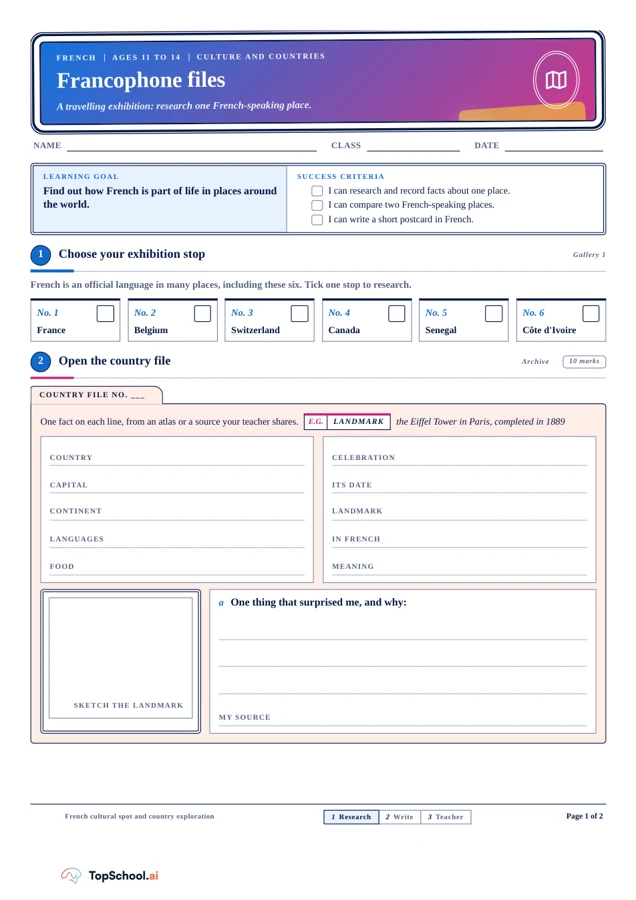
Research one place where French is an official language, compare it with a partner’s place and write a short postcard in French. Country-file prompts cover a capital, continent, languages, food, celebration, landmark and a source for each fact.
Read the material
Research one place where French is an official language, compare it with a partner’s place and write a short postcard in French. Country-file prompts cover a capital, continent, languages, food, celebration, landmark and a source for each fact.
Activity. Use the preview for diagrams and layout.
Page 1
NAME
CLASS
DATE
LEARNING GOAL
Find out how French is part of life in places around
the world.
SUCCESS CRITERIA
I can research and record facts about one place.
I can compare two French-speaking places.
I can write a short postcard in French.
French is an official language in many places, including these six. Tick one stop to research.
No. 1
France
No. 2
Belgium
No. 3
Switzerland
No. 4
Canada
No. 5
Senegal
No. 6
Côte d'Ivoire
French cultural spot and country exploration
F R E N C H
A G E S 11 TO 1 4
C U LT U R E A N D C O U N T R I E S
Francophone files
A travelling exhibition: research one French-speaking place.
1
Choose your exhibition stop
Gallery 1
2
Open the country file
Archive
10 marks
One fact on each line, from an atlas or a source your teacher shares.
E.G.
LANDMARK
the Eiffel Tower in Paris, completed in 1889
COUNTRY
CAPITAL
CONTINENT
LANGUAGES
FOOD
CELEBRATION
ITS DATE
LANDMARK
IN FRENCH
MEANING
a One thing that surprised me, and why:
MY SOURCE
COUNTRY FILE NO. ___
SKETCH THE LANDMARK
2 Write
3 Teacher
1 Research
Page 1 of 2
Page 2
Use your file and a partner's. These three exhibits can help.
1
2 FEBRUARY
La Chandeleur in France, traditionally
celebrated with crêpes
2
24 JUNE
Quebec's Fête nationale, in Canada
3
14 JULY
The national day of France
EXHIBIT
PLACE A:
PLACE B:
A celebration and date
A landmark
A food
a One way the two places are similar:
b One way they are different:
Read the model aloud. Then write your own postcard in French from the place you researched.
Model postcard: about 40 words
Write your postcard in French
Checklist: a greeting, your name, where you live, a celebration or landmark, a question, a thank you.
Go further: add a sentence about food with nous mangeons (we eat).
French cultural spot and country exploration
F R E N C H
F R A N C O P H O N E F I L E S
C O M PA R E A N D W R I T E
Two places, one language
3
Compare two French-speaking places
Gallery 2
8 marks
4
Send a postcard home
Studio
10 marks
Bonjour Léa !
Je m'appelle Sam et j'habite à Paris. Aujourd'hui, c'est
le 2 février, la Chandeleur. À la maison, nous
mangeons des crêpes. Demain, je visite la tour Eiffel
avec ma famille. Ça va ? Merci beaucoup pour ta
lettre !
À bientôt, Sam
PHRASEBOOK
Bonjour
Hello
Je m'appelle...
My name is...
J'habite à...
I live in...
Ça va ?
How are you?
Merci beaucoup
Thank you very much
Bonne fête !
Happy celebration!
TO
STAMP
1 Research
3 Teacher
2 Write
Page 2 of 2
Page 1
Francophone files: explore two French-speaking
places
Teacher companion
French | Pupils aged 11 to 14
Use with the exact 2-page original file. Keep pupil or staff activity pages separate from this teacher companion.
When to use it
Use after pupils can locate places on an atlas and have practised the postcard phrases. Model
how to find a reliable source and distinguish a fact about a place from a generalisation about
everyone who lives there.
Purpose
Research and compare two French-speaking places, recording sourced facts and writing a
short postcard in French.
Start here
Choose one of the six suggested places and open an atlas or a source shared by the teacher.
A teaching sequence
1. Choose a place where French is an official language and research its capital, continent,
languages, food, celebration, date and landmark. Record sources for each set of facts.
2. Sketch the landmark and note one surprising fact, checking names and dates against
reliable sources. Compare with a partner without generalising about a whole population.
3. Use the French model and phrasebook to write a short postcard with greeting, name, where
you live, landmark or celebration, question and thanks.
4. Use the checklist, then add the optional food sentence. Ask, “Which source confirms the
date?” Verify place details before sharing.
Checking guidance
Check that each research fact has a source and that the place name, language status,
landmark and celebration date are accurate. Look for a comparison grounded in the facts
gathered rather than a broad claim about a culture. Review the postcard for the listed
features and intelligible French.
Use a fact-and-source check for each research row, then review the postcard against its
greeting, introduction, place, landmark/celebration, question and thanks. Do not require
disclosure of a real home address.
Support
Provide a map, a small set of trusted sources and a vocabulary list. Pupils can record short
notes before drafting sentences and use the phrasebook for openings. Encourage specific
wording such as “this celebration is observed on…” rather than claiming that everyone
celebrates it.
Take it further
Ask pupils to compare how French is used in two places, including other languages spoken
there. They can add a short source note in French or investigate how a celebration or
landmark has changed over time.
Things to keep in mind
A country or region contains many communities and languages; one landmark, food or
celebration cannot represent everyone. Facts and official-language status should be checked
against reliable current sources. The example postcard is a model, not a full account of life in
Paris.
Francophone files: explore two French-speaking places
Teacher companion | Page 1
A teaching sequence
Research and compare two French-speaking places, recording sourced facts and writing a short postcard in French.
Research a named place
Choose a place where French is an official language and research its capital, continent, languages, food, celebration, date and landmark. Record sources for each set of facts.
Which reliable source supports each recorded fact and language status?
Compare specific details
Sketch the landmark and note one surprising fact, checking names and dates against reliable sources. Compare with a partner without generalising about a whole population.
Which date or landmark have you checked without generalising about everyone?
Write from your place file
Use the French model and phrasebook to write a short postcard with greeting, name, where you live, landmark or celebration, question and thanks.
Does the postcard use details belonging to the place you researched?
Check the French and facts
Use the checklist, then add the optional food sentence. Verify place details before sharing.
Which source confirms the celebration date before you share it?
Before you teach
Look for the thinking behind an answer, choose the support your class needs and leave room for an independent response.
What to look for
Check that each research fact has a source and that the place name, language status, landmark and celebration date are accurate. Look for a comparison grounded in the facts gathered rather than a broad claim about a culture. Review the postcard for the listed features and intelligible French. Use a fact-and-source check for each research row, then review the postcard against its greeting, introduction, place, landmark/celebration, question and thanks. Do not require disclosure of a real home address.
Give a little support
Provide a map, a small set of trusted sources and a vocabulary list. Pupils can record short notes before drafting sentences and use the phrasebook for openings. Encourage specific wording such as “this celebration is observed on…” rather than claiming that everyone celebrates it.
Take the idea further
Ask pupils to compare how French is used in two places, including other languages spoken there. They can add a short source note in French or investigate how a celebration or landmark has changed over time.
Things to keep in mind
A country or region contains many communities and languages; one landmark, food or celebration cannot represent everyone. Facts and official-language status should be checked against reliable current sources. The example postcard is a model, not a full account of life in Paris.
Keep the idea. Make it yours.
Bring your topic, learning goal and class context to PLAI™, then review what you create.
Ideas to try with your class
Sample teaching perspectives on what to try, what to adapt and what to watch for.
Meet The Creators
Meet a creator whose teaching interests connect with this template.
Storytime Sidekick
Pupils choose one of six French-speaking places, research sourced facts and compare it with a partner’s exhibit before writing a postcard in French. The fields ask for a source alongside country, languages, food, celebration and landmark.
Extra Page
For ages 11 to 14, the exhibition format links research and a short written message. The model names distinct dates for La Chandeleur, Quebec’s Fête nationale and France’s national day, showing why a place label matters in the comparison.
Chalk & Chai
The source line gives the pupil somewhere to record where each fact came from, while the model postcard can be read aloud before drafting. A landmark sketch offers an additional way to capture the researched place.
Reread Reminder
The six examples do not represent every Francophone community or the full life of a country. Verify facts with suitable sources and keep celebrations attached to their stated places and dates rather than generalising about all French speakers.