
Languages and literacy
Write a newspaper report: read, plan and draft
Read a fictional newspaper report, identify its six genre features and build a report through planning and drafting. Three pupil pages include a rooftop-garden model, a planning desk and a front-page writing space. The companion distinguishes the fixed reading answers from the open planning and writing task.
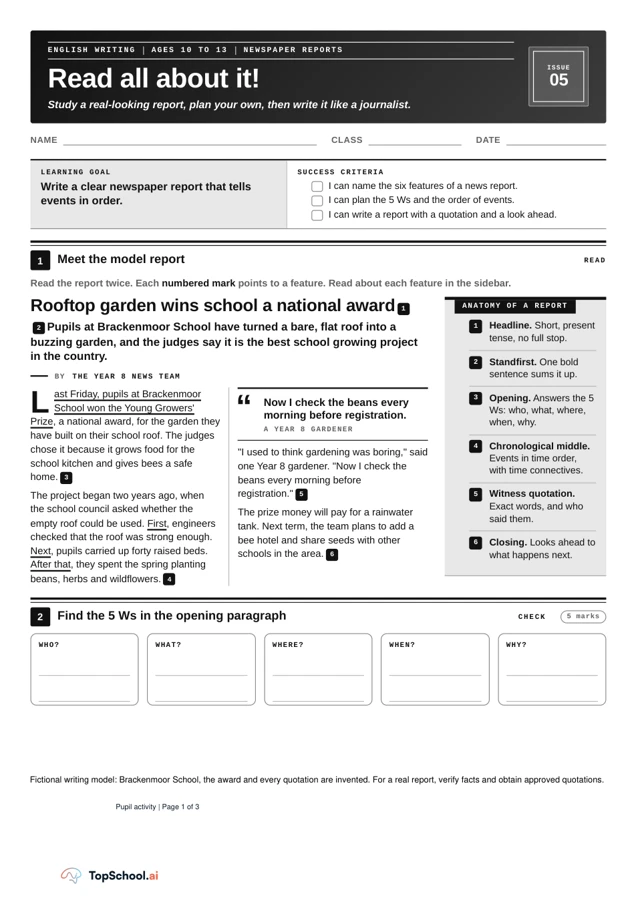
Read the material
Read a fictional newspaper report, identify its six genre features and build a report through planning and drafting. Three pupil pages include a rooftop-garden model, a planning desk and a front-page writing space. The companion distinguishes the fixed reading answers from the open planning and writing task.
Pupil worksheet. Use the preview for diagrams and layout.
Page 1
NAME
CLASS
DATE
LEARNING GOAL
Write a clear newspaper report that tells
events in order.
SUCCESS CRITERIA
I can name the six features of a news report.
I can plan the 5 Ws and the order of events.
I can write a report with a quotation and a look ahead.
Read the report twice. Each numbered mark points to a feature. Read about each feature in the sidebar.
Rooftop garden wins school a national award
1
2 Pupils at Brackenmoor School have turned a bare, flat roof into a
buzzing garden, and the judges say it is the best school growing project
in the country.
BY
THE YEAR 8 NEWS TEAM
L
ast Friday, pupils at Brackenmoor
School won the Young Growers'
Prize, a national award, for the garden they
have built on their school roof. The judges
chose it because it grows food for the
school kitchen and gives bees a safe
home.
3
The project began two years ago, when
the school council asked whether the
empty roof could be used. First, engineers
checked that the roof was strong enough.
Next, pupils carried up forty raised beds.
After that, they spent the spring planting
beans, herbs and wildflowers.
4
"I used to think gardening was boring," said
one Year 8 gardener. "Now I check the
beans every morning before
registration."
5
The prize money will pay for a rainwater
tank. Next term, the team plans to add a
bee hotel and share seeds with other
schools in the area.
6
ANATOMY OF A REPORT
1
Headline. Short, present
tense, no full stop.
2
Standfirst. One bold
sentence sums it up.
3
Opening. Answers the 5
Ws: who, what, where,
when, why.
4
Chronological middle.
Events in time order,
with time connectives.
5
Witness quotation.
Exact words, and who
said them.
6
Closing. Looks ahead to
what happens next.
E N G L I S H W R I T I N G
A G E S 1 0 T O 1 3
N E W S P A P E R R E P O R T S
Read all about it!
Study a real-looking report, plan your own, then write it like a journalist.
ISSUE
05
1
Meet the model report
R E A D
Now I check the beans every
morning before registration.
A YEAR 8 GARDENER
“
2
Find the 5 Ws in the opening paragraph
C H E C K
5 marks
WHO?
WHAT?
WHERE?
WHEN?
WHY?
Fictional writing model: Brackenmoor School, the award and every quotation are invented. For a real report, verify facts and obtain approved quotations.
Pupil activity | Page 1 of 3
Page 2
NAME
CLASS
DATE
Use a real event, or circle one:
The school hall floods
A class pet goes missing
A record-breaking walk
Paragraph 2
What happened
first?
Paragraph 3
What happened
next?
Paragraph 4
Who said what?
Paragraph 5
What happens
next?
JOINING WORDS
TIME
First · Next · After that ·
Later · Meanwhile · Finally
CAUSE
because · so · as a result ·
therefore
SAYING
said · explained · added ·
admitted · According to ...
TWO HEADLINE TRIES Short, present tense, no full stop.
STANDFIRST DRAFT One sentence that sums up the story.
I S S U E 0 5
N E W S P A P E R R E P O R T S
P L A N N I N G D E S K
Plan your report
3
Choose a story and gather the facts
P L A N
WHO? Use roles, such as "a Year 7 pupil".
WHAT HAPPENED? The main event.
WHERE? The place, as exactly as you can.
WHEN? Day, date or time of day.
WHY? What caused it, or why it matters.
HOW? An extra detail readers will want.
4
Plan your paragraphs
P L A N
5
Draft the headline and standfirst
D R A F T
Pupil activity | Page 2 of 3
Page 3
NEWSPAPER NAME
REPORTER
DATE
HEADLINE
STANDFIRST
OPENING: THE 5 WS, THEN EVENTS IN ORDER
QUOTATION, THEN LOOK AHEAD
EDITOR'S CHECKLIST
Headline: short, present tense, no
full stop
Standfirst sums up the story
Opening answers the 5 Ws
Middle in time order, past tense,
with connectives
A quotation, and who said it
Ending looks ahead
I S S U E 0 5
N E W S P A P E R R E P O R T S
F R O N T P A G E
Write your front page
Pupil activity | Page 3 of 3
Page 1
Teacher companion
Write a newspaper report: read, plan and draft
Five Ws
Who: pupils at Brackenmoor School. What: won the fictional Young Growers’ Prize. Where: the school
rooftop garden. When: last Friday within the invented model, not a real date. Why: growing food for the
school kitchen and giving bees a safe home.
Six features
Headline; standfirst; opening with the 5 Ws; chronological middle; attributed quotation; closing look ahead.
These identify genre features, not proof of journalistic accuracy.
Plan and draft
Pupil chooses a real verified event or an explicitly fictional practice story, gathers
who/what/where/when/why/how, plans ordered paragraphs and drafts headline, standfirst and around 250
words. Review accuracy and structure separately. Never fabricate a quotation presented as real.
Sequence and review
Three pupil pages form this
edition.
 Five Ws:
one mark each, total 5; planning and drafting use the printed checklist rather than an invented numerical
score.
Teacher companion | Page 1 of 1
A teaching sequence
Pupils should locate the five Ws, plan events in chronological order and draft a report with a headline, standfirst, attributed quotation and look ahead. They should distinguish genre structure from the separate need to verify real facts and quotations.
Read the model as a reporter
Discuss how the headline and standfirst prepare the reader. Find the five Ws in the opening and check each against the model rather than guessing from the headline.
Where does the opening give each of the five Ws?
Gather your story's facts
Choose the story and gather who, what, where, when, why and how. Use the printed practice scenarios as fiction, or verify details and obtain approved quotations for a real report.
Is this a fictional practice detail or a fact you have verified?
Plan order and quotations
Plan the middle paragraphs in time order. Rehearse a witness quotation and its attribution, then draft two possible headlines and a one-sentence standfirst.
Whose words are these, and have you kept their attribution?
Check the front page
Write the front page and review it with the editor’s checklist. Check structure and accuracy separately, revisiting any paragraph whose order or source of information is unclear.
Which accuracy check is still needed after checking the report's structure?
Before you teach
Look for the thinking behind an answer, choose the support your class needs and leave room for an independent response.
What to look for
A useful model answer identifies pupils at Brackenmoor School winning the fictional prize last Friday for growing food and supporting bees. In a draft, look for ordered events and a clear quotation source. If a pupil presents an invented witness as real, return to the chosen story’s status before revising the wording.
Give a little support
Plan one paragraph orally before writing, using the five-W boxes and the printed time connectives. Give each planned paragraph a single purpose: first event, next event, quotation or look ahead. Keep the checklist beside the draft so pupils can revise one feature at a time.
Take the idea further
Try two different headlines and standfirsts for the same verified or fictional facts. Ask a partner what each version leads them to expect, then revise the opening to fulfil that expectation without exaggerating the event. Explain which revision makes the report clearer.
Things to keep in mind
Every school, award, event and quotation in the model is invented. Obtain approved facts and quotations for a real report.
Keep the idea. Make it yours.
Bring your topic, learning goal and class context to PLAI™, then review what you create.
Ideas to try with your class
Sample teaching perspectives on what to try, what to adapt and what to watch for.
Meet The Creators
Meet a creator whose teaching interests connect with this template.
Steady Marker
The three-page newspaper frame models a rooftop garden prize report with a headline, standfirst, five-W opening, chronological middle, attributed quotation and look ahead. Pupils then plan the five Ws and sequence before drafting.
The Curious Pencil
The sample makes genre structure visible, while the planning section asks pupils to apply the features to a new report. The example’s quotation and award details should be treated as part of its model story, not reusable facts.
Board Eraser
The numbered feature key links each part of the sample to a named job. Pupils can plan the who, what, where, when and why first, then order events before writing the headline and standfirst.
One Last Sticky Note
A persuasive newspaper form does not make its claims true. For real reporting, verify facts, names, dates and quotations independently; the sample is a writing model rather than evidence of an actual rooftop garden award.