
Wellbeing and personal development
Reflect on an experience: what, so what, now what?
Turn one experience into a clear reflection by describing what happened, exploring why it mattered and choosing an action for next time. A worked volunteering example shows how feelings, surprise, subject links and a specific next step can add depth.
Read the material
Turn one experience into a clear reflection by describing what happened, exploring why it mattered and choosing an action for next time. A worked volunteering example shows how feelings, surprise, subject links and a specific next step can add depth.
Activity. Use the preview for diagrams and layout.
Page 1
LEARNING GOAL
Turn one real experience into learning:
what it meant and what you will do next.
See page 2 for an example.
SUCCESS CRITERIA
I can describe one moment.
I can explain why it mattered.
I can plan a specific next step.
ENTRY
NAME
ACTIVITY
DATE
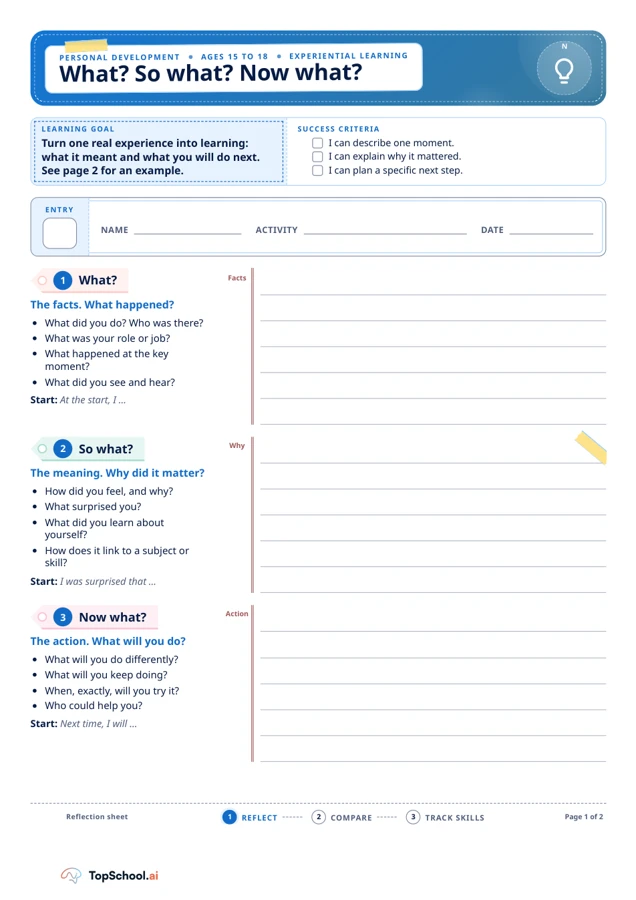
The facts. What happened?
What did you do? Who was there?
What was your role or job?
What happened at the key
moment?
What did you see and hear?
Start: At the start, I ...
The meaning. Why did it matter?
How did you feel, and why?
What surprised you?
What did you learn about
yourself?
How does it link to a subject or
skill?
Start: I was surprised that ...
The action. What will you do?
What will you do differently?
What will you keep doing?
When, exactly, will you try it?
Who could help you?
Start: Next time, I will ...
Reflection sheet
1
REFLECT
2
COMPARE
3
TRACK SKILLS
PERSONAL DEVELOPMENT
AGES 15 TO 18
EXPERIENTIAL LEARNING
What? So what? Now what?
N
1
What?
Facts
2
So what?
Why
3
Now what?
Action
Page 1 of 2
Page 2
GO FURTHER
Which skill grew most?
Write one sentence for an
application: the skill, what
you did, the result.
SKILL
NOT YET
NEARLY
GOT IT
EVIDENCE: ONE THING I DID OR SAID
Teamwork
Shared jobs, helped
others
Communication
Listened, explained,
asked
Problem solving
Spotted a problem,
tried a fix
Resilience
Kept going when it was
hard
The example is fictional
1
REFLECT
2
COMPARE
3
TRACK SKILLS
PERSONAL DEVELOPMENT
AGES 15 TO 18
COMPARE AND TRACK
Read an example, then track your skills
4
A reflection with depth
EXAMPLE: A VOLUNTEERING SESSION AT A COMMUNITY GARDEN
SPOT THE DEPTH
F
a feeling and why
S
a surprise
L
a link to a subject or skill
A a next action
I spent three hours with four other students at a local community
garden. We weeded two raised beds, moved compost in a
wheelbarrow and planted lettuce seedlings. The leader showed us
how far apart to space them.
What
I felt awkward at first because I knew nobody F . The hardest part
surprised me: not the digging, but agreeing who did what. We lost
about twenty minutes before anyone made a plan S . Spacing linked
to Biology: plants too close together compete for light, water and
nutrients L . I learnt I give instructions more confidently when I have
a clear job myself.
So
what
At the next session, I will suggest a five-minute plan before we start
and offer to keep time for each job A . I will ask the leader one
question about the soil.
Now
what
DESCRIPTION ONLY
"We weeded, moved compost
and planted lettuces. It was
fun."
What is missing? Name two things.
5
Skills tracker
Page 2 of 2
A teaching sequence
Describe a significant moment, explain what it taught you and identify a specific next action.
Describe what happened
In “What?”, record facts about the activity, your role and a key moment, without analysing it yet.
Which details are facts about the activity and your role?
Explain why the moment mattered
In “So what?”, consider a feeling, surprise or challenge and link it to a skill, subject or change in understanding.
What feeling, surprise or learning can you connect to the experience?
Choose a specific next action
Choose a next action, when to try it and who could help in Now what. Compare the fictional volunteering reflection with the description-only example to identify what adds depth.
What will you try, when, and who could help?
Record a skill through evidence
Use the skills tracker to note evidence of teamwork, communication, problem solving or resilience. Choose a next action, say when you will try it and name any support needed.
What did you actually do or say that supports this skill reflection?
Before you teach
Look for the thinking behind an answer, choose the support your class needs and leave room for an independent response.
What to look for
A useful reflection includes a concrete moment, an explanation of its meaning and an action that can be tried. Check that the next step is specific enough to remember and that the skill claim is supported by something the pupil did or said. Longer writing alone does not make a reflection deeper.
Give a little support
Use a brief spoken rehearsal, drawing or bullet notes before full sentences. Offer sentence starters and let pupils choose a school-based or low-stakes experience. They may skip personal details. Model the difference between describing an event and explaining why it mattered.
Take the idea further
Ask pupils to revisit the action after trying it and record what changed. They can identify evidence of progress, revise the plan and explain how a skill transfers to another subject or future activity.
Things to keep in mind
The frame supports reflection but does not assess a person’s character or prove that a skill has been mastered. Experiences differ, and pupils may not have equal access to volunteering or extracurricular activities. Offer an everyday classroom task as an equally valid starting point.
Keep the idea. Make it yours.
Bring your topic, learning goal and class context to PLAI™, then review what you create.
Ideas to try with your class
Sample teaching perspectives on what to try, what to adapt and what to watch for.
Meet The Creators
Meet a creator whose teaching interests connect with this template.

Five More Minutes
The two-page reflection separates “What?” facts from “So what?” meaning and “Now what?” action, then asks when the next step will happen and who might help. The second page adds an example, skill evidence and a comparison tracker.
Gentle Reminder
The form moves from a real experience to a specific next action, with fields for a key moment, the pupil’s role and what changed. This gives reflection a clearer purpose than a general account of an activity.
Organised Pile
The sentence starters give pupils a way to begin each section, while the skill table helps connect teamwork, communication, problem solving or resilience to an action. The fictional garden example can be examined before pupils choose their own experience.
Tea at Breaktime
A reflection describes the pupil’s interpretation of an experience; it does not independently prove an outcome or skill level. Keep the example labelled fictional and ask for one concrete piece of evidence behind any application statement.