
Maths
Equation moves: model, practise and check
For Year 6 pupils, follow a worked model, complete partly shown inverse-operation steps, then solve equations independently and check by substitution.
Read the material
For Year 6 pupils, follow a worked model, complete partly shown inverse-operation steps, then solve equations independently and check by substitution.
Pupil worksheet. Use the preview for diagrams and layout.
Page 1
Equation moves: model, practise and check
Mathematics | Year 6 | Pupil activity
Solve one-step and two-step equations by doing the same operation to both sides, then check by
substitution.
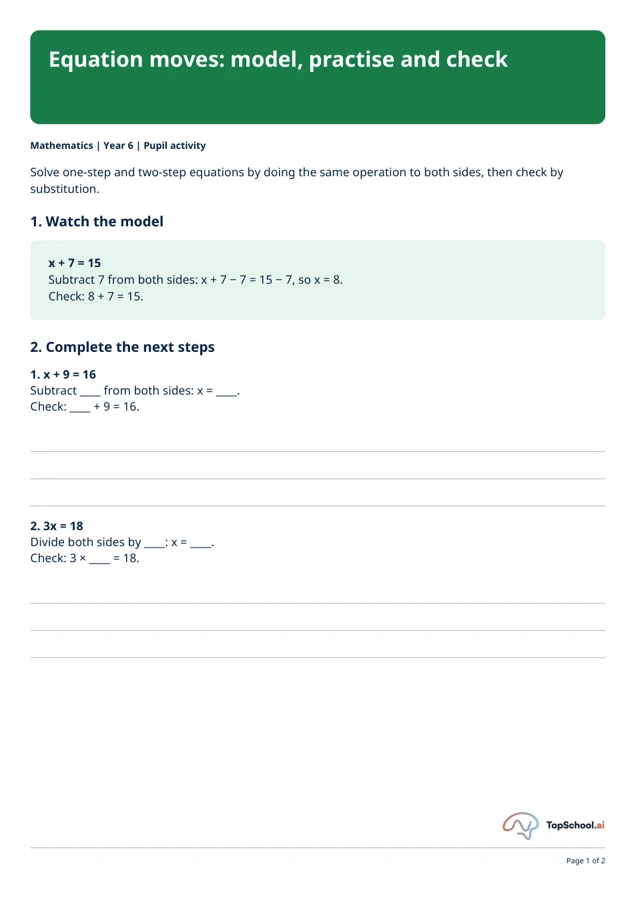
1. Watch the model
x + 7 = 15
Subtract 7 from both sides: x + 7 − 7 = 15 − 7, so x = 8.
Check: 8 + 7 = 15.
2. Complete the next steps
1. x + 9 = 16
Subtract ____ from both sides: x = ____.
Check: ____ + 9 = 16.
2. 3x = 18
Divide both sides by ____: x = ____.
Check: 3 × ____ = 18.
Page 1 of 2
Page 2
Equation moves: practise and check
Mathematics | Year 6 | Pupil activity
3. Your independent questions
2x + 4 = 18. Show the subtraction and division steps.
x − 6 = 11. Show the inverse operation.
Check one answer by substitution.
4. Supported Year 6 stretch
3x + 4 = 25. First subtract 4 from both sides. Then divide both sides by 3.
My working:
Answer: x = __________
Page 2 of 2
Page 1
Equation moves: teacher answer key
Teacher key | Supports the Year 6 pupil activity
Supported worksheet: Equation moves: model, practise and check.
1. Partly completed examples
1) Subtract 9, x = 7; check 7 + 9 = 16.
2) Divide by 3, x = 6; check 3 × 6 = 18.
2. Independent questions
2x + 4 = 18: subtract 4 to get 2x = 14; divide by 2 to get x = 7.
For x − 6 = 11, add 6 to both sides; x = 17.
3. Stretch
Subtract 4 to get 3x = 21; divide by 3, x = 7.
Check: 3 × 7 + 4 = 25.
Page 1 of 1
A teaching sequence
Solve Year 6 one-step and two-step equations by applying inverse operations to both sides, then verify answers by substitution.
Read and check the model
Follow the worked model and check it by substitution.
Does substituting 8 make x + 7 = 15 true?
Complete missing operations
Complete the missing steps in the partly completed equations.
Have you applied the inverse operation to both sides?
Solve independently
Solve the independent equations and show each inverse operation.
Which line shows the subtraction before division?
Try the supported stretch
Try the supported Year 6 stretch, then check by substitution.
Does substitution confirm your value for 3x + 4 = 25?
Before you teach
Look for the thinking behind an answer, choose the support your class needs and leave room for an independent response.
What to look for
Independent answers: x+9=16 gives 7; 3x=18 gives 6; 2x+4=18 gives 7. The supported stretch 3x+4=25 gives 7.
Give a little support
Use a balance drawing and keep one-step equations available before two-step work.
Take the idea further
Explain why subtracting 4 from both sides of 3x + 4 = 25 keeps the equation balanced, then verify x = 7 by substitution.
Things to keep in mind
The stretch stays within one and two-step equations appropriate for this Year 6 edition. Check the methods against the class sequence before use.
Keep the idea. Make it yours.
Bring your topic, learning goal and class context to PLAI™, then review what you create.
Ideas to try with your class
Sample teaching perspectives on what to try, what to adapt and what to watch for.
Meet The Creators
Meet a creator whose teaching interests connect with this template.

Spare Pencil
This two-page Year 6 activity models x + 7 = 15, then asks pupils to complete one-step and two-step examples such as x + 9 = 16 and 3x = 18. It ends with independent questions and a supported stretch.
Calm Table
The page makes inverse operations concrete by showing subtraction or division on both sides and checking with substitution. Its Year 6 scope is narrower than the older equations scaffold.
Organised Pile
Use the model to complete one blank operation and answer, then check by substituting. Keep the supported stretch optional and return to a one-step equation if the sequence is not secure.
Good Question
This resource targets Year 6 one-step and two-step equations; it should not be treated as the same difficulty or audience as the ages 12 to 14 multi-step scaffold. Verify the stretch matches current learning.