Maths
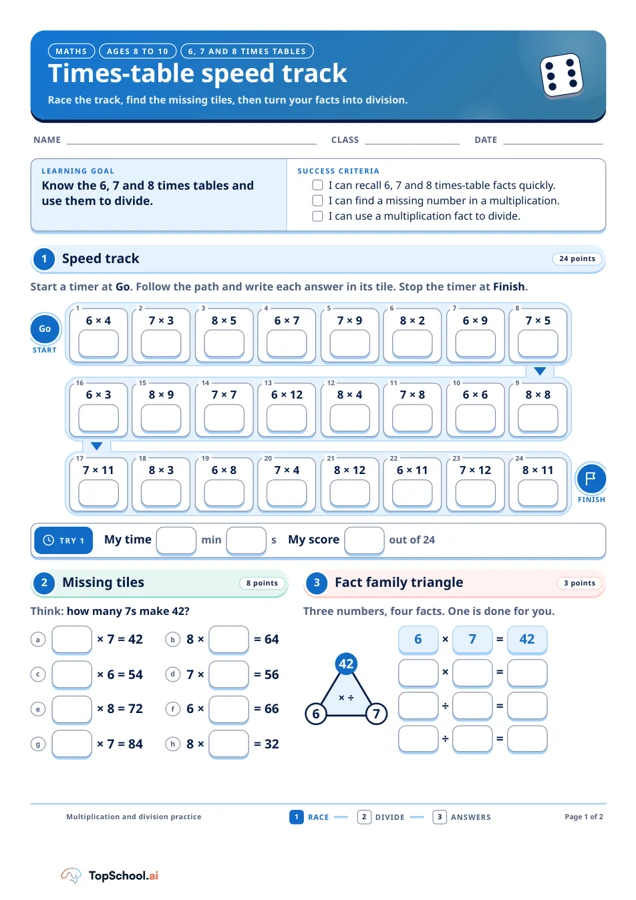
Multiplication and division practice
Recall selected 6, 7 and 8 multiplication facts, find a missing factor, and use a known multiplication fact to calculate a related division fact.
Deputy headteacher and assessment lead
I use worked examples, small steps and retrieval in Year 6 Mathematics, looking at wrong answers to decide what needs modelling again and which question to follow up.
Explore the collectionI teach Year 6 Mathematics and lead assessment and curriculum. In the classroom I use worked examples, careful small steps and retrieval practice. Pupils need time to see how a method works, practise it and return to important knowledge before they are expected to work independently.
Wrong answers provide information. I want teachers to look at what a response shows and decide what should be modelled again, rather than treat an error as a final judgement. Assessment is most useful when it leads to a teaching decision or a question worth following up.
I also think about the information a school collects. A data point should have a purpose and a person who will use it. I value resources that make assessment clear and proportionate, help teachers see what pupils understand and keep the focus on the next useful action.
Model a method and then practise it in small steps.
Use errors as information for the next explanation.
Collect assessment information only when it can guide action.
Explore these templates and decide what fits your own setting.
Maths
Recall selected 6, 7 and 8 multiplication facts, find a missing factor, and use a known multiplication fact to calculate a related division fact.
Maths
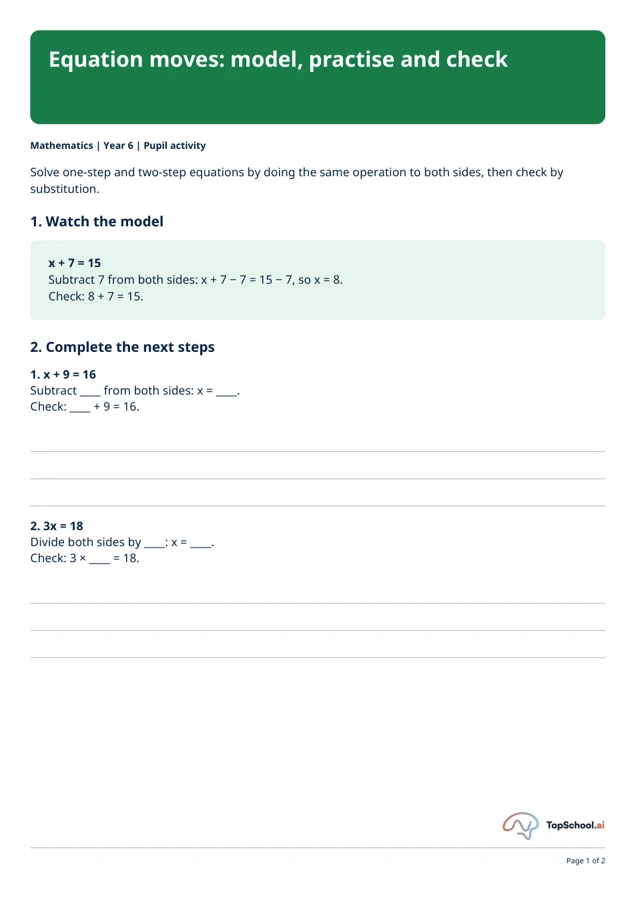
Solve Year 6 one-step and two-step equations by applying inverse operations to both sides, then verify answers by substitution.