
Science
The water cycle in English, Spanish and your language
Connect five water-cycle terms with diagrams, short definitions and English-Spanish examples. The two-page A4 organiser invites pupils to add a home language or draw an idea, and explicitly says that sharing the home-language response is optional.
Name the water-cycle processes. Compare the English and Spanish words in the complete material.
Read the complete materialRead the material
Connect five water-cycle terms with diagrams, short definitions and English-Spanish examples. The two-page A4 organiser invites pupils to add a home language or draw an idea, and explicitly says that sharing the home-language response is optional.
Complete resource. Use the preview for diagrams and layout.
Page 1
LEARNING GOAL
Know five water cycle words in English
and Spanish, and show them in your
own language.
SUCCESS CRITERIA
I can find the five numbered parts on the picture.
I can say each word in English and Spanish.
Find each number on the picture. Read the words. Then write or sketch the idea.
Sketch it
1
evaporation
la evaporación
Water turns into vapour and rises.
In my home language
Sketch it
2
condensation
la condensación
Vapour cools and turns into tiny
drops.
In my home language
Sketch it
3
cloud
la nube
Tiny drops of water float in the sky.
In my home language
Sketch it
4
precipitation
la precipitación
Water falls from clouds to the
ground.
In my home language
Sketch it
5
rain
la lluvia
Drops of liquid water that fall.
In my home language
Your language counts. Write in any language or
script, or just draw. You do not have to share.
The water cycle
Page 1 of 2
SCIENCE AND LANGUAGES
AGES 8 TO 12
THE WATER CYCLE
The water cycle
Learn the words in three languages.
NAME
CLASS
DATE
1
2
3
4
5
The water cycle
el ciclo del agua
Page 2
Three languages, one idea
Read both aloud. Then write it in your home language, or draw it.
1
ENGLISH
The sun warms the water.
SPANISH
El sol calienta el agua.
In my home language (or draw it)
2
ENGLISH
Water from the sea evaporates.
SPANISH
El agua del mar se evapora.
In my home language (or draw it)
3
ENGLISH
Clouds form.
SPANISH
Las nubes se forman.
In my home language (or draw it)
4
ENGLISH
Rain falls.
SPANISH
La lluvia cae.
In my home language (or draw it)
How are they connected?
Pick a word from the bank. Write it on the dashed line, then write a sentence in any language.
Word bank
becomes
makes
falls as
warms
the sun
the sea
water vapour
a cloud
GO FURTHER
Link two other parts of the
water cycle with a word from
the bank.
The water cycle
Page 2 of 2
SCIENCE AND LANGUAGES
AGES 8 TO 12
SENTENCES
Say it in three languages
1
4 sentences
2
2 links
choose a word
choose a word
A teaching sequence
Connect water-cycle concepts with English and Spanish terms, then express or draw an understanding in an optional additional language.
Name the water-cycle processes. Compare the English and Spanish words in the complete material.
Read the complete materialConnect numbered parts and supplied labels
Match the numbered diagram parts with the five terms and read the English and Spanish labels.
Which diagram number belongs to this English-Spanish term?
Choose a language, sketch or blank response
Sketch or write an idea for each term in a language of the pupil’s choice, or leave the space blank.
How would the pupil like to represent the idea without having to share it?
Read the pairs and connect two concepts
Read the paired English-Spanish sentences and use a word from the bank to connect two concepts.
Which joining word expresses the intended relationship?
Explain or draw a checked connection
Explain or draw how the two water-cycle parts relate without requiring the pupil to share a home-language response. Check the explanation with a science source.
What changes between the chosen parts, and what does the science source clarify?
Before you teach
Look for the thinking behind an answer, choose the support your class needs and leave room for an independent response.
What to look for
Look for connections among the numbered diagram, vocabulary and sentence links. Ask: “What changes when water moves from this part to the next?” The page’s cloud definition is simplified; clarify water vapour and condensation with a science source.
Give a little support
Provide an accurate bilingual word list and diagram labels, read the sentence examples aloud and allow drawing instead of writing. Respect a pupil’s choice not to reveal or share a home language.
Take the idea further
Ask pupils to connect another pair of concepts and draw a labelled cycle, checking each sentence for scientific accuracy. They may add a verified translation with help from a fluent speaker.
Things to keep in mind
The English/Spanish cloud wording simplifies the physical process; water vapour is invisible and clouds consist of droplets or ice crystals. Review the science and translations. A pupil’s home-language writing is not provided as an established translation.
Keep the idea. Make it yours.
Bring your topic, learning goal and class context to PLAI™, then review what you create.
Another starting point
Explore a different teaching task from this selection.
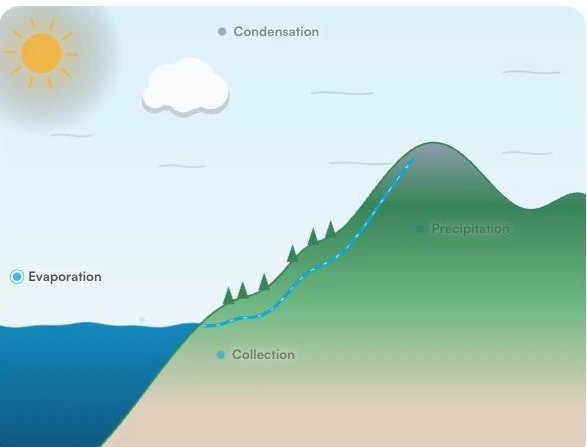
Water cycle: an interactive model
Watch the warm, breezy starting model. Keep wind fixed while exploring sun heat, then select Reset before comparing wind settings so the two investigations remain separate.
Explore resource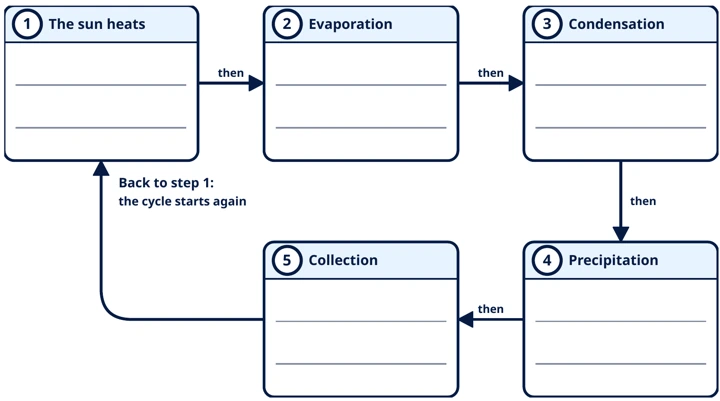
Process flowchart organiser
Read the learning goal and success criteria. Choose whether to begin with the water-cycle boxes or the frog-life-cycle sequence, then review the relevant word bank or stage names.
Explore resourceIdeas to try with your class
Sample teaching perspectives on what to try, what to adapt and what to watch for.
Meet The Creators
Meet a creator whose teaching interests connect with this template.

One Last Sticky Note
The two pages connect five water-cycle terms (evaporation, condensation, cloud, precipitation and rain) to English, Spanish and a pupil-selected home language or drawing. The direction says the learner does not have to share that response.
One More Question
The bilingual sequence moves from matching numbered parts of a picture to reading simple English and Spanish statements about warming, evaporation, cloud formation and rain. It keeps the concept and vocabulary linked across languages.
Margin Note
The learner may write in any language or script, or draw, and the material explicitly says sharing is not required. That lets pupils use their language knowledge without being asked to act as an interpreter for others.
Five More Minutes
Only English and Spanish are printed; the third language is supplied by the pupil or represented visually. Check scientific meaning as well as translation, and do not assume every learner wants to disclose or teach a home language.