
Music and performing arts
The Envelope: drama character and script analysis
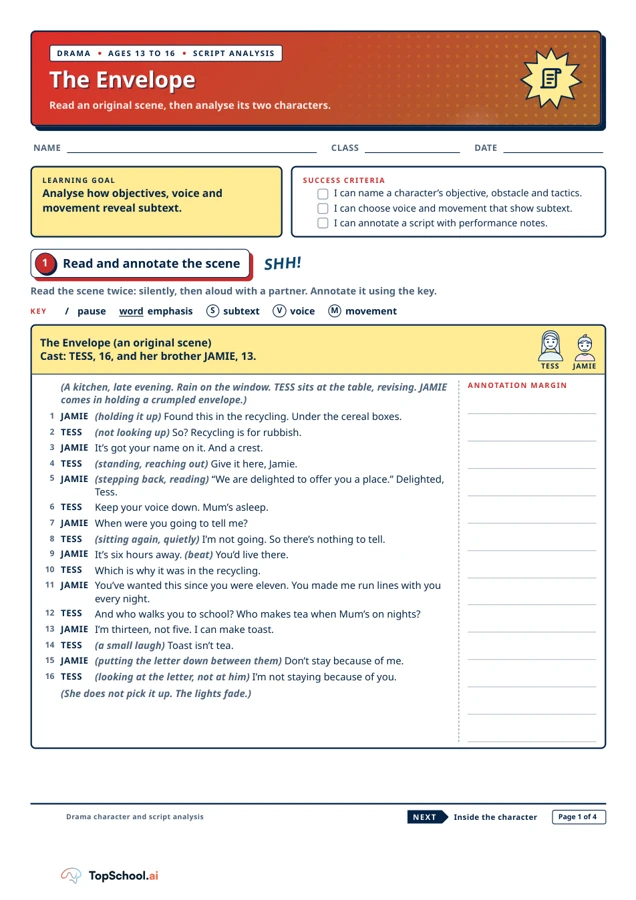
Explore how objectives, obstacles, tactics, voice and movement reveal what characters do not say aloud. The four-page A4 pack includes a kitchen scene between Tess and Jamie, line-by-line prompts, performance choices and a short rehearsal reflection.
Read the material
Explore how objectives, obstacles, tactics, voice and movement reveal what characters do not say aloud. The four-page A4 pack includes a kitchen scene between Tess and Jamie, line-by-line prompts, performance choices and a short rehearsal reflection.
Activity. Use the preview for diagrams and layout.
Page 1
NAME
CLASS
DATE
LEARNING GOAL
Analyse how objectives, voice and
movement reveal subtext.
SUCCESS CRITERIA
I can name a character’s objective, obstacle and tactics.
I can choose voice and movement that show subtext.
I can annotate a script with performance notes.
1
Read and annotate the scene
Read the scene twice: silently, then aloud with a partner. Annotate it using the key.
KEY
/
pause
word emphasis
S
subtext
V
voice
M movement
Drama character and script analysis
Inside the character
DRAMA
AGES 13 TO 16
SCRIPT ANALYSIS
The Envelope
The Envelope
Read an original scene, then analyse its two characters.
SHH!
The Envelope (an original scene)
Cast: TESS, 16, and her brother JAMIE, 13.
TESS
JAMIE
(A kitchen, late evening. Rain on the window. TESS sits at the table, revising. JAMIE
comes in holding a crumpled envelope.)
1 JAMIE (holding it up) Found this in the recycling. Under the cereal boxes.
2 TESS
(not looking up) So? Recycling is for rubbish.
3 JAMIE It’s got your name on it. And a crest.
4 TESS
(standing, reaching out) Give it here, Jamie.
5 JAMIE (stepping back, reading) “We are delighted to offer you a place.” Delighted,
Tess.
6 TESS
Keep your voice down. Mum’s asleep.
7 JAMIE When were you going to tell me?
8 TESS
(sitting again, quietly) I’m not going. So there’s nothing to tell.
9 JAMIE It’s six hours away. (beat) You’d live there.
10 TESS
Which is why it was in the recycling.
11 JAMIE You’ve wanted this since you were eleven. You made me run lines with you
every night.
12 TESS
And who walks you to school? Who makes tea when Mum’s on nights?
13 JAMIE I’m thirteen, not five. I can make toast.
14 TESS
(a small laugh) Toast isn’t tea.
15 JAMIE (putting the letter down between them) Don’t stay because of me.
16 TESS
(looking at the letter, not at him) I’m not staying because of you.
(She does not pick it up. The lights fade.)
ANNOTATION MARGIN
NEXT
Page 1 of 4
Page 2
2
Choose a character
TESS
JAMIE
Tick one character. Answer every panel as that character. Give a line number as evidence each time.
TACTIC VERBS
to dodge
to tease
to plead
to joke
to accuse
to protect
3
The relationship
Drama character and script analysis
Voice and lines
DRAMA
CHARACTER ANALYSIS
Inside the character
Inside the character
Objective: what do they want most?
Start: I want to ... (line ...)
Obstacle: what is in their way?
A person, a fear, a fact or a feeling.
Tactics: how do they try to get it?
Name two tactics, each with a line number.
Given circumstances: the facts
Who, where, when, and what has just happened?
How close are Tess and Jamie? Write S in a box for the start of the scene and E for the end.
DISTANT
CLOSE
HIGHER STATUS at the start:
Tess
Jamie
at the end:
Tess
Jamie
Circle one name each time. What changes between them, and on which line? Explain.
1
2
3
4
5
6
7
8
9
10
NEXT
A
B
C
D
Page 2 of 4
Page 3
4
Voice and movement
Pick one line your character says. Circle one choice in each row. Then explain your choices.
5
Line by line objectives
For each line, write what the speaker wants from the other person. Start with “to” and an action verb. Example: line
6, Tess: to stop Jamie waking Mum, and to end the conversation.
Drama character and script analysis
Subtext
DRAMA
VOICE, MOVEMENT AND OBJECTIVES
Voice, movement and lines
Voice, movement and lines
Voice on line
PACE
slow
steady
fast
PITCH
low
natural
high
VOLUME
quiet
normal
loud
Where is the pause? Which word gets the emphasis?
What tone? Why?
Movement on the same line
POSTURE
open
closed
tense
PROXIMITY
close
apart
moving away
EYE CONTACT
holds
avoids
Describe a gesture and a facial expression. Sitting or
standing (levels)? Why?
Line 1 JAMIE
(holding it up) Found this in the
recycling. Under the cereal boxes.
Objective: to ...
Line 4 TESS
(standing, reaching out) Give it
here, Jamie.
Objective: to ...
Line 7 JAMIE
When were you going to tell me?
Objective: to ...
Line 8 TESS
(sitting again, quietly) I’m not
going. So there’s nothing to tell.
Objective: to ...
Line 12 TESS
And who walks you to school?
Who makes tea when Mum’s on
nights?
Objective: to ...
Line 15 JAMIE
(putting the letter down between
them) Don’t stay because of me.
Objective: to ...
NEXT
V
M
1
2
3
4
5
6
Page 3 of 4
Page 4
6
Find the subtext
Subtext is what a character really means but does not say. Write each character’s private thought.
7
Rehearse and review
Rehearse the scene with a partner using your choices. Perform it for another pair. Ask them to tick what they saw
and give feedback.
WE SAW
a clear pause
a change in proximity
a change of level
eye contact held or avoided
GO FURTHER: DIRECT THE LAST MOMENT
Tess does not pick up the letter. Write a director’s note: where each actor stands, what Tess does with her
hands, and how long the silence lasts.
HOW DID I DO?
Not yet
Getting there
Got it
Drama character and script analysis
CURTAIN
DRAMA
SUBTEXT AND PERFORMANCE
Subtext and performance
Subtext and performance
HMM!
Line 13, JAMIE: “I’m thirteen, not five. I can make
toast.”
JAMIE REALLY THINKS
Line 16, TESS: “I’m not staying because of you.”
TESS REALLY THINKS
What worked: a line and a choice
Even better if: one change
Page 4 of 4
A teaching sequence
Analyse a character’s objective, obstacle and tactics, then choose voice and movement that communicate subtext in performance.
Connect objective, obstacle and tactics
Identify what Tess or Jamie wants most, the obstacle and two tactics, each tied to a line.
Which line supports what Tess or Jamie wants and tries?
Track relationship and status changes
Describe the relationship and consider how status or closeness changes during the scene.
What line or action supports the start-to-end change you describe?
Choose voice, movement and subtext
Choose pace, pitch, volume, pause, emphasis and movement for one line, then explain the subtext behind the choice.
Why does this pause, emphasis or movement fit the selected line?
Rehearse and direct the final silence
Rehearse the scene, ask a partner what they noticed and write a director’s note for the final silence. Link the performance choice to a line.
What audience feedback connects the performance choice with textual evidence?
Before you teach
Look for the thinking behind an answer, choose the support your class needs and leave room for an independent response.
What to look for
Look for choices tied to a line, objective or subtext rather than generic acting labels. Ask: “What did the audience learn from the pause or movement?” The scene supports interpretation; more than one performance choice may be justified.
Give a little support
Choose one character and one section of the scene. Offer a line-numbered script, tactic word bank and a voice/movement choice chart; pupils can explain choices orally before writing a full analysis.
Take the idea further
Ask pairs to direct the final moment in two contrasting ways and explain how each changes the audience’s understanding of Tess’s decision. They can annotate an additional line with a new tactic.
Things to keep in mind
No answer key is included, and interpretations are open. Ask pupils to support their reading with reliable textual evidence.
Keep the idea. Make it yours.
Bring your topic, learning goal and class context to PLAI™, then review what you create.
Ideas to try with your class
Sample teaching perspectives on what to try, what to adapt and what to watch for.
Meet The Creators
Meet the creators whose teaching interests connect with this template. Find an approach to try with your class.

Rachel Sim
I use roles, movement, voice and short improvisation to give quieter pupils a way into Drama, with supported participation and room to build on one another’s ideas.
Meet the creatorPriscilla Amoah
As Head of Drama, I look for devising stimuli that give students something to respond to and help them move into practical exploration.
Meet the creator
One Last Sticky Note
The original scene centres on Tess finding an offer letter in the recycling and her brother Jamie reading it aloud. The four-page task asks pupils to annotate objective, obstacle, tactics, voice, movement and subtext rather than summarise the plot only.
Helpful Highlighter
Reading silently and then aloud with a partner gives pupils two encounters with the scene before performance choices. The envelope creates a playable conflict around Tess’s offer and her claim that she is not going.
The Curious Pencil
The annotation key separates pause, emphasis, subtext, voice and movement. Pupils can mark one tactic at a time, then test whether the choice communicates what Tess is withholding from Jamie.
Planning List
The scene is original fiction, so interpretations should be grounded in its lines and stage directions rather than presented as a real family situation. A performance choice is one possible reading, not the only valid portrayal.