
Languages and literacy
Describe the windy harbour with your senses
For Early Years children aged 3 to 5 with adult support, choose optional imagined sensory details and a simple figurative phrase to describe a harbour scene.
Read the material
For Early Years children aged 3 to 5 with adult support, choose optional imagined sensory details and a simple figurative phrase to describe a harbour scene.
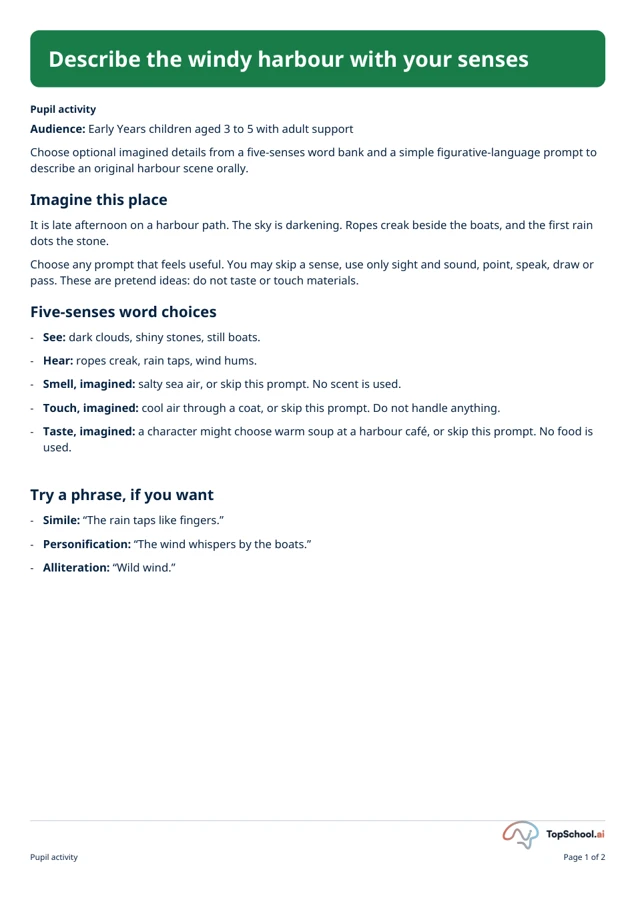
Pupil worksheet. Use the preview for diagrams and layout.
Page 1
Describe the windy harbour with your senses
Pupil activity
Audience: Early Years children aged 3 to 5 with adult support
Choose optional imagined details from a five-senses word bank and a simple figurative-language prompt to
describe an original harbour scene orally.
Imagine this place
It is late afternoon on a harbour path. The sky is darkening. Ropes creak beside the boats, and the first rain
dots the stone.
Choose any prompt that feels useful. You may skip a sense, use only sight and sound, point, speak, draw or
pass. These are pretend ideas: do not taste or touch materials.
Five-senses word choices
-
See: dark clouds, shiny stones, still boats.
-
Hear: ropes creak, rain taps, wind hums.
-
Smell, imagined: salty sea air, or skip this prompt. No scent is used.
-
Touch, imagined: cool air through a coat, or skip this prompt. Do not handle anything.
-
Taste, imagined: a character might choose warm soup at a harbour café, or skip this prompt. No food is
used.
Try a phrase, if you want
-
Simile: “The rain taps like fingers.”
-
Personification: “The wind whispers by the boats.”
-
Alliteration: “Wild wind.”
Pupil activity
Page 1 of 2
Page 2
Describe the windy harbour with your senses
Make a description
1. Draw the wide view of the harbour.
2. Add one close detail.
3. Say: “I imagine ___, and I can hear ___.”
4. Choose one phrase above or make your own.
Pupil activity
Page 2 of 2
A teaching sequence
Choose optional imagined details from a five-senses word bank and a simple figurative-language prompt to describe an original harbour scene orally.
Choose imagined senses
Choose one sight or sound word from the scene. If helpful, choose one optional imagined smell, touch or taste idea; no materials are handled or tasted.
Would sight and sound be enough for your description?
Try a figurative phrase
Try one phrase: a simile, personification or a repeated starting sound.
What does “the wind whispers” help you imagine?
Say and draw the harbour
Dictate or say one sentence, then draw the wide view and one close detail.
Which close detail belongs in your wide harbour view?
Before you teach
Look for the thinking behind an answer, choose the support your class needs and leave room for an independent response.
What to look for
A child might say, “The rain taps like fingers and the wind whispers.” Ask, “Which word helps you imagine the harbour?”
Give a little support
Offer two picture-word choices for sight or sound. Other senses and figurative phrases are optional; accept pointing, gesture, a home-language response or passing.
Take the idea further
Combine a sound and movement in one sentence, for example, “Wild wind whirls past the boats.”
Things to keep in mind
The harbour is imagined, not a real-weather observation. All sensory prompts are optional pretend ideas; do not bring food, scents or objects for tasting, smelling or touching.
Keep the idea. Make it yours.
Bring your topic, learning goal and class context to PLAI™, then review what you create.
Ideas to try with your class
Sample teaching perspectives on what to try, what to adapt and what to watch for.
Meet The Creators
Meet a creator whose teaching interests connect with this template.
Tea at Breaktime
The Early Years harbour prompt makes imagined details optional: pupils may skip a sense, point, speak, draw or pass. It explicitly says not to taste or touch materials and labels smell, touch and taste choices as pretend.
Board Eraser
The two pages move from a late-afternoon scene and word bank to a wide-view drawing, one close detail and an optional phrase. That is a bounded oral-description activity for ages 3 to 5, not a sensory tasting task.
Extra Page
Sight and sound alone are offered as a complete choice, and the sample “wind whispers” phrase can be used or replaced. Adults can wait for a pointing or spoken response without introducing physical objects to prompt the senses.
Bright Margins
No scent, food or tactile material is supplied or required. Preserve the explicit opt-out and imagined wording if adapting the prompt, and do not turn the five senses into a requirement that every child respond to every sense.