
Languages and literacy
El Día de Muertos: reading and cultural comparison
Read a short Spanish passage about Día de Muertos, use a glossary to answer comprehension questions and compare it respectfully with a celebration familiar to the pupil. The A4 workbook combines language practice with a cultural reflection.
Read the material
Read a short Spanish passage about Día de Muertos, use a glossary to answer comprehension questions and compare it respectfully with a celebration familiar to the pupil. The A4 workbook combines language practice with a cultural reflection.
Activity. Use the preview for diagrams and layout.
Page 1
NAME
CLASS
DATE
LEARNING GOAL
Understand a Spanish text and compare
two celebrations.
SUCCESS CRITERIA
I can find key facts in a Spanish text.
I can find Spanish phrases from their English meaning.
I can compare two celebrations with respect.
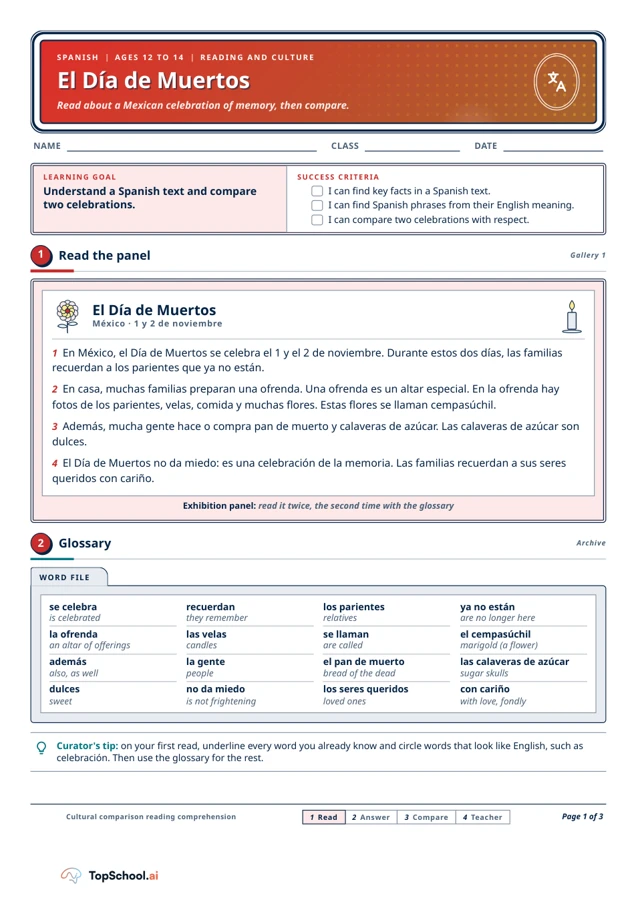
Exhibition panel: read it twice, the second time with the glossary
Curator's tip: on your first read, underline every word you already know and circle words that look like English, such as
celebración. Then use the glossary for the rest.
Cultural comparison reading comprehension
S PA N I S H
AG E S 1 2 TO 1 4
R E A D I N G A N D C U LT U R E
El Día de Muertos
El Día de Muertos
Read about a Mexican celebration of memory, then compare.
1
Read the panel
Gallery 1
El Día de Muertos
México · 1 y 2 de noviembre
1 En México, el Día de Muertos se celebra el 1 y el 2 de noviembre. Durante estos dos días, las familias
recuerdan a los parientes que ya no están.
2 En casa, muchas familias preparan una ofrenda. Una ofrenda es un altar especial. En la ofrenda hay
fotos de los parientes, velas, comida y muchas flores. Estas flores se llaman cempasúchil.
3 Además, mucha gente hace o compra pan de muerto y calaveras de azúcar. Las calaveras de azúcar son
dulces.
4 El Día de Muertos no da miedo: es una celebración de la memoria. Las familias recuerdan a sus seres
queridos con cariño.
2
Glossary
Archive
se celebra
is celebrated
recuerdan
they remember
los parientes
relatives
ya no están
are no longer here
la ofrenda
an altar of offerings
las velas
candles
se llaman
are called
el cempasúchil
marigold (a flower)
además
also, as well
la gente
people
el pan de muerto
bread of the dead
las calaveras de azúcar
sugar skulls
dulces
sweet
no da miedo
is not frightening
los seres queridos
loved ones
con cariño
with love, fondly
WORD FILE
2 Answer
3 Compare
4 Teacher
1 Read
Page 1 of 3
Page 2
These phrases are in the text but not in the glossary. Copy them exactly, with any accents.
at home
many families
a special altar
during these two days
food
a celebration of memory
Circle T (true) or F (false). If it is false, correct it in English.
STATEMENT
CIRCLE
IF FALSE, THE CORRECT FACT
a The Day of the Dead is celebrated in Spain.
T
F
b It is celebrated on 1 and 2 November.
T
F
c Families prepare the ofrenda at school.
T
F
d Sugar skulls are sweet.
T
F
e The Day of the Dead is a frightening festival.
T
F
a Who do families remember on
these two days?
b Name three things you find on
an ofrenda.
c What two things do many
people make or buy?
d
?
INFERENCE
 Why do you think families put photos of their relatives on the ofrenda? Use paragraph 4.
Cultural comparison reading comprehension
S PA N I S H
E L D Í A D E M U E R TO S
CO M P R E H E N S I O N
Read closely and answer
Read closely and answer
3
Find the Spanish for
Gallery 2
6 marks
4
True or false?
Gallery 3
5 marks
5
Answer in English
Gallery 4
8 marks
1 Read
3 Compare
4 Teacher
2 Answer
Page 2 of 3
Page 3
Choose a time when your family or community remembers someone, or celebrates together. It can be any celebration: a
festival, a national day, a birthday, a family meal. Fill the middle column from the text and the right column about yours.
QUESTION
EL DÍA DE MUERTOS
MY CELEBRATION
When?
What do people
do, make or eat?
How does it
feel?
GO FURTHER
Add one sentence in Spanish, starting En mi familia, celebramos ...
Cultural comparison reading comprehension
S PA N I S H
E L D Í A D E M U E R TO S
C U LT U R A L CO M PA R I S O N
Compare two celebrations
Compare two celebrations
6
Side by side
Gallery 5
6 marks
7
Write your comparison
Studio
6 marks
Name your celebration. Give one similarity and one difference, each with a detail.
In Mexico, families ...
In my family, we ...
Both ...
One difference is ...
1 Read
2 Answer
4 Teacher
3 Compare
Page 3 of 3
Page 1
El Día de Muertos: reading and cultural
comparison
Teacher companion
Spanish | Pupils aged 12 to 14
Use with the exact 3-page original file. Keep pupil or staff activity pages separate from this teacher companion.
When to use it
Use the sheet after pupils have enough Spanish to read short factual paragraphs with glossary
support. The comparison task should let each pupil choose a celebration and avoid requiring
private family information.
Purpose
Retrieve information from a Spanish passage and compare one celebration with a celebration
chosen by the pupil using respectful detail.
Start here
Read the Spanish passage once for familiar words, then read again with the glossary
available.
A teaching sequence
1. Read the exhibition panel twice, using the glossary on the second reading and keeping the
Spanish phrases in context.
2. Find phrases in Spanish, then judge the statements as true or false and correct false
information in English.
3. Answer the retrieval and inference questions using the passage; point to the paragraph that
supports an inference.
4. Compare the passage with a celebration of the pupil’s choice and write a similarity and
difference using the supplied starters. Ask, “Which words in the Spanish passage support your
answer?” Point to the text before comparing cultural details respectfully.
Checking guidance
According to the passage, the six phrases are: en casa; muchas familias; un altar especial;
durante estos dos días; comida; una celebración de la memoria.
True/false: a false (Mexico); b true; c false (at home); d true; e false (a celebration of memory,
described with affection rather than fear).
Retrieval: relatives/loved ones who are no longer here; any three of photographs, candles,
food and flowers; pan de muerto and sugar skulls. For the photo inference, accept a link to
remembering loved ones with affection, supported by paragraph 4.
Comparison answers vary. Credit one specific similarity and difference with a detail for each;
allow a public or fictional celebration rather than requiring private family information.
Support
Pre-teach a small number of key words, read the text aloud if useful and provide a line guide.
Pupils may compare with a public or fictional celebration instead of sharing personal family
practices.
Take it further
Ask pupils to draft an additional Spanish sentence comparing one feature, then check it with
an appropriate language source. They can consider how celebrations vary by family, region
and individual choice.
Things to keep in mind
The passage provides one concise account and cannot represent every family or community
in Mexico. Encourage pupils to compare sources and recognise that celebrations vary by
region, family and individual.
El Día de Muertos: reading and cultural comparison
Teacher companion | Page 1
A teaching sequence
Retrieve information from a Spanish passage and compare one celebration with a celebration chosen by the pupil using respectful detail.
Read with the glossary
Read the exhibition panel twice, using the glossary on the second reading and keeping the Spanish phrases in context.
Which familiar or related word helped you understand the panel?
Retrieve and correct statements
Find phrases in Spanish, then judge the statements as true or false and correct false information in English.
Where does the Spanish text support the correction?
Support an inference
Answer the retrieval and inference questions using the passage; point to the paragraph that supports an inference.
Which paragraph supports your idea about the photographs?
Compare respectfully
Compare the passage with a celebration of the pupil’s choice and write a similarity and difference using the supplied starters. Point to the text before comparing cultural details respectfully.
Which detail is from this passage, rather than a claim about every family?
Before you teach
Look for the thinking behind an answer, choose the support your class needs and leave room for an independent response.
What to look for
According to the passage, the six phrases are: en casa; muchas familias; un altar especial; durante estos dos días; comida; una celebración de la memoria. True/false: a false (Mexico); b true; c false (at home); d true; e false (a celebration of memory, described with affection rather than fear). Retrieval: relatives/loved ones who are no longer here; any three of photographs, candles, food and flowers; pan de muerto and sugar skulls. For the photo inference, accept a link to remembering loved ones with affection, supported by paragraph 4. Comparison answers vary. Credit one specific similarity and difference with a detail for each; allow a public or fictional celebration rather than requiring private family information.
Give a little support
Pre-teach a small number of key words, read the text aloud if useful and provide a line guide. Pupils may compare with a public or fictional celebration instead of sharing personal family practices.
Take the idea further
Ask pupils to draft an additional Spanish sentence comparing one feature, then check it with an appropriate language source. They can consider how celebrations vary by family, region and individual choice.
Things to keep in mind
The passage provides one concise account and cannot represent every family or community in Mexico. Encourage pupils to compare sources and recognise that celebrations vary by region, family and individual.
Keep the idea. Make it yours.
Bring your topic, learning goal and class context to PLAI™, then review what you create.
Ideas to try with your class
Sample teaching perspectives on what to try, what to adapt and what to watch for.
Meet The Creators
Meet a creator whose teaching interests connect with this template.

Tea Break Notes
The Spanish panel covers 1 and 2 November, remembering relatives, an ofrenda, cempasúchil, pan de muerto and sugar skulls, with a glossary and retrieval tasks. The final comparison asks pupils to choose another celebration respectfully.
Board Eraser
For ages 12 to 14, the first-read and glossary strategy supports comprehension before pupils compare traditions. The text says “many families” for some practices, leaving room for variation rather than describing every Mexican family as doing the same thing.
Bright Idea Break
Pupils can underline familiar words and cognates before using the glossary for unfamiliar phrases. The English meanings help them return to the Spanish passage for evidence rather than rely on a general impression of the celebration.
Kindly Red Pen
The short panel is not a complete account of a diverse cultural practice. Keep its “many families” scope, use reliable contextual sources for deeper study and avoid asking pupils to represent a culture on behalf of a group.