
Design and technology
Culinary practical skill self-assessment
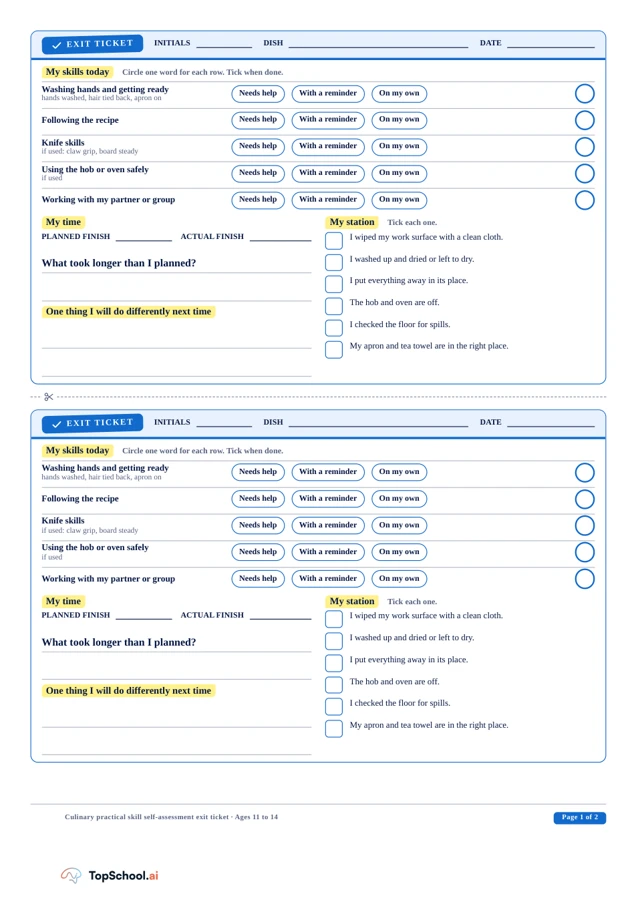
Help pupils reflect on practical cooking skills after a lesson and notice their progress over six sessions. The two-page A4 pack includes two repeated exit tickets on page 1 and a half-term tracker for preparation, recipe following, knife and heat safety, teamwork and a next goal.
Read the material
Help pupils reflect on practical cooking skills after a lesson and notice their progress over six sessions. The two-page A4 pack includes two repeated exit tickets on page 1 and a half-term tracker for preparation, recipe following, knife and heat safety, teamwork and a next goal.
Complete resource. Use the preview for diagrams and layout.
Page 1
INITIALS
DISH
DATE
My skills today
Circle one word for each row. Tick when done.
Washing hands and getting ready
hands washed, hair tied back, apron on
Needs help
With a reminder
On my own
Following the recipe
Needs help
With a reminder
On my own
Knife skills
if used: claw grip, board steady
Needs help
With a reminder
On my own
Using the hob or oven safely
if used
Needs help
With a reminder
On my own
Working with my partner or group
Needs help
With a reminder
On my own
My time
PLANNED FINISH
ACTUAL FINISH
One thing I will do differently next time
My station
Tick each one.
I wiped my work surface with a clean cloth.
I washed up and dried or left to dry.
I put everything away in its place.
The hob and oven are off.
I checked the floor for spills.
My apron and tea towel are in the right place.
Culinary practical skill self-assessment exit ticket · Ages 11 to 14
Page 1 of 2
EXIT TICKET
EXIT TICKET
What took longer than I planned?
What took longer than I planned?
Page 2
INITIALS
CLASS
HALF TERM
LEARNING GOAL
Notice how my practical cooking skills grow over a
half term.
SUCCESS CRITERIA
I can write N, R or O for each skill after a lesson.
I can spot the skill that is growing fastest.
I can set a goal for my next practical.
1
My skill tracker
6 lessons
N
Needs help
R
With a reminder
O
On my own
Skill not used? Write a dash (-).
LESSON
DATE AND DISH
GETTING READY
FOLLOWING THE
RECIPE
KNIFE SKILLS
HOB OR OVEN
WORKING WITH
OTHERS
1
DATE
DISH
2
DATE
DISH
3
DATE
DISH
4
DATE
DISH
5
DATE
DISH
6
DATE
DISH
2
Look back and look ahead
Culinary practical skill self-assessment exit ticket · Ages 11 to 14
Page 2 of 2
FOOD AND NUTRITION
AGES 11 TO 14
SELF-ASSESSMENT
Half-term skill tracker
Track your skills over six practical lessons.
PROUD
GOAL
The skill I am proudest of:
My goal for next time:
A teaching sequence
Reflect on practical cooking routines and skills, identify a next goal and notice change across six lessons.
Describe today's support
Circle a descriptor for each skill used today and note planned/actual finish time and one change for next time.
Which descriptor reflects the support used for this skill today?
Complete one ticket and close down
Complete one of the two duplicate exit-ticket forms and use the station checklist to review close-down tasks.
Which station task still needs an adult safety check?
Track across six lessons
Across six lessons, record date and dish and mark N, R, O or a dash for each skill.
Did you mark a dash for a skill not used?
Choose a future practical goal
At the end of the half term, name a skill the pupil is proud of and a goal for a future practical. Keep safety decisions with the adult.
What support helped today, and what would you like to try next?
Before you teach
Look for the thinking behind an answer, choose the support your class needs and leave room for an independent response.
What to look for
Look for a pupil’s own reflection and one useful next goal, alongside an adult check that the station and appliances are safe. Ask: “What support helped today, and what would you like to try next?” A self-rating does not certify independent safety competence.
Give a little support
Use the descriptor options with a trusted adult and let pupils complete the page privately. Discuss one safe skill at a time; an adult must directly supervise knives, hobs, ovens and clean-up regardless of a pupil’s rating.
Take the idea further
Compare a pupil’s early and later reflections and ask which practice helped them feel more prepared. Set a new goal with a clear next attempt, without turning the six-lesson tracker into a competition.
Things to keep in mind
The self-assessment does not certify safe or independent practical skill. Direct adult supervision and local food-safety procedures remain necessary. Two matching exit tickets appear on page 1; confirm this is intentional before sharing.
Keep the idea. Make it yours.
Bring your topic, learning goal and class context to PLAI™, then review what you create.
Ideas to try with your class
Sample teaching perspectives on what to try, what to adapt and what to watch for.
Meet The Creators
Meet a creator whose teaching interests connect with this template.

Reread Reminder
The exit ticket pairs a skill rating (needs help, with a reminder or on my own) with a station tidy checklist. Knife skills and hob or oven use are marked “if used”, so pupils do not rate equipment they did not handle.
Calm Table
The repeated reflection format is intended to notice change across six practical lessons, including preparation, recipe-following, group work and planned versus actual finish time. It closes with one thing to do differently next time.
Storytime Sidekick
The three choices let a pupil distinguish independent work from work completed with a reminder or help. An adult can clarify that the ticket is a reflection on the lesson and can support honest marking without turning it into a grade.
Open Book Pause
The sheet is a self-assessment, not proof that a safety step was followed or that a skill is secure. Keep the station checklist tied to the actual practical, and use normal adult checks for hot equipment and hazards.