
History and social studies
Compare sociological approaches
Compare functionalist and Marxist explanations of how a school study club may shape opportunities, using a fictional case and one limitation.
Read the material
Compare functionalist and Marxist explanations of how a school study club may shape opportunities, using a fictional case and one limitation.
Pupil worksheet. Use the preview for diagrams and layout.
Page 1
Compare sociological approaches
Pupil activity
Audience: Sociology pupils
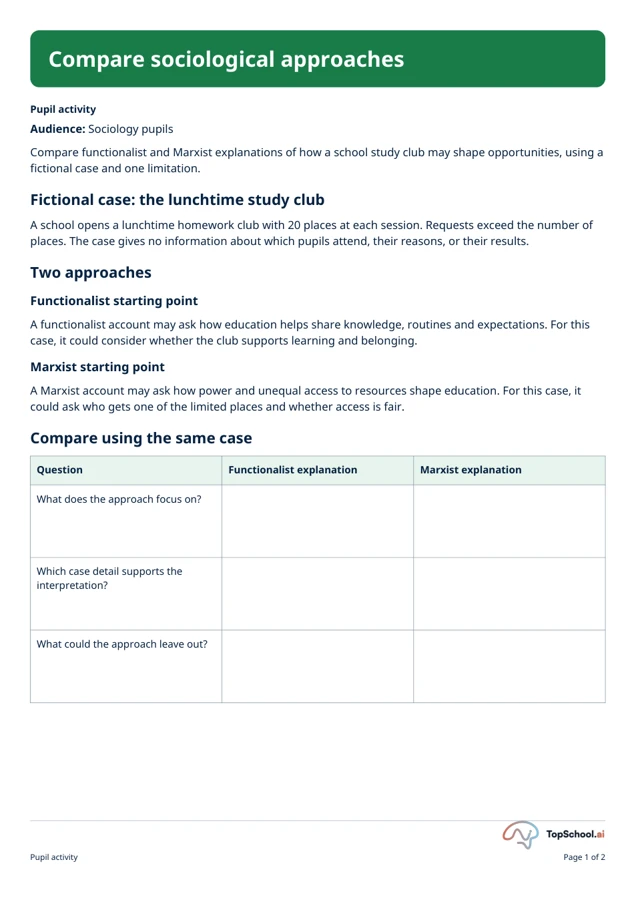
Compare functionalist and Marxist explanations of how a school study club may shape opportunities, using a
fictional case and one limitation.
Fictional case: the lunchtime study club
A school opens a lunchtime homework club with 20 places at each session. Requests exceed the number of
places. The case gives no information about which pupils attend, their reasons, or their results.
Two approaches
Functionalist starting point
A functionalist account may ask how education helps share knowledge, routines and expectations. For this
case, it could consider whether the club supports learning and belonging.
Marxist starting point
A Marxist account may ask how power and unequal access to resources shape education. For this case, it
could ask who gets one of the limited places and whether access is fair.
Compare using the same case
Question
Functionalist explanation
Marxist explanation
What does the approach focus on?
Which case detail supports the
interpretation?
What could the approach leave out?
Pupil activity
Page 1 of 2
Page 2
Compare sociological approaches
Write a judgement
“A __ approach helps explain __ because __. A limitation is __. To find out who benefits, I would need __.”
Do not claim that the club raises attainment or excludes a group: the fictional case provides no outcome or
attendance data.
Pupil activity
Page 2 of 2
A teaching sequence
Compare functionalist and Marxist explanations of how a school study club may shape opportunities, using a fictional case and one limitation.
Apply both approaches to one case
Explain how a functionalist might interpret the study club, using one case detail. Explain how a Marxist might interpret the same club and detail.
How does each approach interpret the same limited club places?
Compare emphasis and limits
Compare what each approach foregrounds and one point it may leave out.
What does one approach foreground that the other may leave out?
Qualify the judgement
Write a qualified judgement and name one extra piece of evidence needed.
What attendance or outcome evidence would you need to identify who benefits?
Before you teach
Look for the thinking behind an answer, choose the support your class needs and leave room for an independent response.
What to look for
A functionalist response may focus on shared learning and preparation; a Marxist response may ask who can access the limited places. The case gives no attendance or attainment data. Ask, “What evidence would show who benefits?”
Give a little support
Use the case detail and sentence frames: “A functionalist might argue _____ because _____”; “A Marxist might ask _____”; “The case cannot show _____”.
Take the idea further
Add a third approach from the taught course and compare what further evidence it would require.
Things to keep in mind
The school and study club are fictional. These short approach summaries are a starter; check terms and emphasis against the current course and specification.
Keep the idea. Make it yours.
Bring your topic, learning goal and class context to PLAI™, then review what you create.
Ideas to try with your class
Sample teaching perspectives on what to try, what to adapt and what to watch for.
Meet The Creators
Meet a creator whose teaching interests connect with this template.

Pocketful of Stories
The fictional club has 20 places, more requests than places, and no attendance or outcome information. The comparison asks functionalist and Marxist readers to use the same case while naming what each approach might leave out.
Five More Minutes
The two-page task anchors each perspective in the limited-place issue, then requests a judgement and the information needed to know who benefits. It explicitly warns against claiming improved attainment or group exclusion from missing data.
Clear Example
A three-column chart (approach focus, case detail, possible omission) helps pupils compare the theories with parallel questions. The final sentence frame supports a qualified judgement and leaves room to identify a limitation.
Margin Note
The case cannot show who attends, why places are requested or what results follow. Keep explanations hypothetical and gather attendance and outcome evidence before making claims about opportunity or attainment.