
Science
Frog or toad? Comparing amphibians
Sort animal features into a Venn diagram, then compare frogs and toads using precise language. The four-page landscape A4 science sheet includes a two-ring sort, a three-ring stretch with newts, a reflection and a final question about which difference matters most.
Read the material
Sort animal features into a Venn diagram, then compare frogs and toads using precise language. The four-page landscape A4 science sheet includes a two-ring sort, a three-ring stretch with newts, a reflection and a final question about which difference matters most.
Activity. Use the preview for diagrams and layout.
Page 1
NAME
CLASS
DATE
LEARNING GOAL
I can compare two animals by finding what they share and what
makes each one different.
SUCCESS CRITERIA
I can sort facts into unique and shared features.
I can use a Venn diagram with two and three rings.
I can compare using both, but and whereas.
1
Sort the fact cards
11 marks
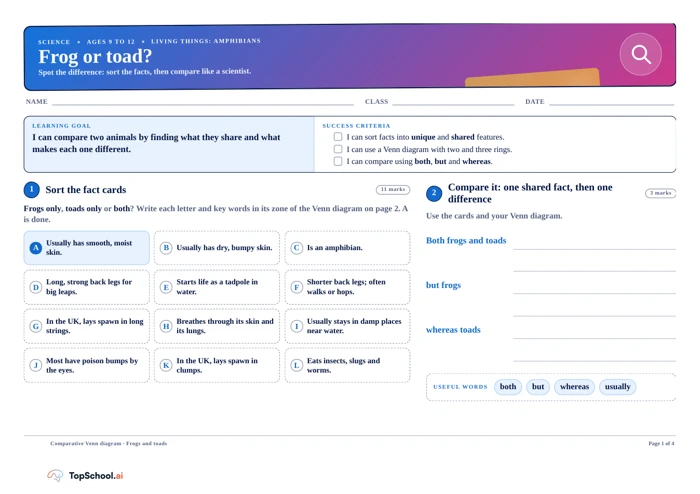
Frogs only, toads only or both? Write each letter and key words in its zone of the Venn diagram on page 2. A
is done.
A
Usually has smooth, moist
skin.
B
Usually has dry, bumpy skin.
C
Is an amphibian.
D
Long, strong back legs for
big leaps.
E
Starts life as a tadpole in
water.
F
Shorter back legs; often
walks or hops.
G
In the UK, lays spawn in long
strings.
H
Breathes through its skin and
its lungs.
I
Usually stays in damp places
near water.
J
Most have poison bumps by
the eyes.
K
In the UK, lays spawn in
clumps.
L
Eats insects, slugs and
worms.
2
Compare it: one shared fact, then one
difference
3 marks
Use the cards and your Venn diagram.
Both frogs and toads
but frogs
whereas toads
USEFUL WORDS
both
but
whereas
usually
Comparative Venn diagram · Frogs and toads
SCIENCE
AGES 9 TO 12
LIVING THINGS: AMPHIBIANS
Frog or toad?
Spot the difference: sort the facts, then compare like a scientist.
Page 1 of 4
Page 2
FROGS ONLY
BOTH
TOADS ONLY
A smooth, moist skin
Frogs: solid ring
Toads: dashed ring
Comparative Venn diagram · Frogs and toads
FROG OR TOAD?
TASK 1
Sort the fact cards into the Venn diagram
Write each letter and key words in its zone. A is done.
Page 2 of 4
Page 3
3
Frog, toad or newt?
10 marks
Write each feature's number in its zone. An overlap means true for every ring it is inside. 1 is done.
1
Is an amphibian.
2
Keeps its tail as an adult.
3
Adult has no tail.
4
Its tadpole grows its back legs first.
5
Its tadpole grows its front legs first.
6
Usually has smooth skin.
7
Often walks or crawls instead of leaping.
8
Starts life in water.
9
Has poison bumps behind the eyes that taste foul to predators.
10
In the UK, wraps each egg in a leaf.
11
Has long, strong back legs for big leaps.
Frog: solid
Toad: dashed
Newt: dotted
FROG
TOAD
NEWT
1
Comparative Venn diagram · Frogs, toads and newts
FROG OR TOAD?
STRETCH
Add a third amphibian: the newt
Three rings, seven zones. Every zone has at least one feature.
Page 3 of 4
Page 4
4
Which is the most important difference?
3 marks
Choose one difference. Does it help the animal survive, or help you tell them apart?
I think the most important difference is
This matters because
SELF-CHECK
Every card and feature has a home.
I kept the word usually where a fact is not true for every kind.
My sentence on page 1 uses both, but and whereas.
Not yet
Getting there
Got it
GO FURTHER
Scientists group toads as one kind of frog. Sketch a Venn diagram that shows this. Where does the toad ring
go?
Comparative Venn diagram · Total 27 marks across pages 1 to 4
FROG OR TOAD?
THINK IT THROUGH
Which difference matters most?
Give a reason, check your work, then go further.
Page 4 of 4
A teaching sequence
Classify features as shared or distinctive among frogs, toads and newts, then explain which difference is most important and why.
Sort qualified animal facts
Sort frog/toad cards into the two-ring diagram, keeping qualifiers such as usually and in the UK attached to each claim.
Have usually and in the UK stayed attached to the claim?
Compare a shared trait and difference
Complete a sentence using both, but and whereas to describe one shared feature and one difference.
Which fact is shared, and which difference needs a qualifier?
Add the newt regions
Try the newt stretch by placing the numbered statements inside the correct regions of the three-ring diagram.
Does the overlap apply to every ring containing the statement?
Explain what a difference means
Choose an important difference, explain whether it relates to survival or identification and complete the self-check. State whether the trait is universal or commonly observed in the species considered, and check the species source.
Is the trait universal or commonly observed in the species considered?
Before you teach
Look for the thinking behind an answer, choose the support your class needs and leave room for an independent response.
What to look for
Look for placements justified by the card wording and sentences that preserve qualifiers such as usually. Ask: “Is this feature true for every animal in the group, or only commonly observed?” The cards should be checked against reliable species sources before being treated as universal facts.
Give a little support
Use picture cards or model the first overlap with a small subset of features. Read qualifiers aloud and allow pupils to explain a placement orally before writing. Keep the three-ring stretch optional and provide vocabulary support for species terms.
Take the idea further
Ask pupils to add a source-checked feature for a local amphibian or compare their classifications with another group. They can revise a broad statement to include a condition or species example.
Things to keep in mind
Animal traits vary by species and region, so broad labels must retain qualifiers. Check examples against reliable sources and explain why traits may vary.
Keep the idea. Make it yours.
Bring your topic, learning goal and class context to PLAI™, then review what you create.
Ideas to try with your class
Sample teaching perspectives on what to try, what to adapt and what to watch for.
Meet The Creators
Meet a creator whose teaching interests connect with this template.

Page-Turner Planner
The four-page activity sorts feature cards into frog-only, toad-only and shared zones, then uses a Venn diagram and comparison language. Its “usually” wording matters: several features are presented as common patterns rather than exceptions-free rules.
Glue Stick Club
Pupils move from card sorting to explaining a shared fact and a difference, then judging which difference matters most. That progression asks for both classification and a reasoned choice, not just a completed diagram.
Bright Margins
The rings and lettered cards reduce copying, while “both”, “but” and “whereas” give pupils language for comparison. Start with the provided smooth-skin example and ask where a shared amphibian feature belongs.
Organised Pile
The facts are simplified teaching statements and include “usually” and UK-specific spawn examples. Check the later newt comparison against the material’s exact scope and a reliable science reference before generalising the cards to every species.