
Languages and literacy
Power, paired: comparing two poems
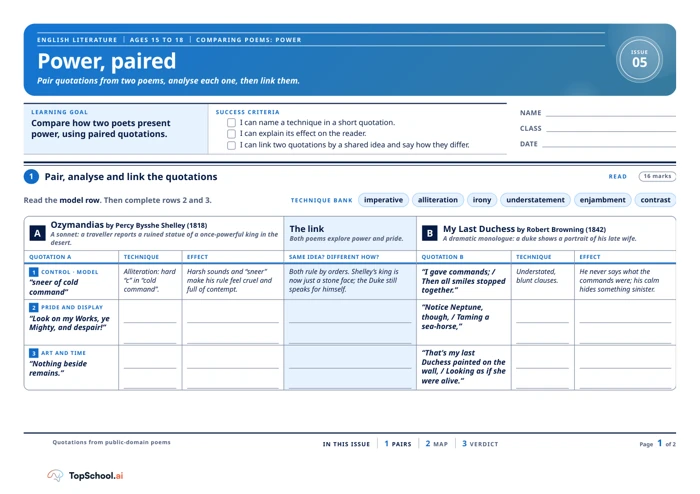
Compare how Percy Bysshe Shelley and Robert Browning present power through paired quotations. This two-page landscape A4 organiser models close analysis, asks pupils to create further pairs and ends with a judgement about which poem presents power more powerfully.
Read the material
Compare how Percy Bysshe Shelley and Robert Browning present power through paired quotations. This two-page landscape A4 organiser models close analysis, asks pupils to create further pairs and ends with a judgement about which poem presents power more powerfully.
Activity. Use the preview for diagrams and layout.
Page 1
LEARNING GOAL
Compare how two poets present
power, using paired quotations.
SUCCESS CRITERIA
I can name a technique in a short quotation.
I can explain its effect on the reader.
I can link two quotations by a shared idea and say how they differ.
NAME
CLASS
DATE
Read the model row. Then complete rows 2 and 3.
TECHNIQUE BANK
imperative
alliteration
irony
understatement
enjambment
contrast
A
Ozymandias by Percy Bysshe Shelley (1818)
A sonnet: a traveller reports a ruined statue of a once-powerful king in the
desert.
The link
Both poems explore power and pride.
B
My Last Duchess by Robert Browning (1842)
A dramatic monologue: a duke shows a portrait of his late wife.
QUOTATION A
TECHNIQUE
EFFECT
SAME IDEA? DIFFERENT HOW?
QUOTATION B
TECHNIQUE
EFFECT
1
CONTROL · MODEL
“sneer of cold
command”
Alliteration: hard
“c” in “cold
command”.
Harsh sounds and “sneer”
make his rule feel cruel and
full of contempt.
Both rule by orders. Shelley’s king is
now just a stone face; the Duke still
speaks for himself.
“I gave commands; /
Then all smiles stopped
together.”
Understated,
blunt clauses.
He never says what the
commands were; his calm
hides something sinister.
2
PRIDE AND DISPLAY
“Look on my Works, ye
Mighty, and despair!”
“Notice Neptune,
though, / Taming a
sea-horse,”
3
ART AND TIME
“Nothing beside
remains.”
“That's my last
Duchess painted on the
wall, / Looking as if she
were alive.”
Quotations from public-domain poems
IN THIS ISSUE
1 PAIRS
2 MAP
3 VERDICT
E N G L I S H L I T E R AT U R E
AG E S 1 5 TO 1 8
CO M PA R I N G P O E M S : P OW E R
Power, paired
Pair quotations from two poems, analyse each one, then link them.
ISSUE
05
1
Pair, analyse and link the quotations
R E A D
16 marks
Page 1 of 2
Page 2
Row 4: find a line from My Last Duchess to pair with Shelley's. Row 5: choose a theme and both quotations yourself.
A: OZYMANDIAS
TECHNIQUE
EFFECT
SAME IDEA? DIFFERENT HOW?
B: MY LAST DUCHESS
TECHNIQUE
EFFECT
4
TIME
“The lone and level
sands stretch far
away.”
YOUR CHOICE
5
THEME:
YOUR CHOICE
Circle 1 (a little) to 3 (strongly). Then write the row number of
your best evidence.
THEME
OZYMANDIAS
MY LAST DUCHESS
BEST ROW
Power
1
2
3
1
2
3
Pride
1
2
3
1
2
3
Control
1
2
3
1
2
3
Time
1
2
3
1
2
3
Art
1
2
3
1
2
3
MY VERDICT
Ozymandias
My Last Duchess
SHELLEY'S POWER
Start: Shelley presents power as ...
BROWNING'S POWER
Start: However, Browning ...
YOUR VERDICT
Start: Ultimately, ... because ...
Comparative literature quote organizer · Judgement desk
I S S U E 0 5
CO M PA R I N G P O E M S : P OW E R
J U D G E M E N T D E S K
Map the themes, then make your judgement
2
Add your own pairs
T H I N K
8 marks
3
Map the themes
P L A N
4
Which poem presents power more powerfully?
W R I T E
12 marks
Page 2 of 2
A teaching sequence
Compare how two poems present power by analysing paired quotations, linking a shared idea to a difference and supporting a final judgement.
Read the paired model
Read the completed model and identify how the technique and effect connect in each poem’s quotation.
How does each named technique support the effect described?
Analyse pride, display, art and time
Complete the pride/display and art/time rows, naming a method and explaining what it makes the reader think about each speaker.
Which quotation supports the different effect in each poem?
Choose further quotation pairs
Choose a Browning line to pair with Shelley's printed time quotation in row four. For row five, select a new theme and a quotation from each full poem.
Which Browning line can you pair with Shelley's time quotation?
Weigh the themes and write a verdict
Rate the themes, identify the strongest evidence and write a verdict with a reason grounded in the comparison. Support the verdict with a method and quotation.
How does the strongest paired evidence support your judgement about power?
Before you teach
Look for the thinking behind an answer, choose the support your class needs and leave room for an independent response.
What to look for
Look for a comparison that analyses both poems and explains how evidence shapes the reader’s view of power. Ask: “What changes when Shelley’s ruined statue is compared with Browning’s speaking Duke?” Check the quoted lines against the full poems and ensure pupils support their verdict with a specific method or effect.
Give a little support
Provide both poems and a short context reminder. Model one line of analysis using the supplied example, then let pupils highlight a technique, paraphrase its effect and compare before writing a full sentence.
Take the idea further
Ask pupils to find a new pair of quotations around one theme and test whether it supports or complicates their verdict. They can compare how the poem’s form shapes each speaker’s authority.
Things to keep in mind
The printed quotations are excerpts; pupils need the full poems and a verified text edition. Use the brief descriptions as a starting point for context, then return to the poem for evidence.
Keep the idea. Make it yours.
Bring your topic, learning goal and class context to PLAI™, then review what you create.
Ideas to try with your class
Sample teaching perspectives on what to try, what to adapt and what to watch for.
Meet The Creators
Meet a creator whose teaching interests connect with this template.

Tea at Breaktime
The model row pairs “sneer of cold command” with “I gave commands” and contrasts the ruined king’s stone face with the Duke’s continuing voice. Later rows ask pupils to compare pride/display and art/time in Shelley and Browning.
The Curious Pencil
The two-page organiser asks for technique, effect, shared idea and difference before a final judgement about power. Its technique bank helps name a choice, but the model shows that analysis must explain the words and their effect.
Kind Check-In
Read the short poem descriptions and model row first, then complete one quotation pair at a time. The final column can be drafted orally as a shared idea plus a difference before pupils write the two analyses.
Step by Step
The selected quotations are only a small sample of each poem. Check interpretations against the full poems, especially where the Duke’s account is unreliable or the speaker’s words invite more than one reading.