
Languages and literacy
Two Londons: comparative essay planner
Compare Blake’s and Wordsworth’s poems about London using evidence, context and a structured essay plan. Develop a thesis and compare speakers; verify quotations against both complete poems used in class before writing.
Read the material
Compare Blake’s and Wordsworth’s poems about London using evidence, context and a structured essay plan. Develop a thesis and compare speakers; verify quotations against both complete poems used in class before writing.
Activity. Use the preview for diagrams and layout.
Page 1
NAME
CLASS
DATE
LEARNING GOAL
Plan an essay that compares how two
poets present London.
SUCCESS CRITERIA
I can compare form, viewpoint, imagery, tone and context.
I can write a thesis that answers the question.
I can plan paragraphs that use both poems each time.
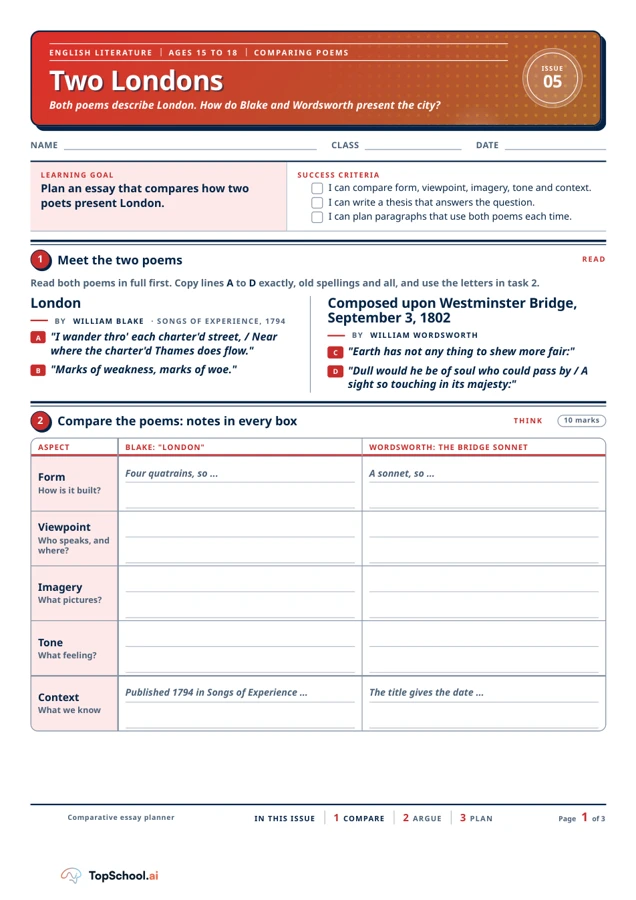
Read both poems in full first. Copy lines A to D exactly, old spellings and all, and use the letters in task 2.
London
BY
WILLIAM BLAKE
· SONGS OF EXPERIENCE, 1794
A
"I wander thro' each charter'd street, / Near
where the charter'd Thames does flow."
B
"Marks of weakness, marks of woe."
Composed upon Westminster Bridge,
September 3, 1802
BY
WILLIAM WORDSWORTH
C
"Earth has not any thing to shew more fair:"
D
"Dull would he be of soul who could pass by / A
sight so touching in its majesty:"
ASPECT
BLAKE: "LONDON"
WORDSWORTH: THE BRIDGE SONNET
Form
How is it built?
Viewpoint
Who speaks, and
where?
Imagery
What pictures?
Tone
What feeling?
Context
What we know
Comparative essay planner
IN THIS ISSUE
1 COMPARE
2 ARGUE
3 PLAN
E N G L I S H L I T E R AT U R E
AG E S 1 5 TO 1 8
CO M PA R I N G P O E M S
Two Londons
Two Londons
Both poems describe London. How do Blake and Wordsworth present the city?
ISSUE
05
1
Meet the two poems
R E A D
2
Compare the poems: notes in every box
T H I N K
10 marks
Four quatrains, so ...
A sonnet, so ...
Published 1794 in Songs of Experience ...
The title gives the date ...
Page 1 of 3
Page 2
NAME
CLASS
DATE
Step 1. Circle the idea your essay will be about, or add your own.
people
control
beauty
calm
power
my own:
Step 2. Write your thesis: one clear answer to the question. Use the frame or
your own words.
Both poets present London, but while Blake shows a city of ..., Wordsworth
...
CONNECTIVES BANK
TO COMPARE
Similarly · Likewise · In the
same way · Both poets
TO CONTRAST
However · In contrast ·
Whereas · On the other
hand · Conversely
TO BUILD
Furthermore · This is
reinforced by · More
strikingly
1
Name both poems
and both poets.
2
Add one point of
context for each
poem.
3
End with your thesis
from task 3.
Follow the numbers. Use the suggested focus, or choose your own.
P1
Focus: form and structure
MY CONNECTIVE
Comparative essay planner · Argument desk
I S S U E 0 5
T WO LO N D O N S
A R G U M E N T D E S K
Build your argument
Build your argument
3
Build your thesis
T H I N K
4
Draft your introduction
D R A F T
Blake's "London" and Wordsworth's sonnet ...
5
Plan paragraph 1
P L A N
1 POINT Both poets ...
2 BLAKE evidence and what it shows
4 ANALYSIS Whereas Blake ..., Wordsworth ...
3 WORDSWORTH evidence and what it shows
Page 2 of 3
Page 3
NAME
CLASS
P2
Focus: imagery and language
MY CONNECTIVE
P3
Focus: tone and viewpoint
MY CONNECTIVE
1
Return to your thesis
in new words.
2
Say which difference
matters most, and
why.
3
End on how each
poet sees the city.
EDITOR'S CHECKLIST
Every paragraph uses both
poems
Quotations copied exactly
A connective in every paragraph
Effects explained, not just
named
Context linked to a point
Conclusion returns to the thesis
GO FURTHER
Plan a short extra paragraph on one way the two poems are alike. Where would it fit in your essay?
Comparative essay planner · Planning desk
I S S U E 0 5
T WO LO N D O N S
P L A N N I N G D E S K
Plan the body and the ending
Plan the body and the ending
6
Plan paragraphs 2 and 3
P L A N
1 POINT Both poets ...
2 BLAKE evidence and what it shows
4 ANALYSIS In contrast, ...
3 WORDSWORTH evidence and what it shows
1 POINT Both poets ...
2 BLAKE evidence and what it shows
4 ANALYSIS On the other hand, ...
3 WORDSWORTH evidence and what it shows
7
Draft your conclusion
D R A F T
Overall, both poems ...
Page 3 of 3
A teaching sequence
Plan a comparative essay that answers the question and uses evidence and analysis from both poems in each body paragraph.
Compare both full poems and their aspects
Compare form, viewpoint, imagery, tone and context for both poems; use each row to record a point about Blake and Wordsworth.
Which quotation supports your note on form, imagery, tone or viewpoint?
Write a comparative thesis and introduction
Choose a comparative idea, write a thesis that answers the question and draft an introduction naming both poets and a relevant context point.
Does the thesis answer how both poets present London?
Plan three paragraphs using both poems
Plan three body paragraphs so each includes a point, evidence from each poem and comparative analysis.
Where does paired evidence support comparative analysis in each paragraph?
Conclude and check exact quotations
Draft a conclusion that returns to the thesis, weighs the most important difference and explains how each poet presents London. Check quotations in class texts.
Which difference matters most to the thesis, and are quotations faithful to the class texts?
Before you teach
Look for the thinking behind an answer, choose the support your class needs and leave room for an independent response.
What to look for
Look for a thesis answering the question and paragraphs that use both poems with evidence and explanation. Ask: “How does the comparison change what you understand about each speaker’s London?” Check quotations and contextual claims against reliable class texts and teaching sources.
Give a little support
Use one paragraph model with both poets and colour-code point, evidence and analysis. Provide the poem texts, connectives bank and a thesis frame; allow pupils to plan orally or in notes before drafting.
Take the idea further
Ask pupils to evaluate a counter-reading of one poem and revise the thesis or paragraph order. They can add another verified quotation to test whether the contrast remains convincing.
Things to keep in mind
The workbook contains short extracts, so pupils need full copies of both poems. Check quotations against the class edition and use context from the poems when building an interpretation.
Keep the idea. Make it yours.
Bring your topic, learning goal and class context to PLAI™, then review what you create.
Ideas to try with your class
Sample teaching perspectives on what to try, what to adapt and what to watch for.
Meet The Creators
Meet a creator whose teaching interests connect with this template.

After the Bell
The three-page planner asks for a Blake and Wordsworth comparison and requires both poems in every body paragraph. It supplies four short lines, then asks pupils to copy them exactly with original spelling before analysing form, viewpoint, imagery, tone and context.
The Curious Pencil
The comparison grid keeps the poems side by side, followed by a thesis choice and a structured argument plan. Asking pupils to read both poems in full first helps prevent the four excerpted lines from standing in for each whole poem.
Quietly Curious
The letter labels A to D link quotations to the planner, reducing repeated copying once the opening instruction is complete. Teachers can model one row on form or viewpoint and show how both poems need evidence in the same paragraph.
Steady Marker
The supplied lines are selected extracts and cannot support claims about every feature of either poem. Confirm exact wording and use the full poems before making claims about context or the poets’ presentation of London.