
Science
Chemistry formula practice: mass concentration
For Years 9 to 13 Chemistry pupils, use mass concentration = solute mass / solution volume and convert cm3 to dm3 before calculating.
Read the material
For Years 9 to 13 Chemistry pupils, use mass concentration = solute mass / solution volume and convert cm3 to dm3 before calculating.
Pupil worksheet. Use the preview for diagrams and layout.
Page 1
Chemistry formula practice: mass concentration
Pupil activity
Audience: Years 9 to 13 Chemistry pupils
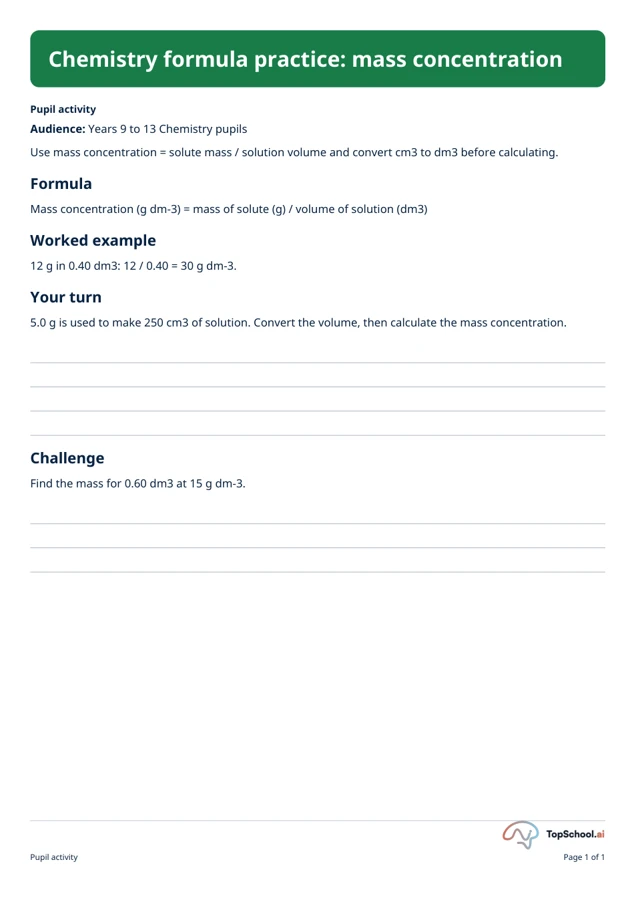
Use mass concentration = solute mass / solution volume and convert cm3 to dm3 before calculating.
Formula
Mass concentration (g dm-3) = mass of solute (g) / volume of solution (dm3)
Worked example
12 g in 0.40 dm3: 12 / 0.40 = 30 g dm-3.
Your turn
5.0 g is used to make 250 cm3 of solution. Convert the volume, then calculate the mass concentration.
Challenge
Find the mass for 0.60 dm3 at 15 g dm-3.
Pupil activity
Page 1 of 1
Page 1
Chemistry formula practice: mass concentration
Teacher key and guidance supporting this exact edition
Teacher answer
250 cm3 = 0.250 dm3. 5.0 / 0.250 = 20 g dm-3.
Teacher challenge check
Mass = concentration × volume = 15 × 0.60 = 9.0 g.
Teacher companion
Page 1 of 1
A teaching sequence
Use mass concentration = solute mass / solution volume and convert cm3 to dm3 before calculating.
Convert the solution volume
Convert 250 cm3 to 0.250 dm3 before dividing.
Have you changed 250 cm³ into 0.250 dm³ before dividing?
Apply the concentration formula
Calculate concentration for 5.0 g in 250 cm3 of solution. Solve the worked example of 12 g in 0.40 dm3.
Does the worked example show mass divided by solution volume?
Check the unit and relationship
Check that the unit is g dm-3.
Is the final concentration expressed in g dm⁻³?
Before you teach
Look for the thinking behind an answer, choose the support your class needs and leave room for an independent response.
What to look for
Teacher check: 5.0 g in 0.250 dm3 gives 20 g dm-3; the extension mass is 9.0 g. Both answers remain in separate collapsed teacher disclosures after their unsolved pupil prompts.
Give a little support
Keep 1000 cm3 = 1 dm3 visible and label units at every step.
Take the idea further
Find the mass needed for 0.60 dm3 at 15 g dm-3; answer 9.0 g.
Things to keep in mind
This set covers mass concentration only and does not claim to match a specific exam specification.
Keep the idea. Make it yours.
Bring your topic, learning goal and class context to PLAI™, then review what you create.
Ideas to try with your class
Sample teaching perspectives on what to try, what to adapt and what to watch for.
Meet The Creators
Meet a creator whose teaching interests connect with this template.

Little Lightbulbs
The one-page task gives mass concentration as solute mass divided by solution volume, then asks pupils to convert 250 cm³ before calculating the result for 5.0 g. A challenge reverses the formula to find mass.
Spare Pencil
The worked 12 g in 0.40 dm³ example shows the expected unit g dm⁻³ before the pupil attempts the conversion problem. This keeps volume conversion central rather than hiding it inside the calculation.
Margin Note
For the given 5.0 g in 250 cm³, convert the volume to dm³ before using mass concentration = mass ÷ volume; check the result is in g dm⁻³. Then try finding the mass for 0.60 dm³ at 15 g dm⁻³.
Kind Check-In
The sheet targets one formula and one volume conversion, not all concentration calculations. Check units and significant figures against the course expectations before using the result as evidence of wider chemistry readiness.