
History and social studies
Why war came in 1914: cause and consequence organiser
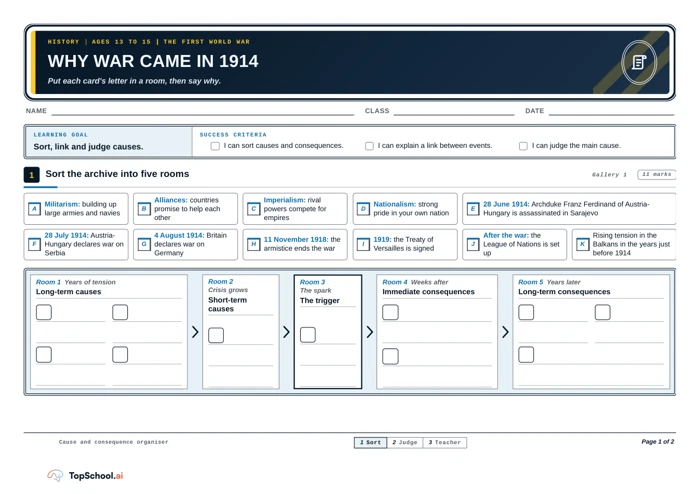
Sort cards about long-term pressures, the 1914 crisis and later events, then explain how causes connect to consequences. The landscape A4 sheet includes a timeline-linked card sort, a model link and a judgement about the main cause.
Read the material
Sort cards about long-term pressures, the 1914 crisis and later events, then explain how causes connect to consequences. The landscape A4 sheet includes a timeline-linked card sort, a model link and a judgement about the main cause.
Activity. Use the preview for diagrams and layout.
Page 1
NAME
CLASS
DATE
LEARNING GOAL
Sort, link and judge causes.
SUCCESS CRITERIA
I can sort causes and consequences.
I can explain a link between events.
I can judge the main cause.
A
Militarism: building up
large armies and navies
B
Alliances: countries
promise to help each
other
C
Imperialism: rival
powers compete for
empires
D
Nationalism: strong
pride in your own nation
E
28 June 1914: Archduke Franz Ferdinand of Austria-
Hungary is assassinated in Sarajevo
F
28 July 1914: Austria-
Hungary declares war on
Serbia
G
4 August 1914: Britain
declares war on
Germany
H
11 November 1918: the
armistice ends the war
I
1919: the Treaty of
Versailles is signed
J
After the war: the
League of Nations is set
up
K
Rising tension in the
Balkans in the years just
before 1914
Room 1 Years of tension
Long-term causes
Room 2
Crisis grows
Short-term
causes
Room 3
The spark
The trigger
Room 4 Weeks after
Immediate consequences
Room 5 Years later
Long-term consequences
Cause and consequence organiser
H I S T O R Y
A G E S 1 3 T O 1 5
T H E F I R S T W O R L D W A R
WHY WAR CAME IN 1914
Put each card's letter in a room, then say why.
1
Sort the archive into five rooms
Gallery 1
11 marks
2 Judge
3 Teacher
1 Sort
Page 1 of 2
Page 2
Write two card letters, then explain: This led to ... because ...
Link 1
long-term cause, then trigger or short-term cause
Link 2
a cause, then an immediate consequence
Link 3
the war's end, then a long-term consequence
Step 1 Rank causes A to E and
K, 1 to 6 (1 = most important).
A
B
C
D
E
K
Step 2, starters: The most important cause was ... because ... · However, ... also mattered, because
... · Overall, I think ...
Step 3 Write your judgement. Use at least two card letters as evidence.
Cause and consequence organiser
H I S T O R Y
T H E F I R S T W O R L D W A R
L I N K S A N D J U D G E M E N T
LINKING THE CATALOGUE
2
Link the documents
Archive
6 marks
E
SARAJEVO
F
SERBIA
E led to F because the assassination of Austria-Hungary's archduke in
Sarajevo set off a crisis. One month later, on 28 July 1914, Austria-Hungary
declared war on Serbia.
MODEL LINK
3
Which cause mattered most?
Gallery 2
10 marks
KEY QUESTION
Was the assassination in Sarajevo
the main cause of the war?
1 Sort
3 Teacher
2 Judge
Page 2 of 2
Page 1
Why war came in 1914: cause and consequence
organiser
Teacher companion
History | Pupils aged 13 to 15
Use with the exact 2-page original file. Keep pupil or staff activity pages separate from this teacher companion.
When to use it
Use the organiser after pupils have encountered the events and terms shown on the cards. It
can support chronological and causal reasoning, but provide reliable source material
separately and make clear that historians may weigh causes differently.
Purpose
Sort historical causes and events, explain causal links and support a judgement about the
relative importance of causes.
Start here
Read the five room labels and sort the lettered cards by the timescale or role each one
describes.
A teaching sequence
1. Place each card in a room for years of tension, crisis, trigger, immediate consequence or
later consequence; explain uncertain placements.
2. Use chosen letter pairs to write causal links, including the assassination and the declaration
of war example.
3. Rank the six listed causes and write a judgement on whether Sarajevo was the main cause.
4. Support the judgement with at least two card letters and explain how the evidence shapes
the ranking. Ask, “Which card supports your ranking, and what does it leave out?” Check the
timeline against suitable sources.
Checking guidance
Look for card placements justified by timescale, complete causal links and a judgement that
weighs rather than merely lists causes. Ask: “Which card best supports your ranking, and
what does it leave out?” Historical causation is interpretive; check the timeline and framing
with suitable sources and subject expertise.
An acceptable causal judgement distinguishes a trigger from longer-term tension, links two
printed cards, and explains why one cause carries more weight. Credit alternative rankings
supported by the cards.
Support
Provide cards one at a time and a simple timeline alongside them. Model one distinction
between a long-term pressure and an immediate event; offer sentence frames for “This led to
… because …” and discuss uncertain placements.
Take it further
Ask pupils to add a source-backed card or note that complicates one room’s category, then
revise the ranking. They can compare two defensible judgements and explain why the
evidence permits different weightings.
Things to keep in mind
The cards provide a compact timeline and causal categories, not a full account of the war.
Historical interpretations may differ, so use reliable evidence and explain why one cause
carries more weight in your judgement.
Why war came in 1914: cause and consequence organiser
Teacher companion | Page 1
A teaching sequence
Sort historical causes and events, explain causal links and support a judgement about the relative importance of causes.
Sort causes, trigger and consequences
Place each card in a room for years of tension, crisis, trigger, immediate consequence or later consequence; explain uncertain placements.
What makes this card a long-term condition, crisis, trigger or consequence?
Explain causal links between cards
Use chosen letter pairs to write causal links, including the assassination and the declaration of war example.
Which event detail supports led to, and what needs more context?
Rank six causes for the Sarajevo question
Rank the six listed causes and write a judgement on whether Sarajevo was the main cause.
Why does the selected cause carry more weight in this argument?
Support and qualify the judgement
Support the judgement with at least two card letters and explain how the evidence shapes the ranking. Check the timeline against suitable sources.
Which two card letters support the ranking, and what does the compact set leave out?
Before you teach
Look for the thinking behind an answer, choose the support your class needs and leave room for an independent response.
What to look for
Look for card placements justified by timescale, complete causal links and a judgement that weighs rather than merely lists causes. Ask: “Which card best supports your ranking, and what does it leave out?” Historical causation is interpretive; check the timeline and framing with suitable sources and subject expertise. An acceptable causal judgement distinguishes a trigger from longer-term tension, links two printed cards, and explains why one cause carries more weight. Credit alternative rankings supported by the cards.
Give a little support
Provide cards one at a time and a simple timeline alongside them. Model one distinction between a long-term pressure and an immediate event; offer sentence frames for “This led to … because …” and discuss uncertain placements.
Take the idea further
Ask pupils to add a source-backed card or note that complicates one room’s category, then revise the ranking. They can compare two defensible judgements and explain why the evidence permits different weightings.
Things to keep in mind
The cards provide a compact timeline and causal categories, not a full account of the war. Historical interpretations may differ, so use reliable evidence and explain why one cause carries more weight in your judgement.
Keep the idea. Make it yours.
Bring your topic, learning goal and class context to PLAI™, then review what you create.
Another starting point
Explore a different teaching task from this selection.
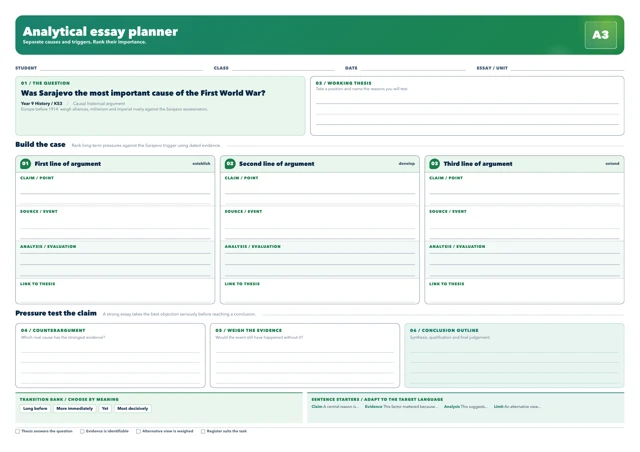
Analytical essay planner: causes of the First World War
Read the First World War question and context, then write a tentative thesis that identifies the causes pupils will compare.
Explore resourceIdeas to try with your class
Sample teaching perspectives on what to try, what to adapt and what to watch for.
Meet The Creators
Meet the creators whose teaching interests connect with this template. Find an approach to try with your class.

Narin Kittisak
I begin Geography and Global Perspectives inquiries with local places, maps and field observations, asking pupils to compare evidence and identify what their account still needs to establish.
Meet the creator
Erik Halvorsen-Ruiz
I often begin a unit with two sources that disagree, because that gives pupils something to examine before I offer a narrative.
Meet the creator
Rachel Ncube
I look for scaffolds that help pupils with different reading needs work on a shared historical question, without changing the question into several unrelated tasks.
Meet the creator
Gentle Reminder
The five “rooms” distinguish long-term causes, short-term causes, trigger, immediate consequences and later consequences. Pupils sort lettered cards, explain three links and rank causes A to E and K before writing a judgement supported by at least two letters.
Margin Note
The dated assassination, declarations of war, armistice, Treaty of Versailles and League of Nations cards support sequencing alongside militarism, alliances, imperialism, nationalism and Balkan tension. The separate rooms prompt pupils to distinguish a trigger from longer pressures.
Steady Marker
The sentence frame “This led to … because …” makes the causal link explicit, while the ranked list gives a planning step before the paragraph. Ask pupils to justify one placement aloud before filling all five rooms.
Reread Reminder
The organiser supplies a summary card set, not a complete historical explanation. The ranking records a pupil’s judgement, so it should be checked against taught evidence and careful discussion of causation rather than marked as one factual order.