
Languages and literacy
Build a clear evidence sentence from survey results
Use the supplied survey figures to write a precise comparison, then check that your conclusion stays within what the small data set can show.
Read the material
Use the supplied survey figures to write a precise comparison, then check that your conclusion stays within what the small data set can show.
Pupil activity and after-attempt self-check. Use the preview for diagrams and layout.
Page 1
Build a clear evidence sentence from survey
results
Pupil activity and after-attempt self-check
Use the supplied survey figures to write a precise comparison, then check that your conclusion stays within
what the small data set can show.
Practice independently or with a partner. Write in the spaces or print this page.
What you are practising
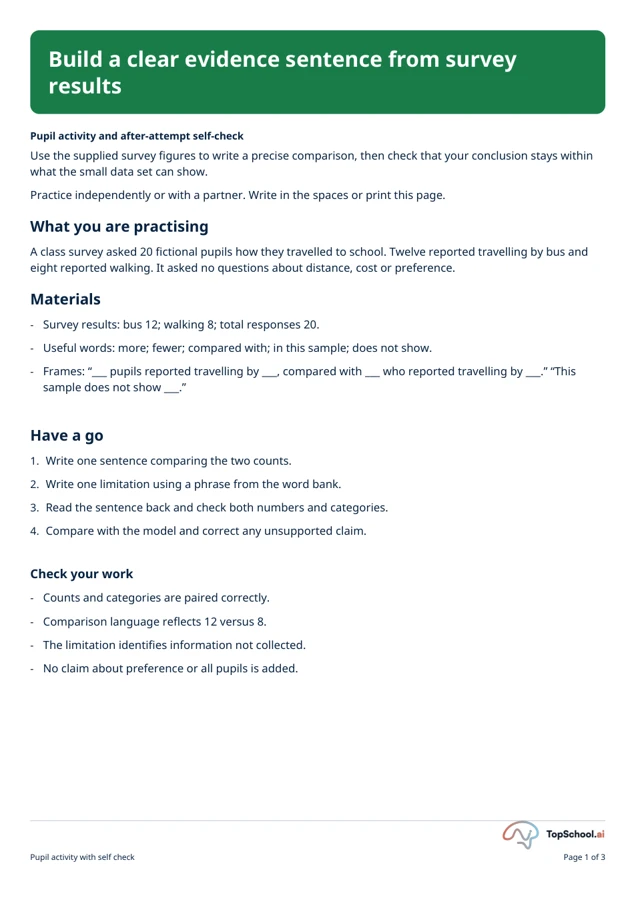
A class survey asked 20 fictional pupils how they travelled to school. Twelve reported travelling by bus and
eight reported walking. It asked no questions about distance, cost or preference.
Materials
-
Survey results: bus 12; walking 8; total responses 20.
-
Useful words: more; fewer; compared with; in this sample; does not show.
-
Frames: “___ pupils reported travelling by ___, compared with ___ who reported travelling by ___.” “This
sample does not show ___.”
Have a go
1. Write one sentence comparing the two counts.
2. Write one limitation using a phrase from the word bank.
3. Read the sentence back and check both numbers and categories.
4. Compare with the model and correct any unsupported claim.
Check your work
-
Counts and categories are paired correctly.
-
Comparison language reflects 12 versus 8.
-
The limitation identifies information not collected.
-
No claim about preference or all pupils is added.
Pupil activity with self check
Page 1 of 3
Page 2
Build a clear evidence sentence from survey results
Your working space
Comparison sentence: ________
Limitation sentence: ________
Numbers checked: 12 ___ 8 ___ Categories checked: bus ___ walking ___
Need a hand?
Use two labelled bars of different lengths or point to the two counts before writing the comparison.
Ready for more?
Rewrite the comparison with “four more”, then explain why that still does not reveal why pupils used those
modes.
Remember
The survey and values are invented for writing practice; they are not real school data.
Pupil activity with self check
Page 2 of 3
Page 3
Build a clear evidence sentence from survey results
Self-check: use after your first attempt
Model answers
“Twelve pupils in this sample reported travelling by bus, compared with eight who reported walking. The
survey does not show why pupils used those modes or whether the same pattern applies to all pupils.” The
first sentence describes the numbers; the second stays within the survey.
Pupil activity with self check
Page 3 of 3
A teaching sequence
Build a sentence that reports two values accurately and a second sentence that states a limitation.
Read the survey's boundaries
Read the fictional survey: 20 responses, with 12 reporting bus and eight walking. It asks nothing about distance, cost or preference, so treat these figures as a small practice set, not school data.
What did the twenty-response survey ask, and what did it leave out?
Write count and category together
Write one sentence pairing each count with its travel mode, using “compared with”. Add a second sentence naming one limit, such as the survey not showing why respondents chose either mode.
Does twelve stay with bus and eight with walking?
Check against the model
Compare with the model. Check that 12 stays with bus and eight with walking, that the difference is four, and that neither sentence claims a preference or pattern for all pupils.
Have you described four more without claiming a preference?
Read back both sentences
Read both sentences back and check the numbers and categories. Use the two labelled bars or point to each count if helpful; try “four more” as an extension, then ask whether this language target fits the class.
Can you explain why the difference does not reveal the reason for travel choices?
Before you teach
Look for the thinking behind an answer, choose the support your class needs and leave room for an independent response.
What to look for
“Twelve pupils in this sample reported travelling by bus, compared with eight who reported walking. The survey does not show why pupils used those modes or whether the same pattern applies to all pupils.” The first sentence describes the numbers; the second stays within the survey. Check that the language target fits your class before choosing the task.
Give a little support
Use two labelled bars of different lengths or point to the two counts before writing the comparison.
Take the idea further
Rewrite the comparison with “four more”, then explain why those counts do not reveal the reasons for travel.
Things to keep in mind
The survey and values are invented for writing practice; they are not real school data.
Keep the idea. Make it yours.
Bring your topic, learning goal and class context to PLAI™, then review what you create.
Ideas to try with your class
Sample teaching perspectives on what to try, what to adapt and what to watch for.
Meet The Creators
Meet a creator whose teaching interests connect with this template.

Good Question
This three-page pupil activity supplies fictional survey results from 20 pupils: 12 travelled by bus and 8 walked. It asks for a precise comparison sentence and a second sentence that names a limitation of this small dataset.
Chalk & Chai
The two counts support a simple evidence statement, while the limitation prompt discourages treating one class survey as a wider population result. The activity can be done independently or with a partner.
The Curious Pencil
Have pupils check that the two counts total 20, state the unit as pupils and then write the comparison. Use a starter for the limitation, such as who was surveyed and what the question did not ask.
Board Eraser
The figures are fictional and the survey describes only the stated 20 pupils. Do not report the result as real school travel data or infer reasons for travel that were not asked.