
Art and design
Art and portfolio reflection
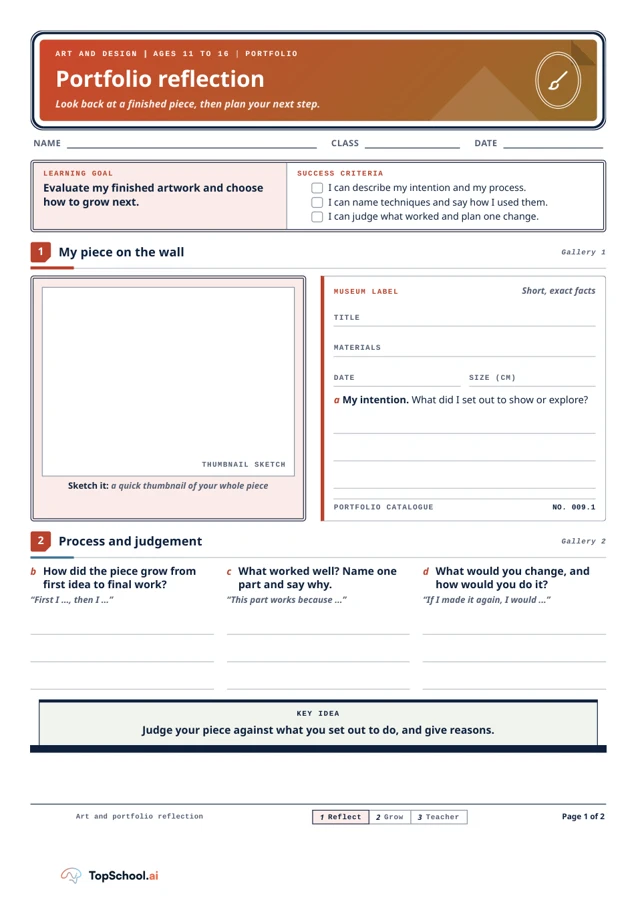
Guide pupils to look back at a finished artwork, describe how it developed and plan one next step. The workbook invites them to record intention, process, techniques and peer feedback, then prepare a short gallery statement for viewers.
Read the material
Guide pupils to look back at a finished artwork, describe how it developed and plan one next step. The workbook invites them to record intention, process, techniques and peer feedback, then prepare a short gallery statement for viewers.
Activity. Use the preview for diagrams and layout.
Page 1
NAME
CLASS
DATE
LEARNING GOAL
Evaluate my finished artwork and choose
how to grow next.
SUCCESS CRITERIA
I can describe my intention and my process.
I can name techniques and say how I used them.
I can judge what worked and plan one change.
Sketch it: a quick thumbnail of your whole piece
MUSEUM LABEL
Short, exact facts
TITLE
MATERIALS
DATE
SIZE (CM)
a My intention. What did I set out to show or explore?
PORTFOLIO CATALOGUE
NO. 009.1
b How did the piece grow from
first idea to final work?
“First I ..., then I ...”
c What worked well? Name one
part and say why.
“This part works because ...”
d What would you change, and
how would you do it?
“If I made it again, I would ...”
Art and portfolio reflection
A R T A N D D E S I G N
A G E S 1 1 T O 1 6
P O R T F O L I O
Portfolio reflection
Look back at a finished piece, then plan your next step.
My piece on the wall
Gallery 1
1
THUMBNAIL SKETCH
Process and judgement
Gallery 2
2
KEY IDEA
Judge your piece against what you set out to do, and give reasons.
2 Grow
3 Teacher
1 Reflect
Page 1 of 2
Page 2
Tick each technique you used. On its line, describe how you used it. Example: Painting, a graded wash for the sky.
A
DRAWING
D
COLLAGE
B
PAINTING
E
3D OR CLAY
C
PRINTMAKING
F
OTHER
COMMENT CARD
INITIALS
Write 60 to 80 words to hang beside your piece. Tell a visitor what it is, how you made it and what to look for.
Art and portfolio reflection
A R T A N D D E S I G N
P O R T F O L I O R E F L E C T I O N
E V A L U A T E A N D G R O W
Looking back, moving on
Techniques I used
Studio
3
My growth plan
Archive
4
ONE SKILL
BY WHEN
HOW I WILL PRACTISE
GROWTH PLAN
Peer comment
Kind and specific
5
+
ONE STRENGTH
?
ONE SUGGESTION
Curator's statement
Gallery 3
6
STARTERS
This piece explores ...
I used ... to ...
Look closely at ...
Next, I want to ...
WORD COUNT
Aim: 60 to 80
1 Reflect
3 Teacher
2 Grow
Page 2 of 2
Page 1
Art and portfolio reflection
Teacher companion
Art and Design | Pupils aged 11 to 16
Use with the exact 2-page original file. Keep pupil or staff activity pages separate from this teacher companion.
When to use it
Use the reflection after pupils have completed an artwork and can revisit their original
intention or process. The page invites evaluation as well as description, so allow time for
pupils to inspect the piece and choose one next step they can practise.
Purpose
Evaluate how an artwork developed, identify a technique or decision that worked, and plan a
specific next step.
Start here
Place a finished artwork nearby and sketch its overall composition in the thumbnail box.
A teaching sequence
1. Use the intention prompt to describe what the artist set out to show or explore; complete
the museum-label facts about title and materials.
2. Describe how the work changed from first idea to finished piece, then name one part that
worked and explain why.
3. Tick techniques used and write how one technique was applied. Use the peer-comment
boxes for one strength and one suggestion.
4. Choose one skill, a time to practise it and a method; draft the 60-80-word curator’s
statement using the starters if helpful. Ask, “Which part communicates your intention best?”
Choose one practicable next step from the reflection.
Checking guidance
Look for a specific link between intention, an artistic choice and a reasoned judgement,
followed by a practicable next step. Ask: “Which part best communicates your intention, and
what would you try next?” The statement word target is a task instruction, not a measure of
artistic quality.
Illustrative response: “The dark foreground helps the lighter subject stand out. Next time I will
practise blending the transition.” Ask which visible detail supports the pupil’s judgement.
Support
Allow pupils to sketch, dictate or use short notes before writing full sentences. Give a choice of
one success criterion to discuss and offer the printed starters, while avoiding a single
definition of what a successful artwork must look like.
Take it further
Ask pupils to compare the first thumbnail with the finished piece and identify one decision that
changed the outcome. They can plan a small experiment with a technique they did not use
and predict how it might alter the work.
Things to keep in mind
The prompts support reflection but do not provide a fixed standard for artistic quality. Invite
pupils to explain how their choices meet their own intentions.
Art and portfolio reflection
Teacher companion | Page 1
A teaching sequence
Evaluate how an artwork developed, identify a technique or decision that worked, and plan a specific next step.
Name your artistic intention
Use the intention prompt to describe what the artist set out to show or explore; complete the museum-label facts about title and materials.
What did you set out to show, and which materials did you use?
Trace the piece's development
Describe how the work changed from first idea to finished piece, then name one part that worked and explain why.
Which change from your first idea helped the intention?
Explain technique and feedback
Tick techniques used and write how one technique was applied. Use the peer-comment boxes for one strength and one suggestion.
Where can a visitor see the technique you named?
Plan growth and write the label
Choose one skill, a time to practise it and a method; draft the 60-80-word curator’s statement using the starters if helpful. Choose one practicable next step from the reflection.
Which part communicates your intention best, and what will you practise next?
Before you teach
Look for the thinking behind an answer, choose the support your class needs and leave room for an independent response.
What to look for
Look for a specific link between intention, an artistic choice and a reasoned judgement, followed by a practicable next step. Ask: “Which part best communicates your intention, and what would you try next?” The statement word target is a task instruction, not a measure of artistic quality. Illustrative response: “The dark foreground helps the lighter subject stand out. Next time I will practise blending the transition.” Ask which visible detail supports the pupil’s judgement.
Give a little support
Allow pupils to sketch, dictate or use short notes before writing full sentences. Give a choice of one success criterion to discuss and offer the printed starters, while avoiding a single definition of what a successful artwork must look like.
Take the idea further
Ask pupils to compare the first thumbnail with the finished piece and identify one decision that changed the outcome. They can plan a small experiment with a technique they did not use and predict how it might alter the work.
Things to keep in mind
The prompts support reflection but do not provide a fixed standard for artistic quality. Invite pupils to explain how their choices meet their own intentions.
Keep the idea. Make it yours.
Bring your topic, learning goal and class context to PLAI™, then review what you create.
Ideas to try with your class
Sample teaching perspectives on what to try, what to adapt and what to watch for.
Meet The Creators
Meet the creators whose teaching interests connect with this template. Find an approach to try with your class.
Isabel Cruz
I work from the sketchbook outward, asking pupils to keep experiments and revisions, reflect on creative choices and discuss where their images and ideas came from.
Meet the creator
Lydia Chen
I connect Art and Design analysis with making, using scaffolds that help students notice, describe and interpret their own choices and explain what they may change.
Meet the creator
Organised Pile
The two pages move from intention and process to technique, peer feedback and a growth plan. The curator’s statement of 60 to 80 words has its own audience and purpose, distinct from the earlier questions about what worked and what to change.
Chalk Dust & Checklists
Designed for ages 11 to 16, the sheet asks pupils to judge a finished artwork against their own intention. The thumbnail, technique inventory and dated skill plan help connect looking back at the piece with a specific next practice step.
Book and Biscuit
The sentence starters give pupils ways to describe process and explain a technique without supplying a judgement for them. A pupil can sketch the work before writing, then select one skill and a practice date for the growth plan.
Tea Break Notes
The reflection depends on a finished artwork and the pupil’s account of its development; the sheet does not assess the art independently. Keep peer comments kind and specific, and avoid treating the word-count target as the quality of the reflection.