
History and social studies
Analytical essay planner: causes of the First World War
Build a causal argument by ranking longer-term pressures against the Sarajevo assassination as a trigger. This A3 planner structures a thesis, evidence-based paragraphs, a counterargument and a final judgement, with sentence starters and a short self-check.
Read the material
Build a causal argument by ranking longer-term pressures against the Sarajevo assassination as a trigger. This A3 planner structures a thesis, evidence-based paragraphs, a counterargument and a final judgement, with sentence starters and a short self-check.
Pupil essay canvas, A3. Use the preview for diagrams and layout.
Page 1
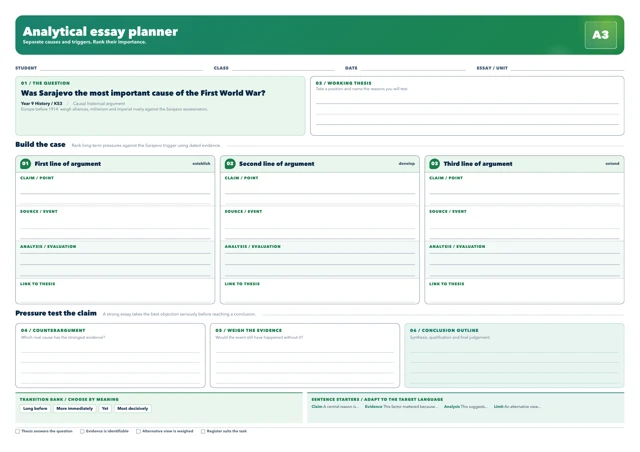
Analytical essay planner
A3
Separate causes and triggers. Rank their importance.
STUDENT CLASS DATE ESSAY / UNIT
01 / THE QUESTION 02 / WORKING THESIS
Take a position and name the reasons you will test.
Was Sarajevo the most important cause of the First World War?
Year 9 History / KS3 / Causal historical argument
Europe before 1914: weigh alliances, militarism and imperial rivalry against the Sarajevo assassination.
Build the case
Rank long-term pressures against the Sarajevo trigger using dated evidence.
01 First line of argument establish 02 Second line of argument develop 03 Third line of argument extend
CLAIM / POINT CLAIM / POINT CLAIM / POINT
SOURCE / EVENT SOURCE / EVENT SOURCE / EVENT
ANALYSIS / EVALUATION ANALYSIS / EVALUATION ANALYSIS / EVALUATION
LINK TO THESIS LINK TO THESIS LINK TO THESIS
Pressure test the claim
A strong essay takes the best objection seriously before reaching a conclusion.
04 / COUNTERARGUMENT 05 / WEIGH THE EVIDENCE 06 / CONCLUSION OUTLINE
Which rival cause has the strongest evidence? Would the event still have happened without it? Synthesis, qualification and final judgement.
TRANSITION BANK / CHOOSE BY MEANING SENTENCE STARTERS / ADAPT TO THE TARGET LANGUAGE
Claim A central reason is... Evidence This factor mattered because... Analysis This suggests... Limit An alternative view...
Long before More immediately Yet Most decisively
Thesis answers the question Evidence is identifiable Alternative view is weighed Register suits the task
A teaching sequence
Develop a historical argument that answers the question, supports claims with identifiable evidence and weighs an alternative cause before reaching a judgement.
Set a provisional judgement
State a provisional answer to the Sarajevo question and identify the factors the essay will compare.
Which causes will you weigh against the Sarajevo trigger?
Build three supported arguments
Build three lines of argument. For each, record a claim, an identifiable source or event, analysis and a link back to the thesis.
Can another reader identify the source or event supporting each claim?
Test the strongest rival cause
Name the strongest rival explanation, then use the counterargument prompt to test whether the judgement accounts for it fairly.
Does your argument take the best alternative explanation seriously?
Qualify the conclusion
Weigh the evidence and outline a conclusion that qualifies the final judgement rather than repeating the opening claim. Test whether removing the chosen factor changes the judgement, then compare that result with the evidence and alternative.
Would your judgement change if this factor were absent?
Before you teach
Look for the thinking behind an answer, choose the support your class needs and leave room for an independent response.
What to look for
Look for a thesis that answers the question, evidence attached to each claim, explanation of significance and a considered alternative. Ask: “Would your judgement change if this factor were absent?” The planner structures an argument but cannot verify historical evidence supplied from elsewhere.
Give a little support
Offer a small set of teacher-checked sources and a paragraph frame with “claim”, “evidence” and “because”. Let pupils discuss one causal link aloud before writing, while keeping the alternative-cause prompt available for the whole class.
Take the idea further
Ask pupils to rank the causes by timescale and explain how a long-term condition and an immediate trigger may interact. They can revise the thesis after comparing the strongest evidence for and against the Sarajevo claim.
Things to keep in mind
The planner supports argument structure but does not check historical claims. Teachers should supply reliable evidence and review how pupils interpret it.
Keep the idea. Make it yours.
Bring your topic, learning goal and class context to PLAI™, then review what you create.
Another starting point
Explore a different teaching task from this selection.
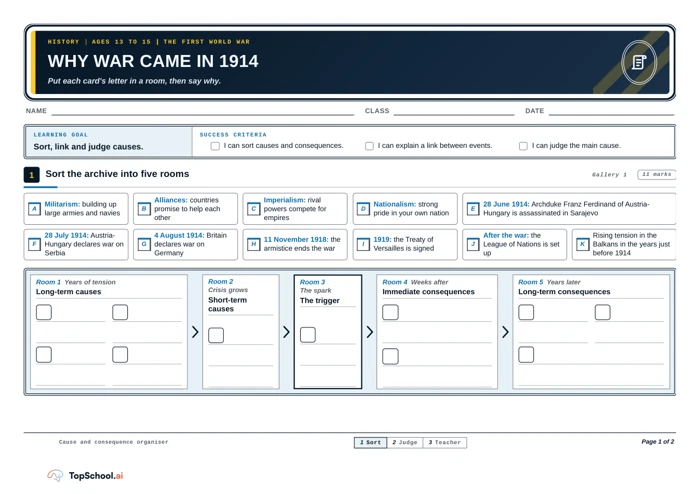
Why war came in 1914: cause and consequence organiser
Read the five room labels and sort the lettered cards by the timescale or role each one describes.
Explore resourceIdeas to try with your class
Sample teaching perspectives on what to try, what to adapt and what to watch for.
Meet The Creators
Meet the creators whose teaching interests connect with this template. Find an approach to try with your class.

Erik Halvorsen-Ruiz
I often begin a unit with two sources that disagree, because that gives pupils something to examine before I offer a narrative.
Meet the creator
Rachel Ncube
I look for scaffolds that help pupils with different reading needs work on a shared historical question, without changing the question into several unrelated tasks.
Meet the creator
Aidan Fitzgerald
I connect retrieval across History and Geography while preserving their distinct evidence methods, helping pupils see whether they are recalling a concept, analysing a source or processing fieldwork data.
Meet the creator
Joseph Turing
I want scaffolds that help pupils access a source at different reading levels while keeping the question and historical method intact.
Meet the creator
Clear Example
The Sarajevo question is followed by a thesis, three claim-evidence-analysis links, a counterargument and a judgement. The final pressure test asks whether the event would still have occurred without a rival cause, directing pupils to weigh trigger against longer-term pressure.
Calm Table
This Year 9 history planner makes causal ranking the work: alliances, militarism and imperial rivalry are tested against Sarajevo rather than listed as parallel facts. The transition bank helps sequence claims, while the conclusion outline returns to the chosen thesis.
Paperclip Perspective
The claim, source/event, analysis and thesis-link boxes give pupils a repeatable structure for each body point. A teacher can model one completed line first, showing how a dated event supports reasoning rather than filling the whole planner for them.
Storytime Sidekick
The planner names possible causes but supplies no historical evidence set. Pupils need reliable sources and dates before ranking explanations; the organiser itself cannot establish that one factor was more important than another.