
Languages and literacy
Analytical essay planner: how reports frame a school travel trial
For Year 9 English and Media pupils, plan a multi-paragraph essay that compares how two fictional reports frame the same school travel proposal for different readers.
Read the material
For Year 9 English and Media pupils, plan a multi-paragraph essay that compares how two fictional reports frame the same school travel proposal for different readers.
Pupil worksheet. Use the preview for diagrams and layout.
Page 1
Analytical essay planner: how reports frame a
school travel trial
Pupil activity
Audience: Year 9 English and Media pupils
Plan a multi-paragraph essay that compares how two fictional reports frame the same school travel proposal
for different readers.
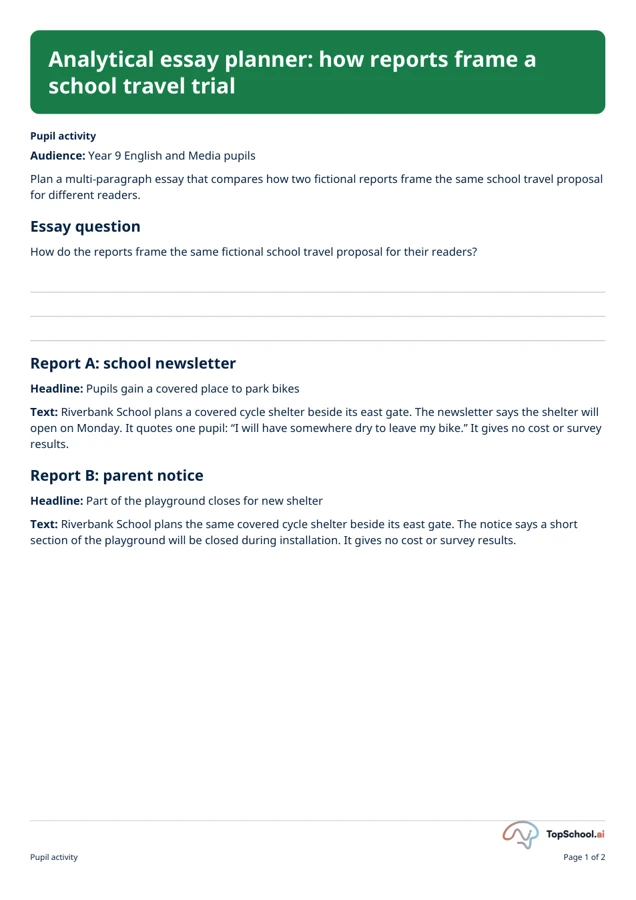
Essay question
How do the reports frame the same fictional school travel proposal for their readers?
Report A: school newsletter
Headline: Pupils gain a covered place to park bikes
Text: Riverbank School plans a covered cycle shelter beside its east gate. The newsletter says the shelter will
open on Monday. It quotes one pupil: “I will have somewhere dry to leave my bike.” It gives no cost or survey
results.
Report B: parent notice
Headline: Part of the playground closes for new shelter
Text: Riverbank School plans the same covered cycle shelter beside its east gate. The notice says a short
section of the playground will be closed during installation. It gives no cost or survey results.
Pupil activity
Page 1 of 2
Page 2
Analytical essay planner: how reports frame a school travel trial
Plan a full essay
Paragraph
Plan: point, evidence, explanation and link
Introduction and thesis
Report A: headline and audience
Report B: headline and audience
Comparison and alternative view
Conclusion
Use precise evidence such as “covered place” and “playground closes”. Explain what each phrase foregrounds
and what the short reports leave unanswered.
Pupil activity
Page 2 of 2
A teaching sequence
Plan a multi-paragraph essay that compares how two fictional reports frame the same school travel proposal for different readers.
Frame the essay's judgement
Write a thesis that answers how the reports frame the proposal.
What difference in emphasis will your thesis explain?
Plan evidence for both reports
Plan one paragraph for each report using a short quotation as evidence.
What does each headline foreground for its reader?
Compare fact and emphasis
Compare one shared fact and one difference in emphasis.
Which fact appears in both reports, and which detail changes the focus?
Consider another reading
Add an alternative reading and a conclusion that returns to the question.
How do the missing cost and survey details limit your conclusion?
Before you teach
Look for the thinking behind an answer, choose the support your class needs and leave room for an independent response.
What to look for
A defensible thesis might say the newsletter emphasises convenience while the parent notice foregrounds disruption; “covered place” and “path closes” support that reading. Ask, “Which detail could complicate your view?”
Give a little support
Use the paragraph table and the frames “The headline foregrounds _____” and “This may lead readers to _____”.
Take the idea further
Evaluate whether either report gives enough evidence to judge the whole proposal.
Things to keep in mind
Both reports are invented classroom texts. They describe no real school, scheme or measured outcome; check assessed terminology against the course specification.
Keep the idea. Make it yours.
Bring your topic, learning goal and class context to PLAI™, then review what you create.
Ideas to try with your class
Sample teaching perspectives on what to try, what to adapt and what to watch for.
Meet The Creators
Meet a creator whose teaching interests connect with this template.

Quietly Curious
Both reports describe the same planned cycle shelter, but the newsletter foregrounds a dry place for a pupil’s bike while the parent notice highlights a playground closure. The planner asks pupils to connect those wording choices to different readers.
Bright Margins
The two-page scaffold builds from thesis to separate report analysis, comparison, alternative view and conclusion. Because neither fictional report gives cost or survey results, pupils can examine framing without mistaking the proposal for a proven outcome.
Chalk Dust & Checklists
The prompt supplies exact phrases such as “covered place” and “playground closes” for close comparison. Pupils can annotate what each headline brings forward, then use the paragraph plan to explain how the same proposal is presented differently.
Good Question
The texts are fictional and omit costs and survey evidence; they show contrasting emphasis, not actual school opinion or impact. Extend the task by asking what evidence would be needed to judge the proposal’s reception or practical effect.