
Wellbeing and personal development
All about me activity sheet
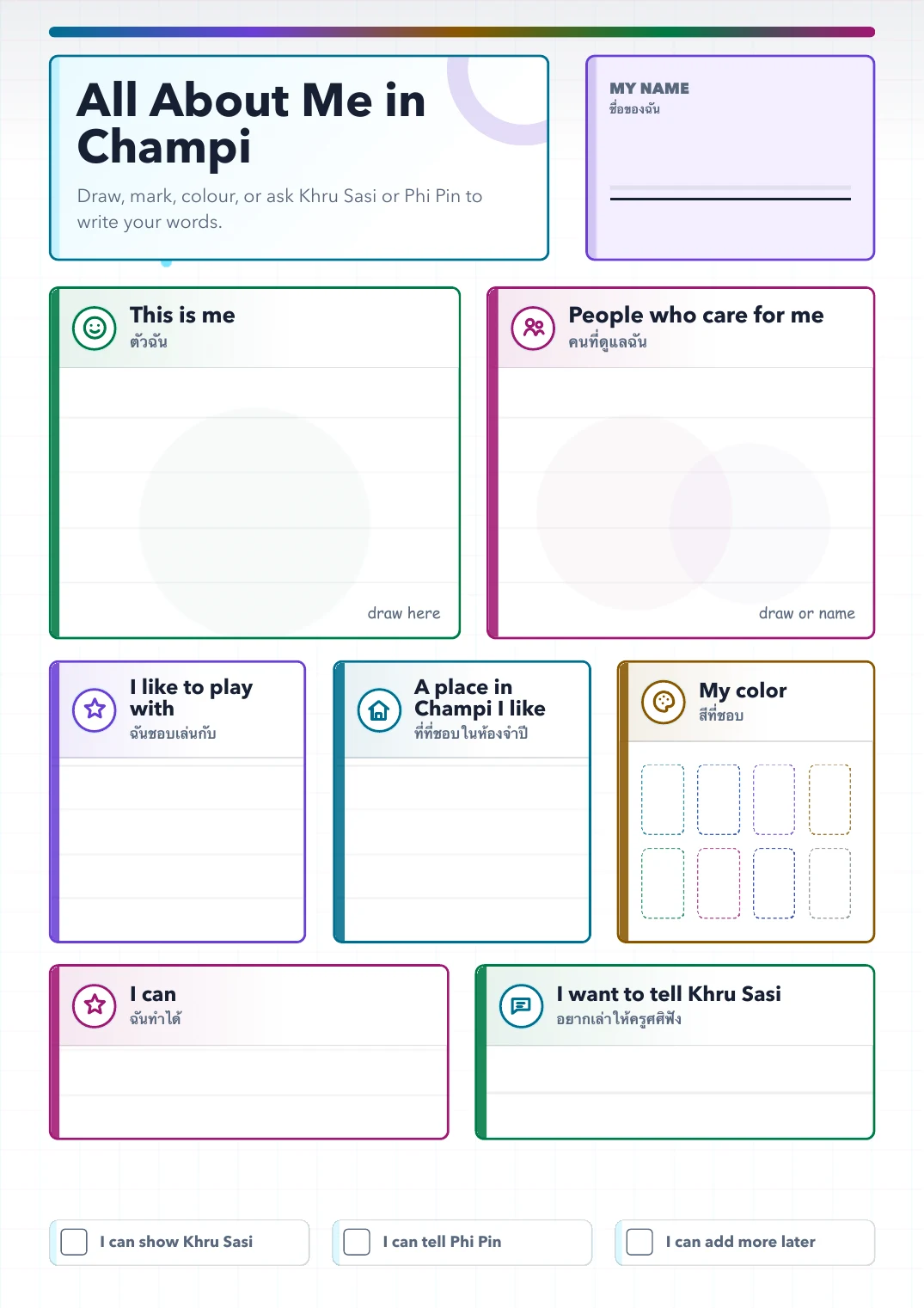
Invite a child to represent themselves through drawing, words or colour, with English and Thai prompts on one page. The sheet offers ways to share a name, interests and a message, while allowing an adult to write when that is more accessible.
Read the material
Invite a child to represent themselves through drawing, words or colour, with English and Thai prompts on one page. The sheet offers ways to share a name, interests and a message, while allowing an adult to write when that is more accessible.
Complete resource. Use the preview for diagrams and layout.
Page 1
MY NAME
ชื่อของฉัน
I can show Khru Sasi
 I can tell Phi Pin
 I can add more later
All About Me inChampi
Draw, mark, colour, or ask Khru Sasi or Phi Pin to
write your words.
This is me
ตัวฉัน
draw here
People who care for me
คนที่ดูแลฉัน
draw or name
I like to playwith
ฉันชอบเล่นกับ
A place inChampi I like
ที่ที่ชอบในห้องจำปี
My color
สีที่ชอบ
I can
ฉันทำได้
I want to tell Khru Sasi
อยากเล่าให้ครูศศิฟัง
A teaching sequence
Choose a way to communicate selected facts, interests or ideas about oneself through drawing, colour, speech or writing.
Choose how to begin
Let the child choose whether to write their name, draw themselves or ask an adult to write it.
Would you like to draw, mark, speak or leave this part blank?
Draw yourself and your people
Offer the drawing spaces for a self-portrait and for people who care for them, without requiring names or explanations.
Would you like to use the drawing space without names or explanations?
Select what to answer
Invite the child to choose which prompts to answer about play, a favourite place or colour, and something they can do.
Which interest or skill, if any, would you like to show?
Choose whether to share
Ask whether there is anything they want to tell Khru Sasi, then let them choose to share it, tell Phi Pin or add more later. Accept pointing, drawing, words or a blank response.
Would you like to tell me about this part, or add more later?
Before you teach
Look for the thinking behind an answer, choose the support your class needs and leave room for an independent response.
What to look for
Notice whether the child can choose a response mode and communicate one idea they wish to share. A drawing, spoken answer or adult-scribed phrase can each be a valid response. Ask: “Would you like to tell me about this part?” Accept a refusal or a blank field without treating it as a deficit.
Give a little support
Reduce the number of prompts and let the child select which ones to answer. Offer large drawing space, familiar spoken language and an adult scribe if wanted. Do not require a child to name family members or disclose anything they would rather keep private.
Take the idea further
If the child chooses, invite them to add a new detail later or share one part with a trusted person. Keep the emphasis on the child’s choice, not on collecting a complete personal profile or comparing disclosures between pupils.
Things to keep in mind
The page contains personal prompts about identity, interests and people who care for the child. Participation and each answer should be optional. The sheet does not include teacher guidance, and its classroom-specific names and bilingual text need local review before wider distribution.
Keep the idea. Make it yours.
Bring your topic, learning goal and class context to PLAI™, then review what you create.
Ideas to try with your class
Sample teaching perspectives on what to try, what to adapt and what to watch for.
Meet The Creators
Meet the creators whose teaching interests connect with this template. Find an approach to try with your class.

Sasithorn Bunyarat
I want activities to be practical and sensitive to the group’s readiness, with space for the teacher to adjust the pace.
Meet the creatorYupin Tha-ngam
I can contribute observations and practical ideas, while the teacher brings the wider context and decides what belongs in the plan.
Meet the creator
Kindly Red Pen
The bilingual prompts invite a name, people who care for the pupil, play interests, a favourite place or colour, something they can do and something they want to tell a named adult. Drawing, marking, colouring or asking an adult to write are all stated options.
Pocketful of Stories
This is a communication activity grounded in the Champi classroom names Khru Sasi and Phi Pin, not a generic assessment of writing. The “I can show” and “I can tell” prompts make room for a pupil to communicate without completing every box in prose.
Pencil Case Pal
A pupil can respond with a drawing, colour choice, mark or dictated words, with the named adults available to write. Offer the prompts selectively so the pupil can choose what to share and how to represent it.
Glue Stick Club
The “People who care for me” and “I can” areas invite personal details and drawings, so let the pupil choose what to complete and handle the page as personal information. Start a follow-up with a drawing the child chooses to share.