
Planning template
Action proposal planner
Turn a researched school or community issue into a proposal that can be discussed and tested. The A4 working sheet and A3 planning canvas prompt pupils to gather evidence, identify people, plan actions and resources, and revisit the decision.
Read the material
Turn a researched school or community issue into a proposal that can be discussed and tested. The A4 working sheet and A3 planning canvas prompt pupils to gather evidence, identify people, plan actions and resources, and revisit the decision.
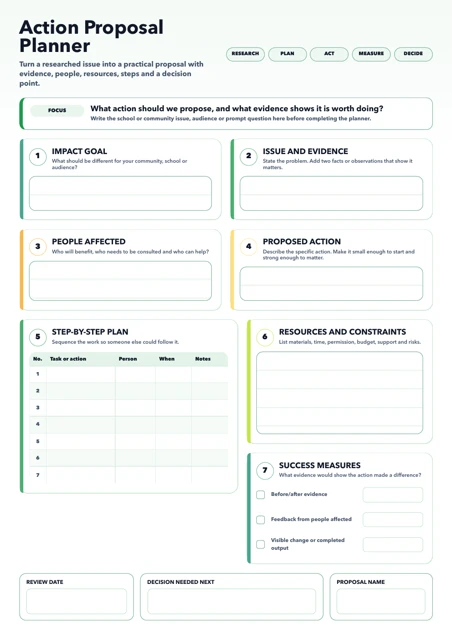
Pupil working sheet, A4. Use the preview for diagrams and layout.
Page 1
Action Proposal
Planner
RESEARCH PLAN ACT MEASURE DECIDE
Turn a researched issue into a practical proposal with
evidence, people, resources, steps and a decision
point.
What action should we propose, and what evidence shows it is worth doing?
FOCUS
Write the school or community issue, audience or prompt question here before completing the planner.
IMPACT GOAL ISSUE AND EVIDENCE
1 2
What should be different for your community, school or State the problem. Add two facts or observations that show it
audience? matters.
PEOPLE AFFECTED PROPOSED ACTION
3 4
Who will benefit, who needs to be consulted and who can help? Describe the specific action. Make it small enough to start and
strong enough to matter.
STEP-BY-STEP PLAN RESOURCES AND CONSTRAINTS
5 6
Sequence the work so someone else could follow it. List materials, time, permission, budget, support and risks.
No. Task or action Person When Notes
1
2
3
4
5
6
SUCCESS MEASURES
7
7 What evidence would show the action made a difference?
Before/after evidence
Feedback from people affected
Visible change or completed
output
REVIEW DATE DECISION NEEDED NEXT PROPOSAL NAME
Page 1
Action Proposal Canvas
UNDERSTAND DESIGN MOBILISE ACT REVIEW
A shared planning board for turning research into a realistic school or community
action proposal.
Action focus or prompt question
FOCUS
Use this space to name the issue, target audience, proposed campaign, local challenge or teacher-set question.
THE CHANGE WE WANT PROPOSED LOCAL ACTION RESOURCES
1 4 6
Name the improvement in one sentence. Make the action concrete: what will happen, where, how often and with whom? What materials, time, space, permission, money or
expertise are needed?
IMPLEMENTATION PLAN
5
Break the proposal into tasks that can be assigned and reviewed.
No. Task or action Owner Start Finish Evidence or notes
EVIDENCE BASE
2 SUCCESS EVIDENCE
What research, observations or data justify the 7
proposal? 1 How will the team know the action worked?
2
3
4
5
6
7
PEOPLE MAP 8 8 NEXT DECISION
3
What will be approved, changed or tried next after
Beneficiaries, decision-makers, supporters and
review?
possible blockers.
BENEFITS APPROVES HELPS
RESEARCH CONNECT PLAN ACT REFLECT
Understand the issue Work with people affected Design realistic action Start small and record evidence Improve the next step
A teaching sequence
Produce a proposal that connects a defined issue and evidence with a specific action, named people or resources, and evidence to review before a next decision.
Define the issue
Name the issue and the people affected. Separate the question the group is investigating from a solution it has not yet tested.
Which question are you investigating before choosing a solution?
Gather evidence and people
Add two facts or observations that show why the issue matters, then list people to consult, people who can help and any decision-makers.
Which two facts show why the issue matters to these people?
Plan a realistic action
Describe one realistic action and sequence the work so another person could follow it. Add materials, permission, time, costs or risks that need checking.
What permission or resource still needs checking before you begin?
Agree how to review
Choose evidence to review, set a review date and state what decision the group will make next. Agree what will be recorded and who will judge whether the action helped.
What will you record, and who should judge whether the action helped?
Before you teach
Look for the thinking behind an answer, choose the support your class needs and leave room for an independent response.
What to look for
Look for a proposal that connects a stated issue to evidence, identifies people affected and describes actions another person could carry out. Ask: “What will you record to tell whether this action made a difference, and who should be part of that judgement?” A completed plan is not evidence that an action succeeded.
Give a little support
Model one neutral example of the difference between a problem, evidence and a proposed action. Provide a planning partner or sentence stems such as “We observed…”, “We could try…” and “We will review…”. Keep consent, permissions, money and safety decisions with the responsible adults.
Take the idea further
Ask the group to compare two possible actions against the evidence, people affected, resources and risks. They can refine one success measure and decide what evidence would be strong enough to continue, adapt or stop the proposal.
Things to keep in mind
The planner helps pupils organise a proposal, but it cannot supply research, stakeholder permission or evidence that an action will work. Treat the success measures as planning prompts, not proof of impact.
Keep the idea. Make it yours.
Bring your topic, learning goal and class context to PLAI™, then review what you create.
Ideas to try with your class
Sample teaching perspectives on what to try, what to adapt and what to watch for.
Meet The Creators
Meet the creators whose teaching interests connect with this template. Find an approach to try with your class.

Helena Marsh
Time is limited, so I want to remove tasks that do not help and give staff space to concentrate on the work that matters.
Meet the creator
Tomás Ferreira Lima
I ask pupils to work with an argument they do not agree with, find evidence for it and explain it in a way its supporter would recognise.
Meet the creator
Bright Idea Break
The planner connects an issue and two supporting facts to affected people, a specific action, a sequenced plan, resources and a decision date. Its fields make the proposal traceable from evidence to the next choice rather than stopping at an idea.
After the Bell
This suits project work once pupils have researched a school or community issue. The seven-row action table asks who will do what and when, while the review date and decision field give the proposal a practical endpoint.
Pencil Case Pal
Pupils can draft the issue and action orally before filling the planner, then use one row per step. A shared example can clarify the difference between evidence of a problem and a prediction about what the proposed action may change.
Chalk Dust & Checklists
A completed planner is a proposal, not approval to act or proof that the action will work. Before implementation, an adult should review permissions, affected groups, resources and how the impact measure will be gathered.