
Languages and literacy
A tiny story: find the important details
For Early Years children aged 3 to 5 with adult support, retell one event and link an idea about the character to a word or action in an original story.
Read the material
For Early Years children aged 3 to 5 with adult support, retell one event and link an idea about the character to a word or action in an original story.
Pupil document. Use the preview for diagrams and layout.
Page 1
Teaching template
1
A tiny story: find the important details
Audience: Early Years children aged 3 to 5 with adult support
Retell one event and link an idea about the character to a word or action in an original story.
Story
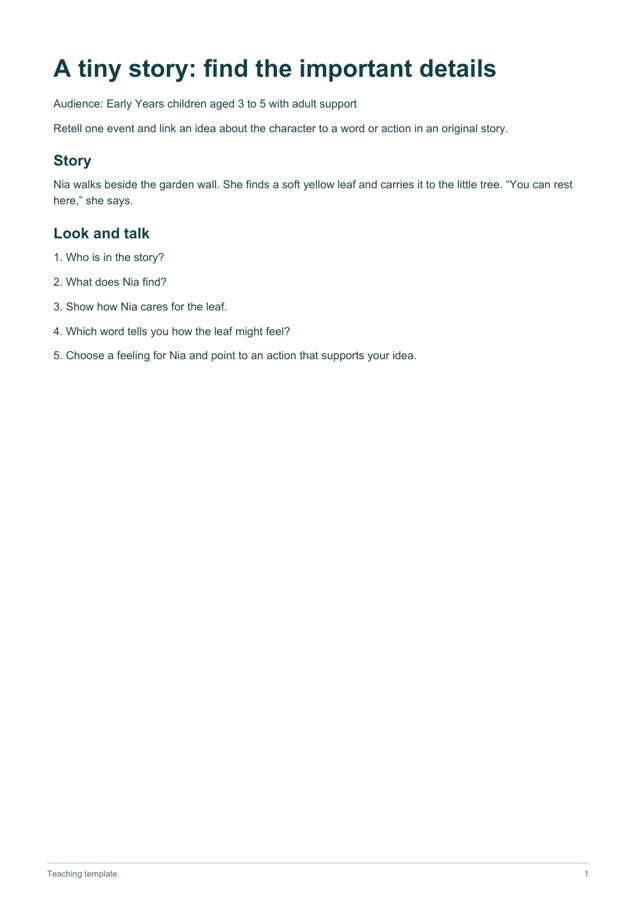
Nia walks beside the garden wall. She finds a soft yellow leaf and carries it to the little tree. “You can rest
here,” she says.
Look and talk
1. Who is in the story?
2. What does Nia find?
3. Show how Nia cares for the leaf.
4. Which word tells you how the leaf might feel?
5. Choose a feeling for Nia and point to an action that supports your idea.
A teaching sequence
Retell one event and link an idea about the character to a word or action in an original story.
Retell who and where
Retell who is in the story and where Nia is.
Where is Nia when she finds the leaf?
Point to the caring action
Point to the action that shows what Nia does with the leaf.
What does Nia do with the leaf?
Describe the leaf
Say the phrase “soft leaf” together. Ask the child to point to the word that describes how the leaf might feel.
Which word tells you how the leaf might feel?
Connect a feeling to a clue
Choose a feeling for Nia and point to a story clue.
What action supports the feeling you chose for Nia?
Before you teach
Look for the thinking behind an answer, choose the support your class needs and leave room for an independent response.
What to look for
A useful response names a detail, such as Nia carrying the leaf carefully. Ask, “What did Nia do that makes you think that?”
Give a little support
Use a leaf picture, act out “find” and “carry”, and offer two feeling words instead of requiring writing.
Take the idea further
Change the final sentence and tell how the new ending changes Nia's action.
Things to keep in mind
The story is an original short example. Different interpretations are welcome when linked to a word or action.
Keep the idea. Make it yours.
Bring your topic, learning goal and class context to PLAI™, then review what you create.
Ideas to try with your class
Sample teaching perspectives on what to try, what to adapt and what to watch for.
Meet The Creators
Meet a creator whose teaching interests connect with this template.

Gentle Reminder
This one-page original story follows Nia as she finds a soft yellow leaf and carries it to a little tree. Four questions ask who is present, what she finds, how she cares for it and which word suggests how it might feel.
Page-Turner Planner
The short text supports retelling one event and connecting an idea about Nia to a word or action. “Soft” and “You can rest here” give children details to notice without requiring a long passage.
Bright Margins
Read the story aloud, let children point to or repeat a detail, then ask how it supports an idea about Nia. Accept an oral response or gesture before expecting a written explanation.
Kind Check-In
The story is an original fictional text, not an observation of a real child or animal. The leaf's possible feeling is imaginative interpretation; distinguish that from the literal details in the story.