Same topic, a more demanding question
Compare two fair-test questions and see what changes when pupils must judge, revise and explain a plan.
On this page4 sections
A pupil can name the variable in an investigation. Your next question can ask them to judge whether the plan will actually test it. In this illustrative science example, the investigation stays familiar while the answer must show more: identify a problem, revise the plan and explain why the change matters.
Compare the questions
Illustrative question revision
The plan and both questions below are prepared examples for discussion, not a record of pupil work or a completed experiment.
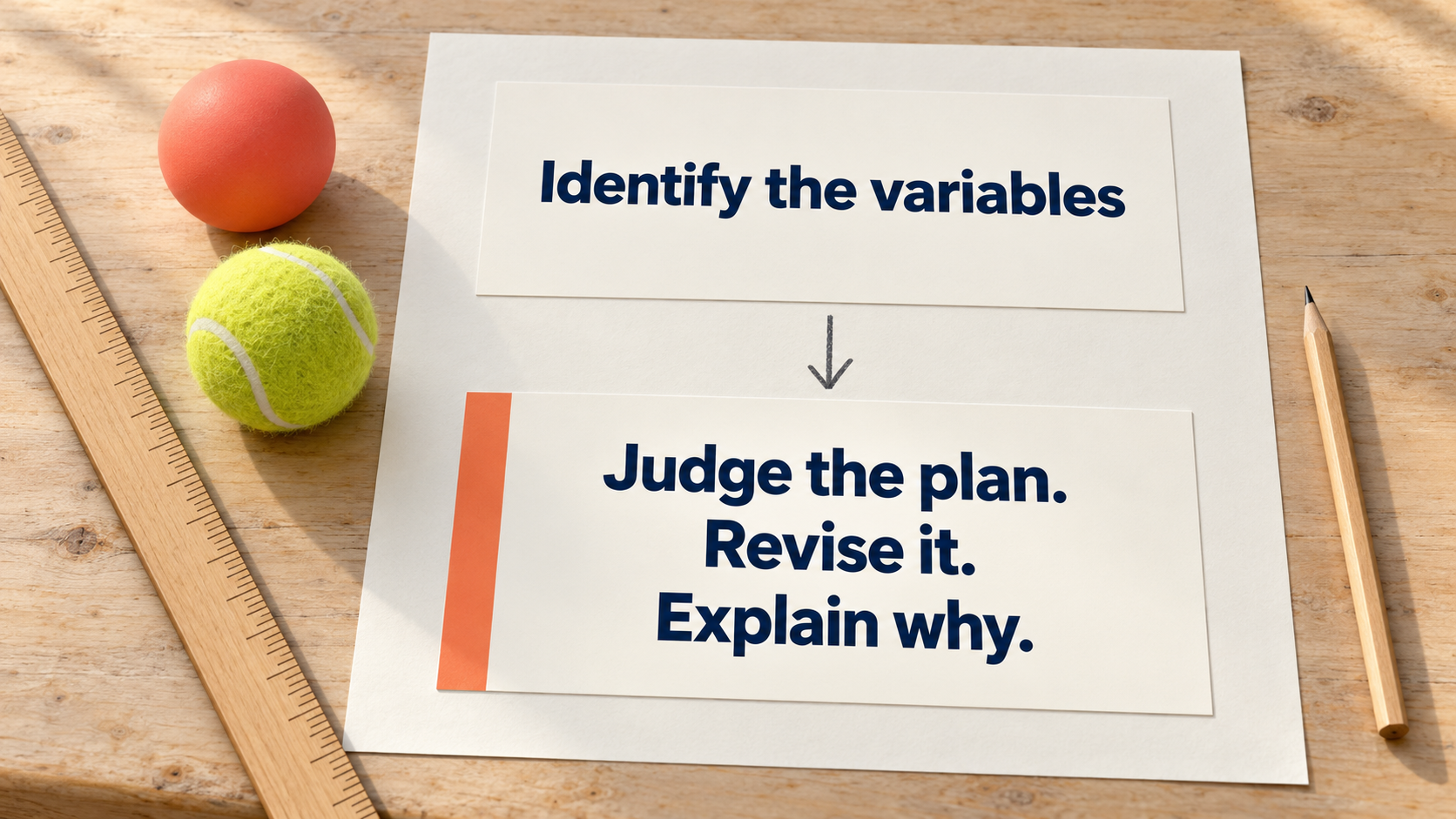
Investigate whether drop height affects bounce height. Drop a rubber ball from 20 cm and a tennis ball from 60 cm, measuring how high each bounces. Keep the floor, release technique and measuring method the same.
Starting question
Which variable is the investigation intended to change, and what will be measured?
Revised question
Can this plan test the effect of drop height on bounce height fairly? Identify the problem, revise the plan and explain why your change matters.
Keep the shared plan visible for both questions. Pupils need to understand drop height, bounce height and the roles of variables before tackling the comparison. This is a planning discussion; no results are supplied.
What changes in the question
The starting question accepts two names: drop height and bounce height. The revision requires pupils to inspect the plan and explain whether it can answer the investigation question.
Science Buddies’ guidance on variables distinguishes identifying variables from explaining how they support a fair test. Our comparison makes that difference explicit in the response required.
A pupil may already notice the problem while answering the first question. The revision asks them to make that thinking visible. Extra wording alone does not make a question more demanding.
What a sufficient answer shows
Drop height is the intended independent variable; bounce height is the dependent variable being measured. But the plan also changes the ball. If the bounce heights differ, this comparison cannot tell us whether the difference is due to drop height, the ball, or both.
A sufficient answer identifies that problem, proposes using the same ball at both heights and explains the reason: changing the ball introduces another possible explanation. Keep the same floor, release technique and measuring method too. Primary Connections’ fair-test guidance links the choice of variables to the question an investigation can answer.
Repeating drops at each height would help check consistency. Repeating the mixed-ball comparison would leave its central problem unresolved.
“Use the same ball” is a useful correction, but the revised question also asks why. Pupils could explain aloud, annotate the plan or write a response. Judge whether their explanation connects the correction to the investigation question.
The two-page Planning a fair test worksheet below shows this correction in context. Its model changes drop height and measures bounce height while keeping the same ball, floor, measuring method and person reading the ruler. Compare those controls with the mixed-ball plan above, then ask pupils to explain why keeping the ball the same matters.
Open the two-page worksheet PDF
Try the edit with one question
Choose a familiar question and decide what reasoning you want an answer to show. Keep the scenario and necessary support available, then work through a satisfactory response before using the revision.
When checking what a worksheet asks pupils to do, look beyond the command word to the answer it requires. Use pupils’ actual explanations to decide what to revisit. One successful response alone does not establish secure understanding.
You can also explore TopSchool for teachers.