Bring one reviewed resource to a department conversation
A worksheet can have a preferred answer and still leave room for judgement. Bring one question about pupils’ reasoning to a colleague.

On this page3 sections
You’ve checked the answers and can see where a worksheet might fit in a lesson. Then you reach a question with more than one answer you could defend. Before you use it, you want to know how a colleague would judge the reasoning.
That’s enough to start a useful department conversation. Bring the worksheet, say what you want pupils to practise, and ask about the point where your own judgement is still unsettled.
Bring the question as well as the map
Take Map reading: Kestrel Vale, a Geography resource built around a fictional place. The first page gives pupils the map; the second moves from grid references and compass directions to explanation and choice.
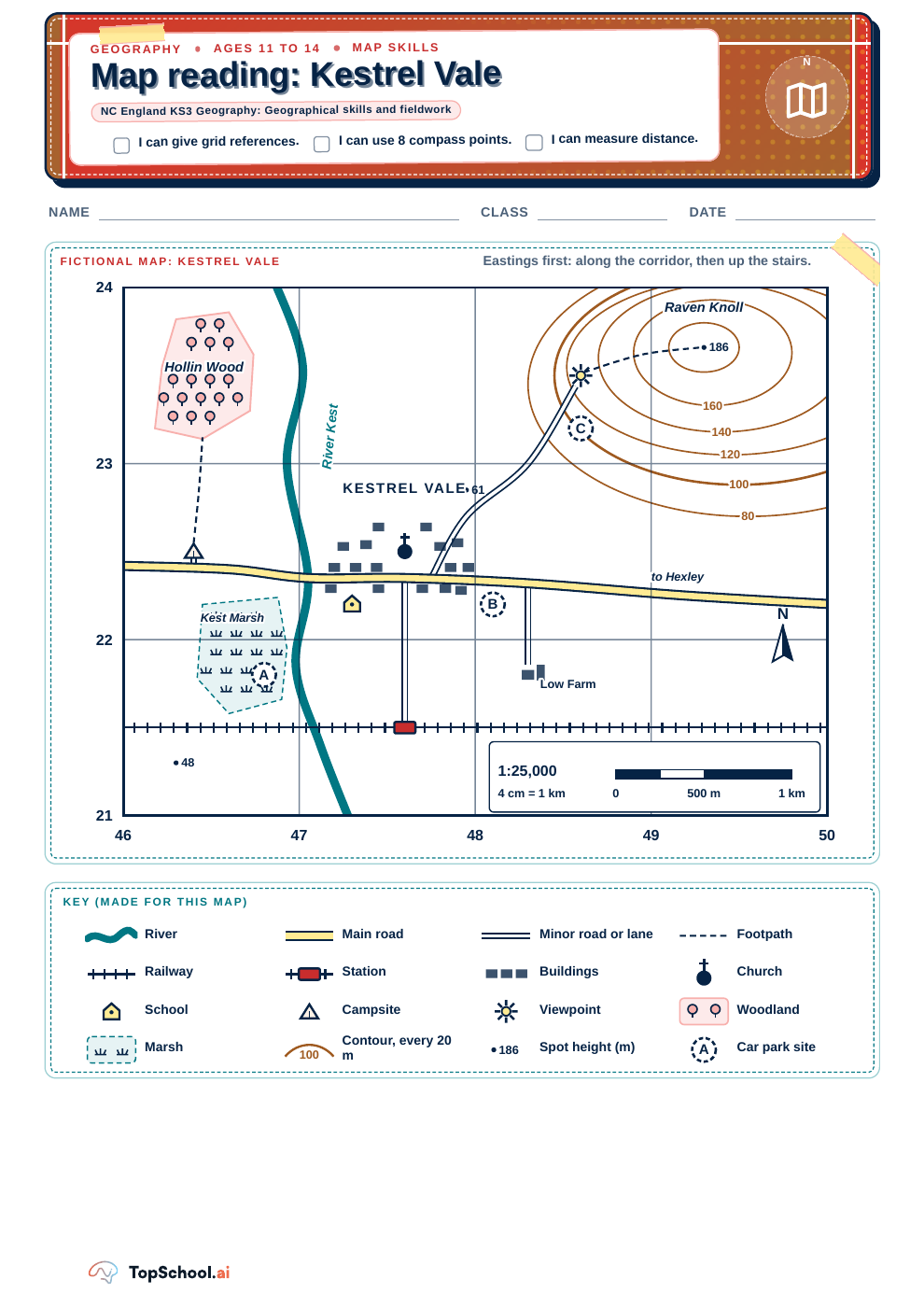
In task 7 on page 2, pupils choose a site for a new car park. They must give a reason for their choice and one against the other sites. You might bring that question to a colleague because you want pupils to explain how they have weighed the map evidence.
The teacher notes identify B as the strongest site. They also say to credit C if a pupil argues for visitors to the viewpoint and names its problems. What would you need to see in the pupil’s explanation before you accepted C?
Decide what makes the reasoning convincing
A pupil could point to the viewpoint to explain the appeal of C. The same answer would need to deal with its position up a narrow lane on a slope. You and your colleague might agree about the preferred site and still differ on whether an explanation has taken those drawbacks seriously enough.
Ask your colleague to look at the map and the guidance with you. Would naming a drawback be enough, or would you expect the pupil to explain how it affects their recommendation? The worksheet already asks for reasons on both sides. Your discussion is about how much explanation would make those reasons persuasive.
Keep the original task beside you while you talk. If you’re considering an extra prompt, let your colleague challenge it. Asking pupils to say how a drawback affects their choice might help, but it could also supply a link you wanted them to make for themselves.
Leave one small question for another look
If your colleague is willing, offer to write that possible prompt and leave it with the original task and notes. They can read it when they have time, with the map in front of them.
You can return to it with a narrower question: does the prompt make the expected explanation clearer, and is that the help you want pupils to have?
Leave room for the answer to change your mind. If the original task already gives pupils the challenge you want, there may be nothing to add.