Concept maps that show how ideas connect
The words between the boxes do much of the work in a concept map. A short science example shows how a more precise link gives you and your pupils something to discuss.

On this page4 sections
“Liquid water” and “water vapour” are familiar labels in a water-cycle lesson. Joining them with a line shows that they belong together, but leaves the relationship unexplained. Add “evaporates into” and you have a statement you can read, question and check: liquid water evaporates into water vapour.
Those few words matter. In Novak and Cañas’s explanation of concept maps, concepts are joined by linking phrases that form meaningful statements. When you’re preparing a map, reading those statements aloud can help you notice where a connection is still vague, even if all the right vocabulary is on the page.
Build a map you can read aloud
The example below starts with one question: How does water change between a liquid and a gas? It fits the evaporation and condensation content in the Year 4 science programme of study in England, once pupils have met both processes and can distinguish liquids from gases.
There are only two concepts here because the relationship between them is the part we want pupils to explain. Rivers, rainfall and clouds would give us more to talk about, but they would also take attention away from the change in each direction.
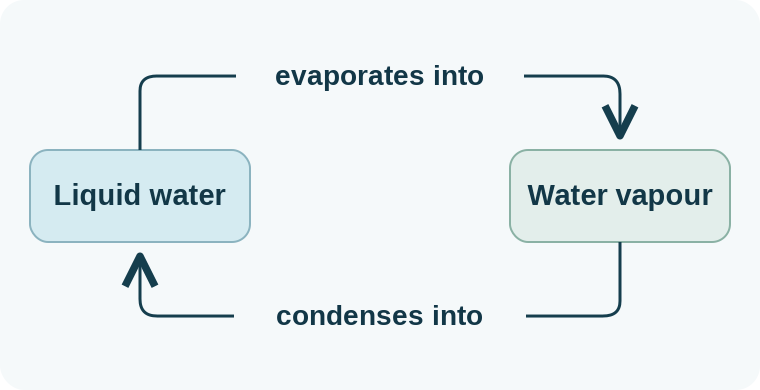
Following the upper arrow gives “Liquid water evaporates into water vapour.” Starting at the other end and following the lower arrow gives “Water vapour condenses into liquid water.” The same two concepts appear in both sentences, but the direction and the phrase change the meaning.
That is also a useful moment to be precise about the science. Water vapour is a gas; the Met Office describes how it condenses into tiny liquid droplets. A visible droplet is liquid water. The map keeps those two states separate and shows the changes between them, rather than trying to represent the whole water cycle.
When a linking phrase leaves too much unsaid
Suppose the upper arrow said “is connected to”. A pupil could read “Liquid water is connected to water vapour” without explaining what happens to the water. The words would fit almost any pair of ideas on the page.
Changing that phrase to “evaporates into” makes a more useful starting point for conversation. You can ask what is changing, then follow the other arrow to talk about condensation. If a pupil begins at liquid water when describing condensation, you have a particular part of the explanation to revisit together.
Sometimes a pupil will offer “turns into” before they remember “evaporates”. Let them explain what they mean. They may understand the change from liquid to gas and need help recalling its name, or they may still be unsure which state comes first. Hearing the whole sentence helps you decide where to begin. If the word itself is the obstacle, the vocabulary-support example explores how to offer help while leaving pupils something to explain.
Hearing the thinking behind a finished map
Once you’ve discussed the example, pupils can draw the two arrows and choose their own phrases. They can also say the relationships aloud while pointing to the concepts, with a word bank or other support they usually use. The explanation is still the part you’re listening for.
A finished map won’t tell you everything on its own. A pupil may have copied a phrase accurately, so it helps to ask them to describe one change without looking at the model. Their response gives you a starting point for deciding whether to spend more time on the science or on finding words to express it.
Trying the same check with a worksheet
The relationships become more varied as a map grows. In the Motion and forces concept map, for pupils aged 14 to 16, the link from force to newtons is already completed. It gives you a useful starting point for discussing why a phrase fits before pupils fill in the gaps around it.
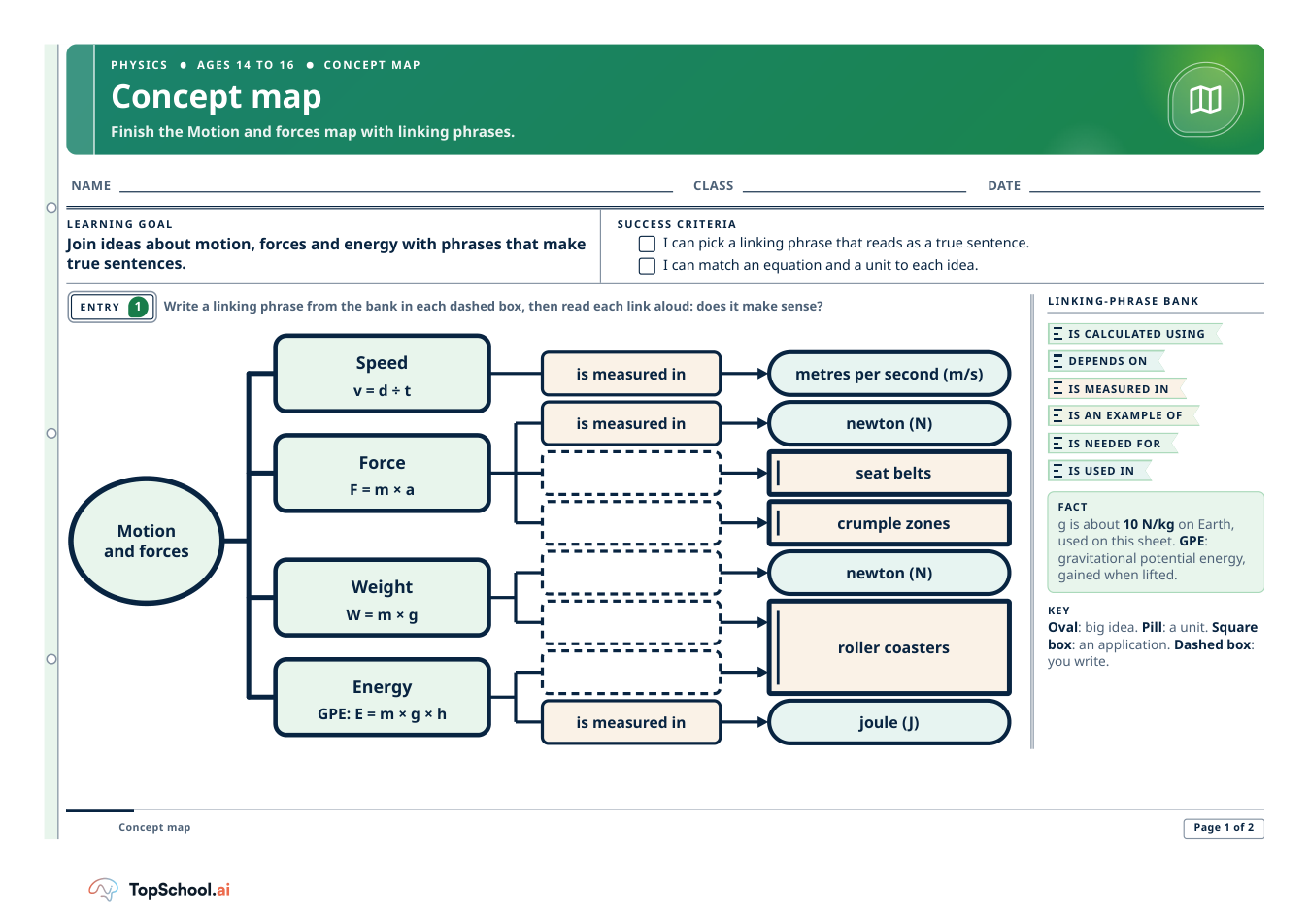
“Force is measured in newtons” connects a quantity to its unit. In the water example, “evaporates into” explains a change. The phrase has a different job in each map, so pupils need to think about what the concepts mean to one another. “Is measured in” won’t explain the relationship between force and acceleration.
The worksheet then leaves room for pupils to build a map of their own, choosing eight ideas from the concept bank. You could pause after their first connection and ask them to read it aloud. That gives you something specific to discuss while the map is taking shape.
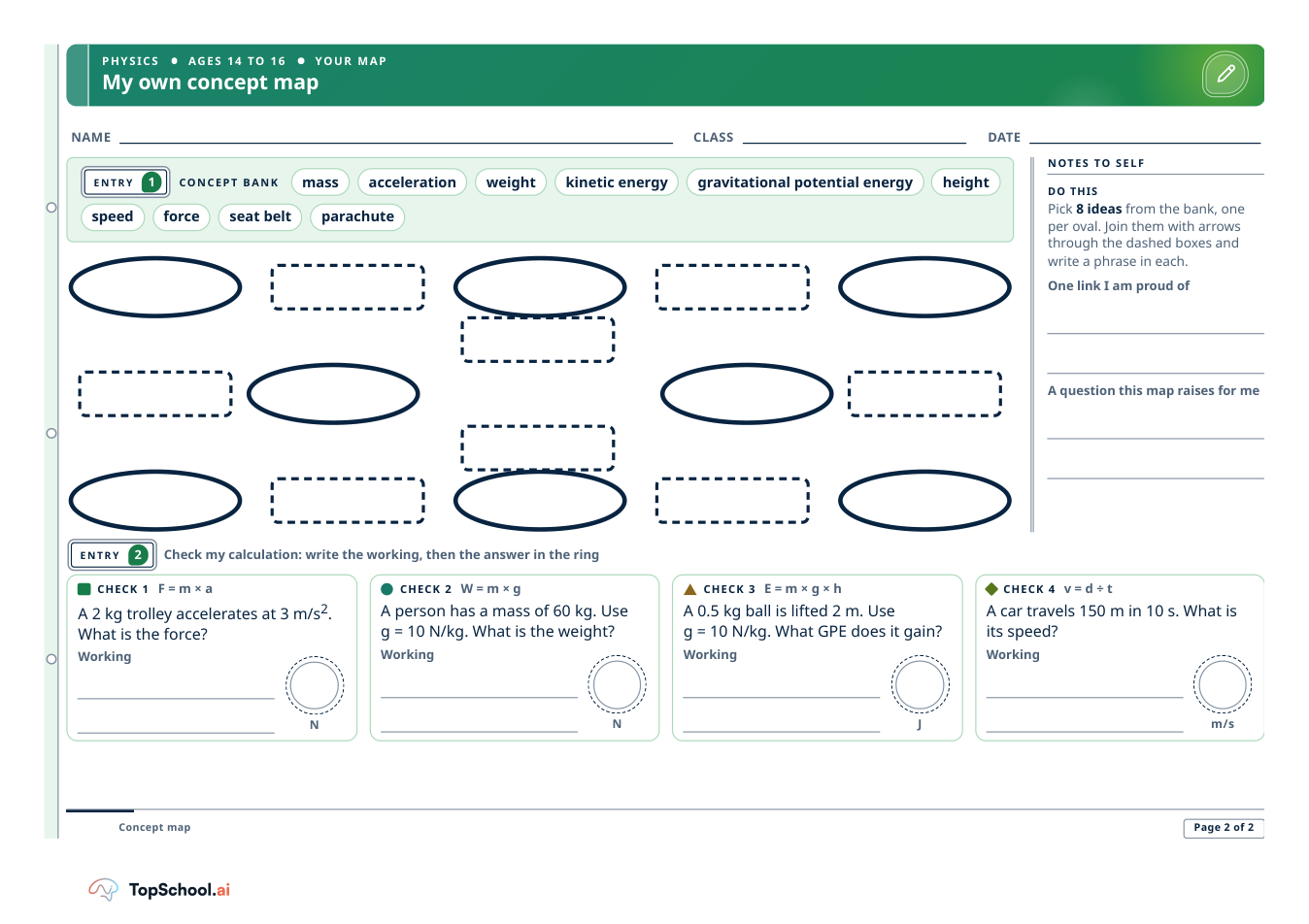
Both worksheet pages above link to the Library item details, where you can check the teaching context and file options. You can also read the complete worksheet at full size as you choose a connection to explore with your class.