
Add vocabulary support without supplying every answer
Use a photosynthesis worksheet to explore what vocabulary support gives pupils, and what you still want them to explain.

On this page4 sections
A pupil may understand the science but get stuck on a word in the question. A short glossary can help them get started. Before you add one, check what it gives them: help with the language, or the answer you want them to work out?
Start with what you want pupils to explain
Imagine your pupils have already studied photosynthesis. You want them to predict which leaf will make glucose under different light conditions, then explain why. Remembering a definition is a different task.
The EEF’s secondary science guidance recommends choosing vocabulary carefully and teaching it in context. Start with the words that might stop pupils from understanding your question.
Look at what the worksheet gives them
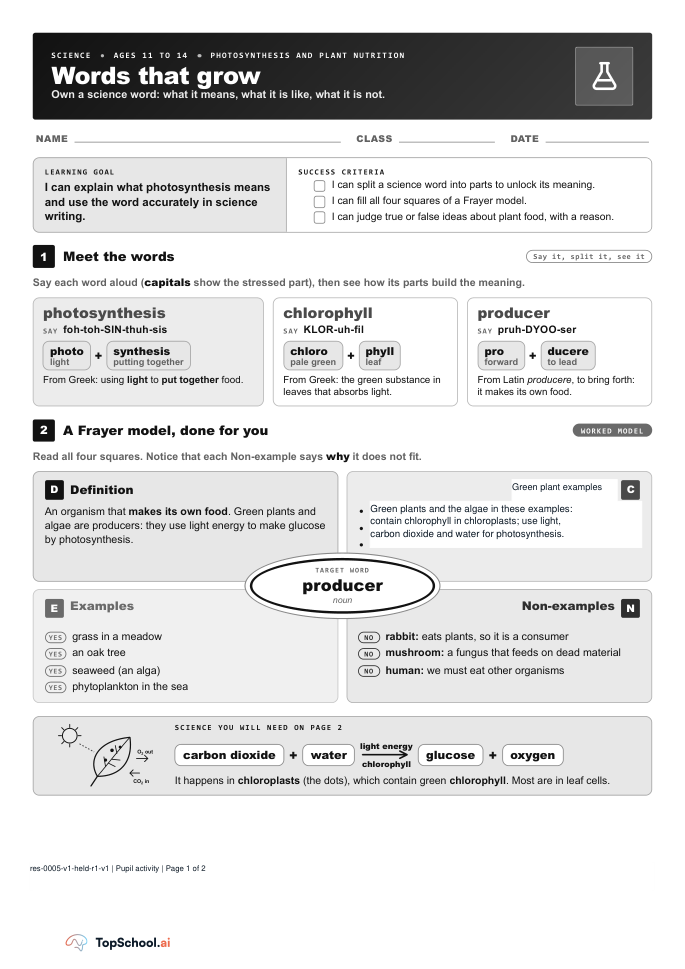
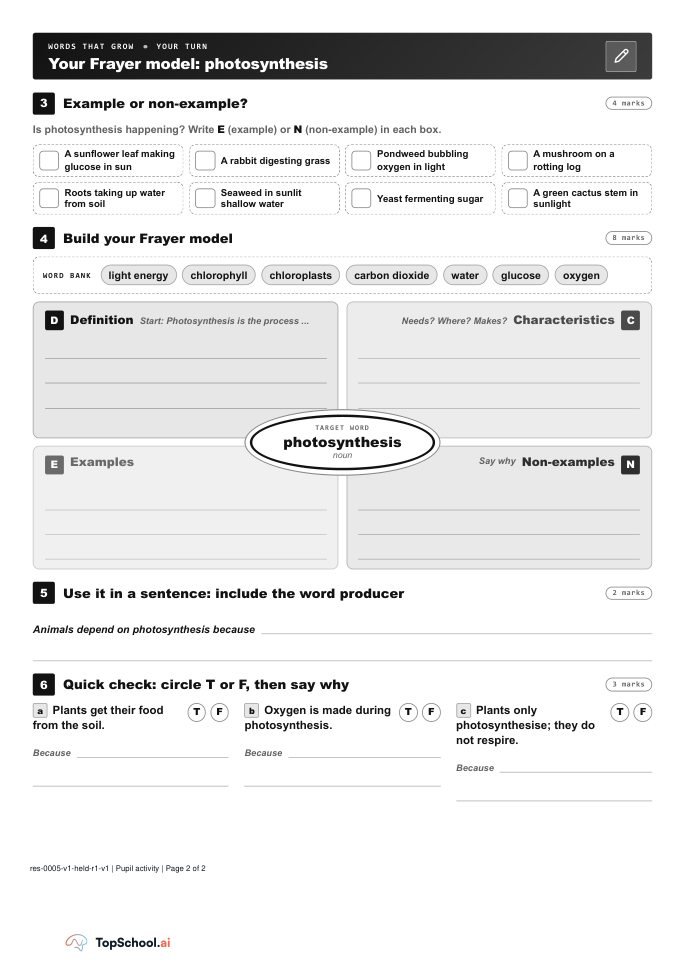
The two-page worksheet below, Words that grow, introduces the vocabulary before asking pupils to build a Frayer model for photosynthesis. This gives them four boxes to explore a word: its definition, characteristics, examples and non-examples.
On page 2, a word bank suggests terms they can use. Pupils still need to explain how those terms fit together. Page 1 goes further: the worked model and word equation already link light energy with glucose production. Keep that in mind if you use the worksheet alongside a question that asks pupils to explain that link for themselves.
Words that grow: Frayer model for photosynthesis
Open the two-page worksheet PDF
Read the worksheet as text
CLASS
DATE
LEARNING GOAL
I can explain what photosynthesis means
and use the word accurately in science
writing.
SUCCESS CRITERIA
I can split a science word into parts to unlock its meaning.
I can fill all four squares of a Frayer model.
I can judge true or false ideas about plant food, with a reason.
1
Meet the words
Say it, split it, see it
Say each word aloud (capitals show the stressed part), then see how its parts build the meaning.
photosynthesis
SAY foh-toh-SIN-thuh-sis
photo
light
+
synthesis
putting together
From Greek: using light to put together food.
chlorophyll
SAY KLOR-uh-fil
chloro
pale green
+
phyll
leaf
From Greek: the green substance in
leaves that absorbs light.
producer
SAY pruh-DYOO-ser
pro
forward
+
ducere
to lead
From Latin producere, to bring forth:
it makes its own food.
2
A Frayer model, done for you
WORKED MODEL
Read all four squares. Notice that each Non-example says why it does not fit.
O2 out
CO2 in
SCIENCE YOU WILL NEED ON PAGE 2
carbon dioxide
+
water
light energy
chlorophyll
glucose
+
oxygen
It happens in chloroplasts (the dots), which contain green chlorophyll. Most are in leaf cells.
SCIENCE
AGES 11 TO 14
PHOTOSYNTHESIS AND PLANT NUTRITION
Words that grow
Own a science word: what it means, what it is like, what it is not.
D
Definition
An organism that makes its own food. Green plants and
algae are producers: they use light energy to make glucose
by photosynthesis.
C
E
Examples
YES
grass in a meadow
YES
an oak tree
YES
seaweed (an alga)
YES
phytoplankton in the sea
Non-examples
N
NO
rabbit: eats plants, so it is a consumer
NO
mushroom: a fungus that feeds on dead material
NO
human: we must eat other organisms
TARGET WORD
producer
noun
Green plant examples
Green plants and the algae in these examples:
contain chlorophyll in chloroplasts; use light,
carbon dioxide and water for photosynthesis.
res-0005-v1-held-r1-v1 | Pupil activity | Page 1 of 2
3
Example or non-example?
4 marks
Is photosynthesis happening? Write E (example) or N (non-example) in each box.
A sunflower leaf making
glucose in sun
A rabbit digesting grass
Pondweed bubbling
oxygen in light
A mushroom on a
rotting log
Roots taking up water
from soil
Seaweed in sunlit
shallow water
Yeast fermenting sugar
A green cactus stem in
sunlight
4
Build your Frayer model
8 marks
WORD BANK
light energy
chlorophyll
chloroplasts
carbon dioxide
water
glucose
oxygen
5
Use it in a sentence: include the word producer
2 marks
Animals depend on photosynthesis because
6
Quick check: circle T or F, then say why
3 marks
a
Plants get their food
from the soil.
T
F
Because
b
Oxygen is made during
photosynthesis.
T
F
Because
c
Plants only
photosynthesise; they do
not respire.
T
F
Because
WORDS THAT GROW
YOUR TURN
Your Frayer model: photosynthesis
D
Definition Start: Photosynthesis is the process ...
Needs? Where? Makes? Characteristics
C
E
Examples
Say why Non-examples
N
TARGET WORD
photosynthesis
noun
res-0005-v1-held-r1-v1 | Pupil activity | Page 2 of 2
Now try a separate classroom example. Compare a short glossary with a sentence that gives pupils the explanation.
Illustrative classroom example
Two similar healthy green leaves are kept for the same period, one in suitable light and one in darkness. Both have enough water and carbon dioxide, with the same suitable temperature.
Question for pupils
Predict which leaf will make glucose by photosynthesis under these conditions. Explain why.
A short glossary
| Word | Meaning |
|---|---|
| Predict | Say what you expect to happen, using what you know. |
| Glucose | A type of sugar. |
| Carbon dioxide | A gas found in air. |
A sentence that gives the answer
The leaf in light will make glucose by photosynthesis because the process needs light energy.
The glossary explains the words but leaves pupils to make the prediction and give a reason. The second prompt does both for them. If you give pupils that sentence, their response tells you less about whether they can build the explanation themselves.
Ask how they reached their answer
Choosing the leaf in light is only part of the answer. Ask pupils why. Look for an explanation that connects light energy with making glucose, as described in Oak National Academy’s photosynthesis lesson. The question is about making glucose by photosynthesis, so any glucose already in the leaf is beside the point.
Pupils could explain aloud or use an annotated diagram if that suits their access needs. You are still looking for the same understanding. If they repeat a glossary definition, ask how it explains the difference between the two leaves.
Keep the support that helps
A definition is useful when you are teaching a new word. If you want to check whether pupils can remember that definition, leaving it beside the question changes what their answer can show you.
If pupils still cannot explain the science, go back to the concept. Taking away the glossary will not fill that gap. Keep necessary access arrangements in place, and review temporary prompts according to what you want pupils to do for themselves.
Try this with one of your own questions. Decide what you want pupils to explain, then check each piece of support against that aim as you adapt the task or refine a worksheet.