
Wellbeing and personal development
Settling in: transition and reflection
Help pupils prepare for a change of school or phase by learning about one another, noticing what feels familiar and identifying questions. The reflection prompts invite pupils to name a next step at their own pace.
Read the material
Help pupils prepare for a change of school or phase by learning about one another, noticing what feels familiar and identifying questions. The reflection prompts invite pupils to name a next step at their own pace.
Complete resource. Use the preview for diagrams and layout.
Page 1
MY INITIALS
PARTNER INITIALS
DATE
LEARNING GOAL
Ask kind questions and
listen well.
SUCCESS CRITERIA
I can ask, listen and write key words.
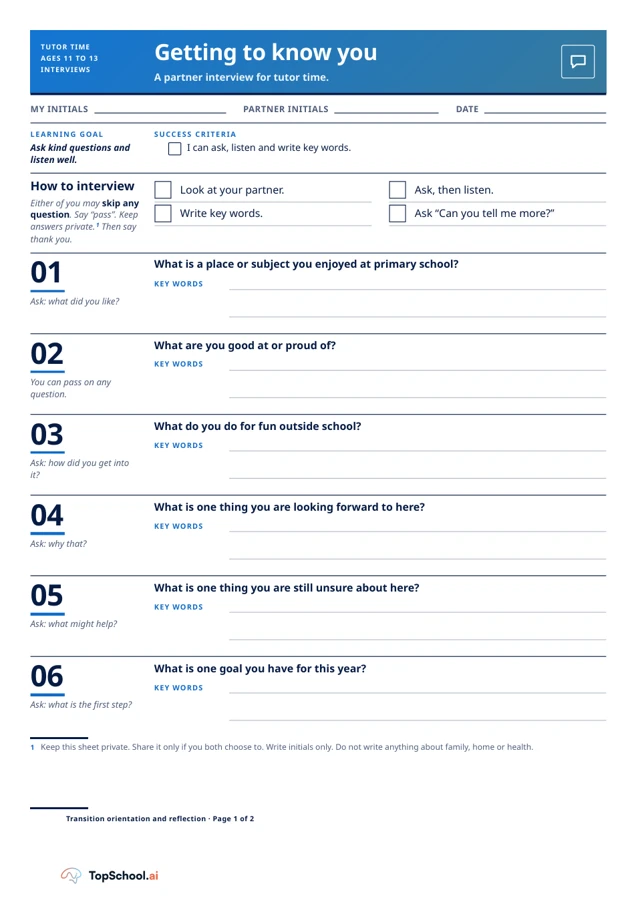
How to interview
Either of you may skip any
question. Say “pass”. Keep
answers private.1 Then say
thank you.
Look at your partner.
Ask, then listen.
Write key words.
Ask “Can you tell me more?”
01
Ask: what did you like?
What is a place or subject you enjoyed at primary school?
KEY WORDS
02
You can pass on any
question.
What are you good at or proud of?
KEY WORDS
03
Ask: how did you get into
it?
What do you do for fun outside school?
KEY WORDS
04
Ask: why that?
What is one thing you are looking forward to here?
KEY WORDS
05
Ask: what might help?
What is one thing you are still unsure about here?
KEY WORDS
06
Ask: what is the first step?
What is one goal you have for this year?
KEY WORDS
1 Keep this sheet private. Share it only if you both choose to. Write initials only. Do not write anything about family, home or health.
Transition orientation and reflection · Page 1 of 2
TUTOR TIME
AGES 11 TO 13
INTERVIEWS
Getting to know you
A partner interview for tutor time.
Page 2
1
A place or subject
I enjoyed
2
Good at or
proud of
3
Something I do
for fun
4
Something I look
forward to
5
Still unsure about
6
My goal for
this year
What we have
in common
Find three things
we share.
Something new
Something new I learned
about my partner.
Settling in
Optional. Something that
would help me settle in.
Your teacher may read this.
Transition orientation and reflection · Page 2 of 2
TUTOR TIME
AGES 11 TO 13
INTERVIEWS
About me
A teaching sequence
Support pupils to share a manageable part of their experience, notice a strength or question, and identify one practical next step for settling into a new setting.
Choose interview prompts and sharing
Pair pupils or let them work individually; invite them to choose a few interview prompts rather than answer every question. Listen without interrupting and record only what the partner agrees to share.
Which questions would both pupils like to answer or pass?
Note familiar, new and optional questions
Use the reflection prompts to note something familiar, something new and an optional question about the next stage.
What does the pupil choose to record without sensitive personal detail?
Select a practical settling-in step
Choose one practical settling-in step, such as finding a room or asking where to get help.
Which room, routine or help point would make the next step clearer?
Offer a private adult check-in
Offer a private check-in with a trusted adult for any concern that needs a response beyond the activity.
Which concern needs the school's support process beyond this activity?
Before you teach
Look for the thinking behind an answer, choose the support your class needs and leave room for an independent response.
What to look for
Check participation through an optional reflection or conversation, not through the amount of personal information disclosed. Ask whether each pupil knows where to get practical help and follow the setting’s usual process if a concern is raised. Keep the check-in private where possible.
Give a little support
Offer prompt cards, a choice of partner or private response, extra processing time and a simple map or orientation information. Let pupils use drawing, symbols or an adult scribe. Check that each pupil can identify a familiar member of staff.
Take the idea further
Invite pupils to turn a question into a practical information request, or create a short welcome guide with routes, routines and named sources of help that staff have checked. Ask them to review the guide with someone new to the setting.
Things to keep in mind
This activity is not a counselling or safeguarding assessment and should not pressure pupils to share sensitive information. Make support routes clear, protect any recorded responses and use the setting’s established procedures for concerns. Offer a private way to ask for help.
Keep the idea. Make it yours.
Bring your topic, learning goal and class context to PLAI™, then review what you create.
Ideas to try with your class
Sample teaching perspectives on what to try, what to adapt and what to watch for.
Meet The Creators
Meet the creators whose teaching interests connect with this template. Find an approach to try with your class.

Bernadette Cheong
Transition into secondary school is not just a change of timetable; it can change how pupils see themselves and how they experience familiar strengths.
Meet the creator
Callum Ferris
I target Year 6 retrieval at the class’s current gaps and prepare transition communication for families considering different secondary settings, keeping the next step clear and relevant.
Meet the creator
Nicholas Blaker
I use a clear curriculum map to connect what pupils have learned with what comes next, keeping Year 6 preparation proportionate across different secondary-school pathways.
Meet the creator
Gareth Pryce
My classroom work is Year 7 Geography, so transition is not an abstract process for me: it meets pupils in the routines and subjects they encounter when they arrive.
Meet the creator
Paperclip Perspective
This two-page transition activity asks pupils to interview a partner about a favourite primary-school subject or place, strengths, worries and questions. It explicitly says either pupil may pass, keep answers private and thank the partner.
Reread Reminder
The interview routine practises asking, listening and recording key words while giving pupils control over what they share. The prompts can help a new partner find a manageable topic for conversation.
Thoughtful Pause
Read the privacy and pass directions first, model a neutral follow-up such as “Can you tell me more?” and let pupils choose whether to write or share a response.
Clear Example
This is a peer conversation prompt, not a transition assessment or a source of confidential support. Explain what “private” means in the setting and follow safeguarding procedures if a safety concern is disclosed.