
Study and learning skills
Self-assessment and peer assessment
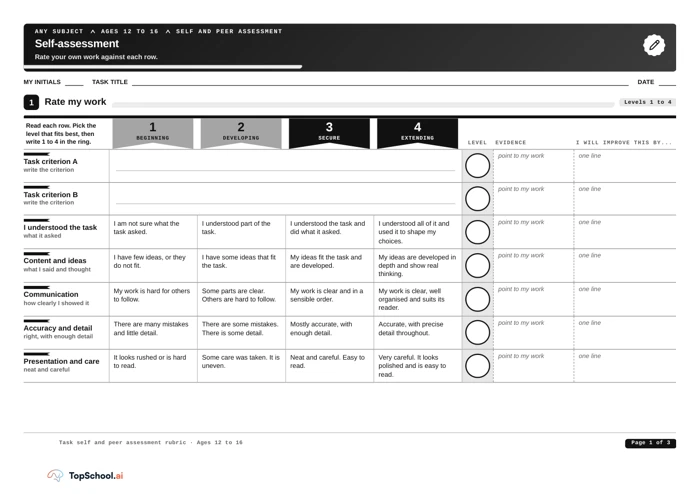
Use a four-level rubric to review one’s own work, then consider a partner’s work and practise specific feedback. Blank criteria let the teacher connect the language to the task being assessed before pupils begin. Start with one criterion.
Read the material
Use a four-level rubric to review one’s own work, then consider a partner’s work and practise specific feedback. Blank criteria let the teacher connect the language to the task being assessed before pupils begin. Start with one criterion.
Complete resource. Use the preview for diagrams and layout.
Page 1
MY INITIALS
TASK TITLE
DATE
1
Rate my work
Levels 1 to 4
Read each row. Pick the
level that fits best, then
write 1 to 4 in the ring.
LEVEL
EVIDENCE
I WILL IMPROVE THIS BY...
Task criterion A
write the criterion
point to my work
one line
Task criterion B
write the criterion
point to my work
one line
I understood the task
what it asked
I am not sure what the
task asked.
I understood part of the
task.
I understood the task and
did what it asked.
I understood all of it and
used it to shape my
choices.
point to my work
one line
Content and ideas
what I said and thought
I have few ideas, or they
do not fit.
I have some ideas that fit
the task.
My ideas fit the task and
are developed.
My ideas are developed in
depth and show real
thinking.
point to my work
one line
Communication
how clearly I showed it
My work is hard for others
to follow.
Some parts are clear.
Others are hard to follow.
My work is clear and in a
sensible order.
My work is clear, well
organised and suits its
reader.
point to my work
one line
Accuracy and detail
right, with enough detail
There are many mistakes
and little detail.
There are some mistakes.
There is some detail.
Mostly accurate, with
enough detail.
Accurate, with precise
detail throughout.
point to my work
one line
Presentation and care
neat and careful
It looks rushed or is hard
to read.
Some care was taken. It is
uneven.
Neat and careful. Easy to
read.
Very careful. It looks
polished and is easy to
read.
point to my work
one line
Task self and peer assessment rubric · Ages 12 to 16
Page 1 of 3
ANY SUBJECT
AGES 12 TO 16
SELF AND PEER ASSESSMENT
Self-assessment
Rate your own work against each row.
1
BEGINNING
2
DEVELOPING
3
SECURE
4
EXTENDING
Page 2
REVIEWER INITIALS
WRITER INITIALS
TASK TITLE
DATE
2
Rate my partner’s work
Levels 1 to 4
Read the work. Pick the
level that fits best, then
write 1 to 4 in the ring.
LEVEL
EVIDENCE
A WAY TO IMPROVE IT...
Task criterion A
write the criterion
a detail from the work
one line
Task criterion B
write the criterion
a detail from the work
one line
Understood the task
what it asked
I cannot see that the task
was understood.
Part of the task was
understood.
The task was understood
and done.
The task was fully
understood and used well.
a detail from the work
one line
Content and ideas
what they said and thought
There are few ideas, or
they do not fit.
There are some ideas that
fit the task.
The ideas fit the task and
are developed.
The ideas are developed
in depth and show real
thinking.
a detail from the work
one line
Communication
how clearly it is shown
It is hard for me to follow.
Some parts are clear.
Others are hard to follow.
It is clear and in a sensible
order.
It is clear, well organised
and suits its reader.
a detail from the work
one line
Accuracy and detail
right, with enough detail
There are many mistakes
and little detail.
There are some mistakes.
There is some detail.
Mostly accurate, with
enough detail.
Accurate, with precise
detail throughout.
a detail from the work
one line
Presentation and care
neat and careful
It looks rushed or is hard
to read.
Some care was taken. It is
uneven.
Neat and careful. Easy to
read.
Very careful. It looks
polished and is easy to
read.
a detail from the work
one line
Task self and peer assessment rubric · Ages 12 to 16
Page 2 of 3
ANY SUBJECT
AGES 12 TO 16
SELF AND PEER ASSESSMENT
Peer assessment
Rate a partner’s work and show your evidence.
1
BEGINNING
2
DEVELOPING
3
SECURE
4
EXTENDING
Page 3
3
My reflection
My own work
4
Feedback for my partner
Their work
Sentence starters
WORKED
One thing that worked well was
.
PRAISE
I liked
 because
.
STRONGER
One way to make it even
stronger is
.
ASK
Could you add
 to show
?
Task self and peer assessment rubric · Ages 12 to 16
Page 3 of 3
ANY SUBJECT
AGES 12 TO 16
SELF AND PEER ASSESSMENT
Say it in words
Reflect on your own work, then give kind, specific feedback.
The strongest part of my work
STRONGEST
NEXT STEP
Two things that worked
WORKED
TRY NEXT
We talked before writing.
I kept it about the work.
TALK FIRST
It is strong because...
My next step:
1.
2.
One thing to try next:
A teaching sequence
Choose a level against a criterion, point to evidence in the work and name a practical next step for self or peer review.
Agree criteria and assess your own work
Agree two task-specific criteria, select levels from one to four and point to work supporting each choice. Name a practical improvement and share the partner page only when the writer is ready.
Which detail supports your level and practical improvement?
Review a willing partner's work
Read the partner’s work and use the same criteria. Record evidence from the work rather than a comment about the person.
Does the comment describe the work against the same criteria?
Reflect and offer actionable feedback
Use the third page to reflect on the strongest part and next step, then offer one specific praise and one actionable suggestion.
Which specific strength and next step can the writer use?
Talk before recording feedback
Check the talk-first reminders: discuss the work before writing and keep feedback focused on the task.
Have both people discussed the task evidence before writing?
Before you teach
Look for the thinking behind an answer, choose the support your class needs and leave room for an independent response.
What to look for
Check that each rating is linked to a visible example and that feedback names an achievable next action. Ask whether the criterion was clear and whether the writer understands the suggestion before revising.
Give a little support
Model a kind, specific comment and provide sentence frames such as “One thing that works is…” and “You could try…”. Let pupils choose a trusted partner or complete only the self-review if peer sharing is unsuitable.
Take the idea further
Ask pupils to revise one part using feedback, then explain whether the change improved the work against the criterion. They can suggest an additional task-specific criterion for the class rubric.
Things to keep in mind
The rubric does not define what counts as secure work until a teacher fills in the task criteria. Peer ratings are not a grade or a judgement of the person. Use school policy for sharing work and avoid requiring pupils to disclose work they prefer to keep private.
Keep the idea. Make it yours.
Bring your topic, learning goal and class context to PLAI™, then review what you create.
Ideas to try with your class
Sample teaching perspectives on what to try, what to adapt and what to watch for.
Meet The Creators
Meet a creator whose teaching interests connect with this template.

Margin Note
This three-page rubric asks pupils to rate work from 1 to 4 against written criteria, point to evidence in the work and name one improvement. It supports both self-assessment and a peer review using initials.
Kindly Red Pen
The criteria include understanding what the task asked and using that understanding to shape choices. Pairing a level with a line of evidence can make feedback more actionable than a number alone.
Calm Table
Read one criterion at a time, point to the relevant work and discuss the next step before assigning a level. Use initials as the sheet requests and avoid public comparison of peers' ratings.
Board Eraser
This general rubric needs task-specific criteria filled in; the example row alone cannot assess every assignment. Use the score to guide revision rather than treating it as a reliable grade without teacher judgement.