
Science
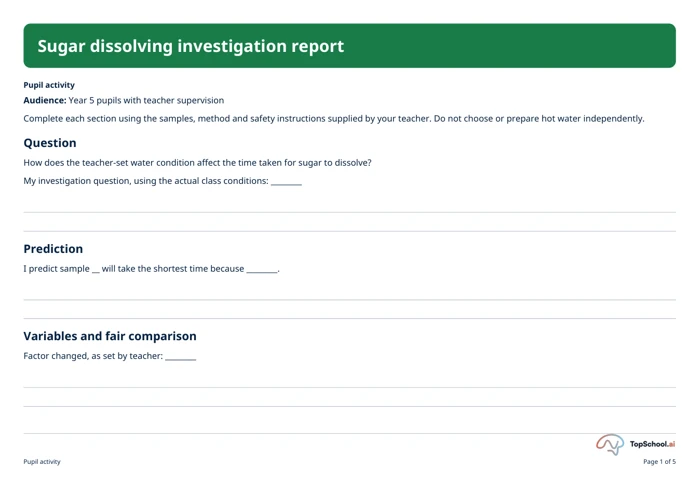
Sugar dissolving investigation report
For Year 5 pupils with teacher supervision, plan a teacher-approved comparison, record repeated dissolving times, graph the results and write an evidence-based conclusion.
Read the material
For Year 5 pupils with teacher supervision, plan a teacher-approved comparison, record repeated dissolving times, graph the results and write an evidence-based conclusion.
Pupil worksheet. Use the preview for diagrams and layout.
Page 1
Sugar dissolving investigation report
Pupil activity
Audience: Year 5 pupils with teacher supervision
Complete each section using the samples, method and safety instructions supplied by your teacher. Do not choose or prepare hot water independently.
Question
How does the teacher-set water condition affect the time taken for sugar to dissolve?
My investigation question, using the actual class conditions: ________
Prediction
I predict sample __ will take the shortest time because ________.
Variables and fair comparison
Factor changed, as set by teacher: ________
Pupil activity
Page 1 of 5
Page 2
Sugar dissolving investigation report
Result measured: ________ Unit: ______
Conditions kept the same, if the approved method allows: ________
Equipment, method and safety
Equipment supplied: ________
Teacher's approved sample labels and conditions: A ________ B ________ C ________
Method exactly as instructed: ________
________
Teacher's safety instructions for this practical: ________
Pupil activity
Page 2 of 5
Page 3
Sugar dissolving investigation report
Results
Sample
Time 1 (s)
Time 2 (s)
Time 3 (s)
Mean (s)
A
B
C
Pupil activity
Page 3 of 5
Page 4
Sugar dissolving investigation report
Graph
Title: ________ Axis labels and units: ________
Use the grid supplied by your teacher or draw axes here: ________
________
________
Pupil activity
Page 4 of 5
Page 5
Sugar dissolving investigation report
Conclusion
The results show ________.
Evidence from my table: ________.
My results do / do not support my prediction because ________.
Evaluation
One limitation or source of variation: ________
One improvement for a repeat, subject to teacher approval: ________
Pupil activity
Page 5 of 5
Page 1
Sugar dissolving investigation report
Teacher key and guidance supporting this exact edition
Teacher guidance
If the approved samples differ only by temperature and other conditions are controlled, warmer water is
generally expected to dissolve sugar faster. Check actual class results before discussing the trend. Do not
present this expected pattern as the result of a practical that has not been performed.
Teacher companion
Page 1 of 1
A teaching sequence
Complete a short investigation report with a question, prediction, variables, teacher-approved method, repeated results, graph, conclusion and evaluation.
Write the actual class question and prediction
Write the question and a prediction with a reason.
Does the prediction refer to the teacher-set samples and include a reason?
Identify variables under the approved method
Name the factor changed, result measured and conditions kept the same under the approved method.
Which factor changes, which result is measured and which conditions can stay equal?
Record the teacher's method and safety instructions
Record teacher-supplied equipment, method and safety instructions.
Have the equipment and conditions been supplied before any practical begins?
Record three repeats and calculate means
Measure three repeats for each sample and calculate means.
Are times and means recorded in seconds for every sample?
Graph, conclude and evaluate
Plot the means and write a conclusion using data, then evaluate one limitation.
Which data support the conclusion, and which limitation affects the comparison?
Before you teach
Look for the thinking behind an answer, choose the support your class needs and leave room for an independent response.
What to look for
If the approved samples differ only by water temperature, warmer water is generally expected to dissolve sugar faster. Use the class measurements to decide whether the data support that pattern; do not assume the result.
Give a little support
Teacher supplies sample labels, conditions, equipment, method, controls and safety instructions before the practical. Pupils copy these into the report.
Take the idea further
Use the range of repeats to compare consistency between samples. Explain why a mean alone does not show every result.
Things to keep in mind
This report template does not set temperatures, quantities, heating steps, equipment or controls. Teacher approval and school procedures govern the actual practical.
Keep the idea. Make it yours.
Bring your topic, learning goal and class context to PLAI™, then review what you create.
Ideas to try with your class
Sample teaching perspectives on what to try, what to adapt and what to watch for.
Meet The Creators
Meet a creator whose teaching interests connect with this template.

Steady Marker
This five-page Year 5 report asks pupils to use teacher-set water conditions, complete a question and prediction, identify variables, record repeated results, graph, conclude and evaluate. It explicitly says pupils must not choose or prepare hot water independently.
Spare Pencil
Samples and supplied safety instructions support a full investigation report while leaving the actual conditions to the teacher. The repeated results connect the method to a graph and evidence-led conclusion.
Page-Turner Planner
The teacher should set the conditions and supervise the activity; pupils record only the class method and data. Use the sample structure to distinguish prediction from measured result.
Five More Minutes
This report does not authorise pupils to heat or handle hot water independently. Follow the teacher-approved method and safety instructions, and do not fill results from the sample as if they were the class's observations.