
Languages and literacy
My story
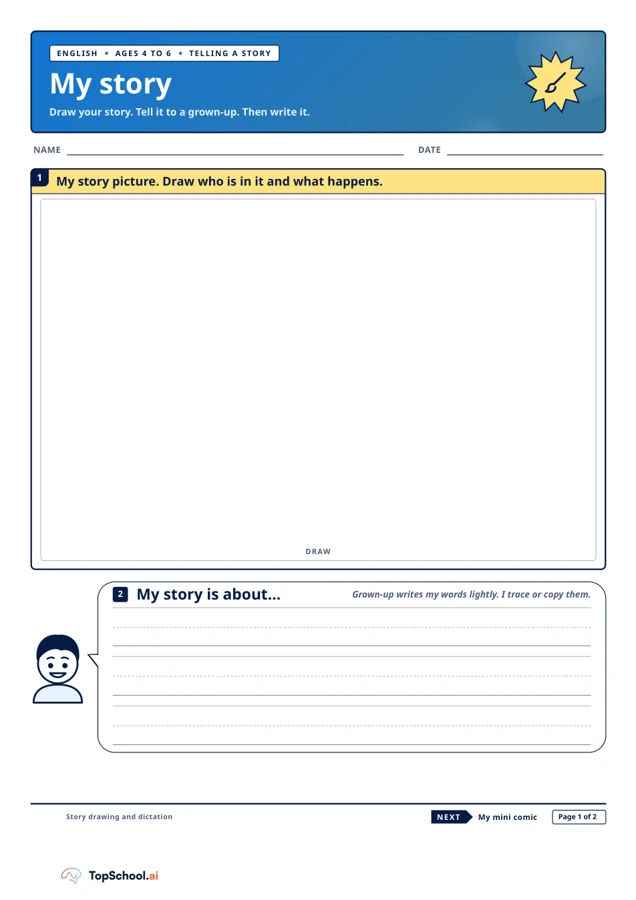
Invite a child to draw a story, tell it to an adult and put the spoken ideas into an early written form. A three-part comic then supports beginning, middle and end, with tracing, copying or writing as options.
Read the material
Invite a child to draw a story, tell it to an adult and put the spoken ideas into an early written form. A three-part comic then supports beginning, middle and end, with tracing, copying or writing as options.
Shared activity record. Use the preview for diagrams and layout.
Page 1
NAME
DATE
Story drawing and dictation
My mini comic
ENGLISH
AGES 4 TO 6
TELLING A STORY
My story
Draw your story. Tell it to a grown-up. Then write it.
My story picture. Draw who is in it and what happens.
DRAW
My story is about…
Grown-up writes my words lightly. I trace or copy them.
NEXT
1
2
Page 1 of 2
Page 2
LEARNING GOAL
Tell a story in order and put my
words on paper.
I CAN
draw my story
say what happens first, next and at the end
trace, copy or write my words
Draw it in three boxes
My comic is called
Story drawing and dictation
Adult guide
ENGLISH
BEGINNING, MIDDLE, END
My mini comic
ZOOM!
Beginning
DRAW
First,
Middle
DRAW
Next,
End
DRAW
At the end,
Say it! Tell your comic to a friend.
first
next
at the end
How did I do? Colour one face.
Not yet
Nearly
I did it!
NEXT
1
2
3
Page 2 of 2
Page 1
My story
Teacher companion
English | Children aged 4 to 6 with an adult
Use with the exact 2-page original file. Keep pupil or staff activity pages separate from this teacher companion.
When to use it
Use this with young children who are beginning to tell a story through drawing and dictation.
An adult can record the child’s own words and offer tracing, copying or independent writing as
appropriate. Keep the adult nearby to record or model writing.
Purpose
Tell a short story in a familiar context and represent the child’s words through drawing,
dictation, tracing, copying or writing.
Start here
Ask the child what the story is about and let them choose who or what to include. Explain that
the adult can write the child’s own words lightly for tracing or copying.
A teaching sequence
1. Draw a story picture and invite the child to tell what is happening. Record the child’s
wording without changing the story for them.
2. Use the beginning, middle and end boxes to draw three moments. Add “First”, “Next” and
“At the end” as prompts.
3. Invite the child to dictate one sentence for each picture, trace or copy the adult-written
words, or write independently.
4. Help the child name the mini comic and tell it to a friend. Use the self-rating to notice what
they can do next time.
Checking guidance
Listen for a clear first, next and ending idea. Check that written or traced words reflect the
child’s spoken meaning, and invite the child to point to the picture that matches each part.
Ask what the child thinks happens next.
Write dictated words faithfully and read them back to the child. Ask the child to point to the
beginning, next event and ending; drawing quality is not the writing objective.
Support
Offer a familiar picture or object as a starting point, ask one open question at a time and
record a short dictated phrase. The child may point, gesture, use home-language words or
draw instead of writing.
Take it further
Invite the child to add speech to one character or change one event and tell what happens in
the new ending. An adult can write the exact words first and ask the child to choose a detail to
add.
Things to keep in mind
Keep the child’s own story and words central; do not assess drawing quality as writing
progress. Let the child choose whether to dictate, trace, copy or write independently. Keep
dictated personal details within the class’s usual privacy practice.
My story
Teacher companion | Page 1
A teaching sequence
Tell a short story in a familiar context and represent the child’s words through drawing, dictation, tracing, copying or writing.
Draw and tell your story
Draw a story picture and invite the child to tell what is happening. Record the child’s wording without changing the story for them.
What is happening in the child's own words?
Choose three story moments
Use the beginning, middle and end boxes to draw three moments. Add “First”, “Next” and “At the end” as prompts.
Which picture belongs first, next and at the end?
Choose how to put words down
Invite the child to dictate one sentence for each picture, trace or copy the adult-written words, or write independently.
Would dictating, tracing, copying or independent writing be useful?
Name and share the comic
Help the child name the mini comic and tell it to a friend. Use the self-rating to notice what they can do next time.
What would you like your friend to know about this story?
Before you teach
Look for the thinking behind an answer, choose the support your class needs and leave room for an independent response.
What to look for
Listen for a clear first, next and ending idea. Check that written or traced words reflect the child’s spoken meaning, and invite the child to point to the picture that matches each part. Ask what the child thinks happens next. Write dictated words faithfully and read them back to the child. Ask the child to point to the beginning, next event and ending; drawing quality is not the writing objective.
Give a little support
Offer a familiar picture or object as a starting point, ask one open question at a time and record a short dictated phrase. The child may point, gesture, use home-language words or draw instead of writing.
Take the idea further
Invite the child to add speech to one character or change one event and tell what happens in the new ending. An adult can write the exact words first and ask the child to choose a detail to add.
Things to keep in mind
Keep the child’s own story and words central; do not assess drawing quality as writing progress. Let the child choose whether to dictate, trace, copy or write independently. Keep dictated personal details within the class’s usual privacy practice.
Keep the idea. Make it yours.
Bring your topic, learning goal and class context to PLAI™, then review what you create.
Ideas for using this resource
Sample teaching perspectives on what to try, what to adapt and what to watch for.
Meet The Creators
Meet a creator whose teaching interests connect with this template.

Bright Margins
A child can draw who is in a story and what happens, tell it to an adult, then trace, copy or write their own words. A second section uses three boxes for first, next and end.
Thoughtful Pause
The sequence preserves the child's spoken story while connecting it to print. Drawing, dictation and writing offer several ways to represent the same idea.
One Last Sticky Note
Write the child's words lightly as instructed and avoid editing them into an adult's story. Invite the child to say what happens first, next and at the end before recording the words.
Tea Break Notes
The page supports one short telling task and does not assess independent writing if an adult has transcribed the response. Keep dictated words distinguishable from copied or independently written text.