
Study and learning skills
Source analysis: two community notices
A source-analysis task using two fictional community notices to compare who made each message, what it says and what it cannot show.
Read the material
A source-analysis task using two fictional community notices to compare who made each message, what it says and what it cannot show.
Pupil activity and after-attempt self-check. Use the preview for diagrams and layout.
Page 1
Source analysis: two community notices
Pupil activity and after-attempt self-check
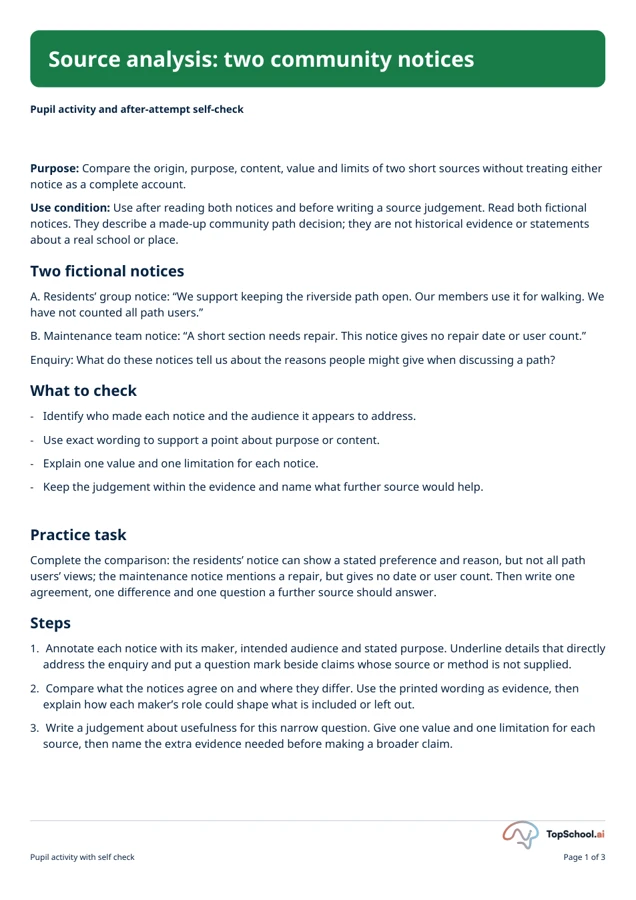
Purpose: Compare the origin, purpose, content, value and limits of two short sources without treating either
notice as a complete account.
Use condition: Use after reading both notices and before writing a source judgement. Read both fictional
notices. They describe a made-up community path decision; they are not historical evidence or statements
about a real school or place.
Two fictional notices
A. Residents’ group notice: “We support keeping the riverside path open. Our members use it for walking. We
have not counted all path users.”
B. Maintenance team notice: “A short section needs repair. This notice gives no repair date or user count.”
Enquiry: What do these notices tell us about the reasons people might give when discussing a path?
What to check
-
Identify who made each notice and the audience it appears to address.
-
Use exact wording to support a point about purpose or content.
-
Explain one value and one limitation for each notice.
-
Keep the judgement within the evidence and name what further source would help.
Practice task
Complete the comparison: the residents’ notice can show a stated preference and reason, but not all path
users’ views; the maintenance notice mentions a repair, but gives no date or user count. Then write one
agreement, one difference and one question a further source should answer.
Steps
1. Annotate each notice with its maker, intended audience and stated purpose. Underline details that directly
address the enquiry and put a question mark beside claims whose source or method is not supplied.
2. Compare what the notices agree on and where they differ. Use the printed wording as evidence, then
explain how each maker’s role could shape what is included or left out.
3. Write a judgement about usefulness for this narrow question. Give one value and one limitation for each
source, then name the extra evidence needed before making a broader claim.
Pupil activity with self check
Page 1 of 3
Page 2
Source analysis: two community notices
Working space
Maker and likely audience, Notice A: ________
Maker and likely audience, Notice B: ________
One agreement and one difference: ________
What the notices cannot establish; useful next source: ________
Support and next action
Read the notices aloud, explain “purpose” as why a message was made, and offer the sentence frame “This
notice is useful for… because… It cannot show…”.
Next action: After the written judgement, ask pupils to underline the phrase that supports it. Then ask which
further source could answer the question left open by both notices.
Check
A strong response uses an exact detail, distinguishes the two purposes and explains a limitation; it does not
simply label one notice biased or reliable.
Limits
Both notices are fictional. They do not establish real local views, a real repair or a historical event.
Pupil activity with self check
Page 2 of 3
Page 3
Source analysis: two community notices
Self-check: use after your first attempt
Model response or judgement
The residents’ notice is useful for identifying one group’s stated preference and its reason, but it cannot show
how all path users feel because it says no full count was made. The maintenance notice establishes that a
repair is mentioned, but gives no date or user evidence. A dated work record and a wider user survey would
answer different remaining questions.
Pupil activity with self check
Page 3 of 3
A teaching sequence
Compare the origin, purpose, content, value and limits of two short sources without treating either notice as a complete account.
Annotate maker, purpose and evidence
Annotate each notice with its maker, intended audience and stated purpose. Underline details that directly address the enquiry and put a question mark beside claims whose source or method is not supplied.
Which exact phrase addresses the enquiry, and which claim needs another source?
Compare agreement and differences
Compare what the notices agree on and where they differ. Use the printed wording as evidence, then explain how each maker’s role could shape what is included or left out.
How could each maker's role shape what the notice includes?
Write a bounded usefulness judgement
Write a judgement about usefulness for this narrow question. Give one value and one limitation for each source, then name the extra evidence needed before making a broader claim.
What value, limitation and useful next source can you justify for each notice?
Before you teach
Look for the thinking behind an answer, choose the support your class needs and leave room for an independent response.
What to look for
A strong response uses an exact detail, distinguishes the two purposes and explains a limitation; it does not simply label one notice biased or reliable.
Give a little support
Read the notices aloud, explain “purpose” as why a message was made, and offer the sentence frame “This notice is useful for… because… It cannot show…”.
Take the idea further
Suggest a third source that could test whether the proposed path change happened and explain what question it would answer.
Things to keep in mind
Both notices are fictional. They do not establish real local views, a real repair or a historical event.
Keep the idea. Make it yours.
Bring your topic, learning goal and class context to PLAI™, then review what you create.
Another starting point
Explore a different teaching task from this selection.
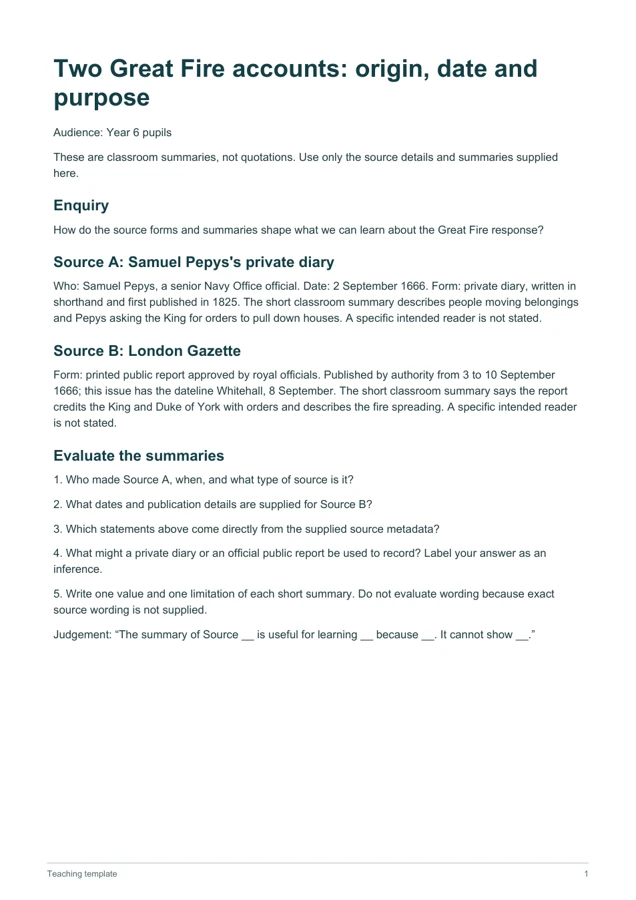
Two Great Fire accounts: origin, date and purpose
Read the two source cards. Treat each paragraph as a classroom summary, not a quotation from the historical source.
Explore resourceIdeas to try with your class
Sample teaching perspectives on what to try, what to adapt and what to watch for.
Meet The Creators
Meet a creator whose teaching interests connect with this template.

Pencil Case Pal
This three-page pupil activity compares two fictional community notices about a made-up path decision. It asks pupils to consider origin, purpose, content, value and limits without treating either notice as a complete account.
Calm Table
The exercise gives two short perspectives for source comparison while explicitly identifying the setting as fictional. Pupils must weigh what each notice can show rather than simply choose a more persuasive voice.
After the Bell
Annotate each notice for author, purpose and stated evidence, then compare what is missing. Let pupils use a chart or oral rehearsal before writing a judgement.
Step by Step
These notices are neither historical evidence nor statements about a real school or place. For real decisions, consult the primary records and relevant people rather than applying the fictional conclusions.