
Languages and literacy
Reading comprehension and translation
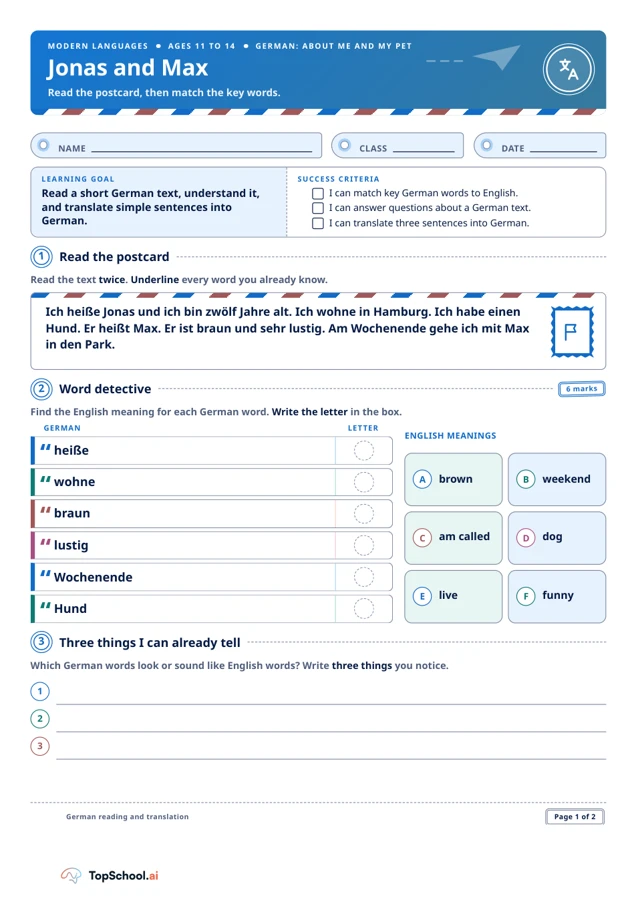
Read a short German postcard about Jonas and his dog, match key words to English meanings and answer questions about the text. Pupils then translate three sentences into German and check capital letters, verb position and spelling against the postcard.
Read the material
Read a short German postcard about Jonas and his dog, match key words to English meanings and answer questions about the text. Pupils then translate three sentences into German and check capital letters, verb position and spelling against the postcard.
Complete resource. Use the preview for diagrams and layout.
Page 1
LEARNING GOAL
Read a short German text, understand it,
and translate simple sentences into
German.
SUCCESS CRITERIA
I can match key German words to English.
I can answer questions about a German text.
I can translate three sentences into German.
Read the postcard
Read the text twice. Underline every word you already know.
Word detective
Find the English meaning for each German word. Write the letter in the box.
GERMAN
LETTER
ENGLISH MEANINGS
A
brown
B
weekend
C
am called
D
dog
E
live
F
funny
Three things I can already tell
Which German words look or sound like English words? Write three things you notice.
1
2
3
German reading and translation
Page 1 of 2
MODERN LANGUAGES
AGES 11 TO 14
GERMAN: ABOUT ME AND MY PET
Jonas and Max
Read the postcard, then match the key words.
NAME
CLASS
DATE
1
Ich heiße Jonas und ich bin zwölf Jahre alt. Ich wohne in Hamburg. Ich habe einen
Hund. Er heißt Max. Er ist braun und sehr lustig. Am Wochenende gehe ich mit Max
in den Park.
2
6 marks
heiße
“
wohne
“
braun
“
lustig
“
Wochenende
“
Hund
“
3
Page 2
Questions about the text
Look back at the postcard. Answer in English.
1
How old is Jonas?
(1 mark)
2
Where does he live?
(1 mark)
3
What is his dog called, and what is he like?
(2 marks)
4
When does Jonas go to the park with Max?
(1 mark)
Translate into German
Write each sentence in German. Use the postcard to help. 2 marks each. Then check and correct your work.
1
I have a dog.
(2 marks)
CORRECT IT
2
I live in Hamburg.
(2 marks)
CORRECT IT
3
He is brown and funny.
(2 marks)
CORRECT IT
Translation checklist
Capitals: every noun starts with one.
Verb: it comes in second place.
Spelling: check each word against the postcard.
Aloud: I read it out loud.
German reading and translation
Page 2 of 2
GERMAN
AGES 11 TO 14
UNDERSTAND AND TRANSLATE
Answer, then translate
1
5 marks
2
6 marks
3
A teaching sequence
Find information in a short German text, connect key words with English meanings and translate simple sentences using the postcard as a model.
Match postcard words with meanings
Match the six German words to their supplied English meanings and discuss any words that look or sound familiar.
Which part of the German text helps you justify this match?
Find details in the postcard
Answer the comprehension questions in English, returning to the postcard to find Jonas's age, city and details about Max.
Where can you locate the evidence for Jonas's age, home and dog?
Translate using the supplied model
Translate the three sentences using the postcard as a model, then use the checklist to review nouns, verb position and spelling.
Have you checked nouns, verb position and spelling against the postcard?
Read and correct with teacher support
Read the translated sentences aloud and correct one point by checking it against the source text. Repeat with a new sentence if useful.
Which point can you check in the source, and which alternative needs the teacher's judgement?
Before you teach
Look for the thinking behind an answer, choose the support your class needs and leave room for an independent response.
What to look for
Look for answers that can be located in the postcard and translations that follow its word order and spelling. Ask, “Which part of the postcard helped you choose that German word?” If a pupil translates word-for-word from English, compare the sentence with the model before correcting it.
Give a little support
Provide the postcard with key words highlighted and complete one translation together. Let pupils use the printed text as a word bank and read each sentence aloud before writing or checking with a partner.
Take the idea further
Ask pupils to change one detail in the postcard and write a new German sentence using the same pattern. Check the new form against vocabulary and grammar already taught in class.
Things to keep in mind
The postcard is a short practice text, not evidence about a real person. The selected worksheet has no answer key, so a teacher should check the translations against the taught forms and accept appropriate alternatives where German grammar allows them.
Keep the idea. Make it yours.
Bring your topic, learning goal and class context to PLAI™, then review what you create.
Ideas to try with your class
Sample teaching perspectives on what to try, what to adapt and what to watch for.
Meet The Creators
Meet a creator whose teaching interests connect with this template.
Planning List
This two-page German activity asks pupils to read a postcard twice, underline familiar words, match selected German vocabulary to English and translate three simple sentences into German using the postcard as a model.
Glue Stick Club
The “word detective” step invites pupils to draw on known vocabulary before tackling comprehension questions and sentence translation. The learning goal and success criteria make reading and writing outcomes visible.
Calm Table
Read the postcard once for its overall message, then reread to locate words that answer a question. Keep the word-matching section available as a scaffold, and compare each translation with the model rather than expecting unsupported recall throughout.
Organised Pile
The task uses one short postcard and a selected vocabulary set. Check translations for meaning and grammar against the taught unit, and do not infer broad German proficiency from this single text.