
Worksheet
Pupil voice and proposal form
Turn an observation into a proposal by describing who it affects, outlining steps, asking a small survey question and considering benefits and risks. The second page asks for resources, an evidence-based pitch and a route for the school to reply.
Read the material
Turn an observation into a proposal by describing who it affects, outlining steps, asking a small survey question and considering benefits and risks. The second page asks for resources, an evidence-based pitch and a route for the school to reply.
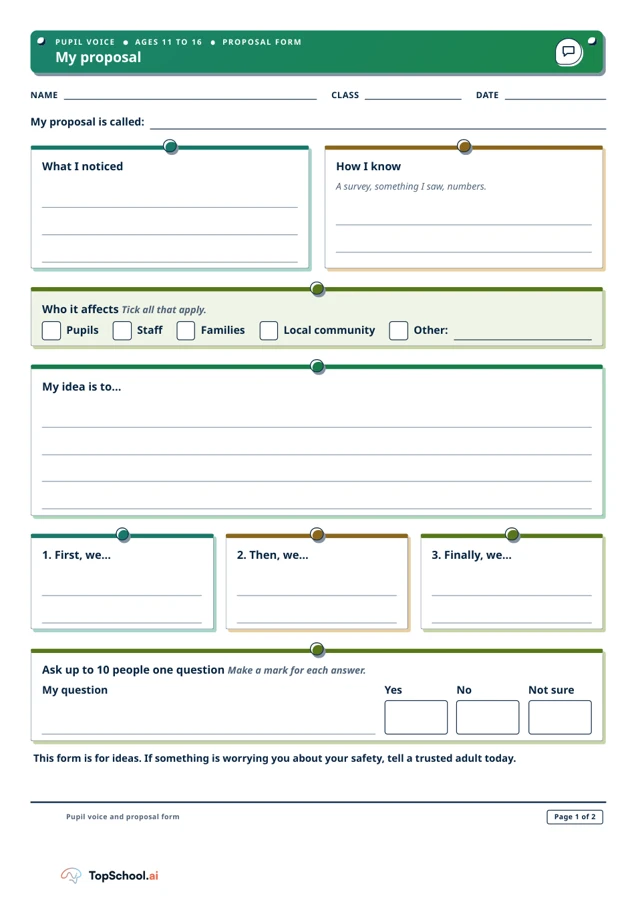
Complete resource. Use the preview for diagrams and layout.
Page 1
NAME
CLASS
DATE
My proposal is called:
This form is for ideas. If something is worrying you about your safety, tell a trusted adult today.
Pupil voice and proposal form
Page 1 of 2
PUPIL VOICE
AGES 11 TO 16
PROPOSAL FORM
My proposal
What I noticed
How I know
A survey, something I saw, numbers.
Who it affects Tick all that apply.
Pupils
Staff
Families
Local community
Other:
My idea is to...
1. First, we...
2. Then, we...
3. Finally, we...
Ask up to 10 people one question Make a mark for each answer.
My question
Yes
No
Not sure
Page 2
NAME
CLASS
DATE
BENEFITS: GOOD THINGS THAT COULD HAPPEN
RISKS: WHAT COULD GO WRONG
1.
1.
2.
2.
3.
3.
We will reply by:
Optional: I would like my name kept private
when this is shared.
Pupil voice and proposal form
Page 2 of 2
PUPIL VOICE
AGES 11 TO 16
PROPOSAL FORM
Making the case
What it needs Estimate, or write “unknown”.
People:
Time:
Materials:
Money:
How I would know it worked
My 50-word pitch What you want, why it matters, what happens next.
What happens next
Pupil voice
group or
school council
A staff lead
A reply to you
A teaching sequence
Describe a school or community issue, propose a sequence of actions, consider benefits and risks, and state what evidence could show whether the idea worked.
Describe the proposal and evidence
Name the proposal and record what was noticed and how the pupil knows it affects the people selected.
What observation or figure supports the need you describe?
Outline actions and a small survey
Describe up to three actions and ask up to ten people one question, recording yes, no or not sure responses.
Does one clear question allow yes, no or not sure responses?
Estimate benefits, risks and needs
List possible benefits and risks, estimate required people, time, materials and money, and note unknowns honestly.
Which figures are estimates and which costs remain unknown?
Pitch the idea and agree a reply
Write a short pitch, choose a way to judge the idea and identify who will respond and by when. Keep estimated figures separate from known costs.
Who will respond, by when, and how could the idea be judged?
Before you teach
Look for the thinking behind an answer, choose the support your class needs and leave room for an independent response.
What to look for
Look for a proposal that links an observed issue with an action and a way to review the result. Ask, “What evidence would help you decide whether the idea worked?” If a survey is used, check that the question is neutral and that respondents are not pressured to take part.
Give a little support
Start with one observed issue and one action. A teacher can help pupils distinguish what they saw from what they assume, then record unknown costs or time instead of asking pupils to guess.
Take the idea further
Ask pupils to compare survey answers with their original observation and note whose views may be missing. Revise the proposal to address one risk and define a fair, observable measure for a later review.
Things to keep in mind
This form is for ideas and does not guarantee that a proposal will be approved or acted on. The pupil should be told who will reply and when. Safety worries should be shared with a trusted adult through the school's process, not handled as a proposal.
Keep the idea. Make it yours.
Bring your topic, learning goal and class context to PLAI™, then review what you create.
Ideas for using this resource
Sample teaching perspectives on what to try, what to adapt and what to watch for.
Meet The Creators
Meet a creator whose teaching interests connect with this template.
Steady Marker
Pupils name an issue, identify who is affected, plan up to three actions and specify evidence that could show whether the idea worked.
Good Question
The proposal structure connects observation, action and evaluation, so a pupil must explain more than the idea itself. The opening safety note makes a clear route for a worry: tell a trusted adult today.
Clear Example
Help pupils distinguish something they saw from a survey or number, then plan one feasible first step. If the topic raises a safety concern, follow the printed direction to tell a trusted adult rather than asking the pupil to solve it through the proposal.
Step by Step
The form gathers ideas; it does not guarantee that a proposal will be adopted or that its evidence will establish cause. Make clear who will review proposals and respond, and follow safeguarding procedures for concerns disclosed.