
Wellbeing and personal development
Pupil profile and transition summary
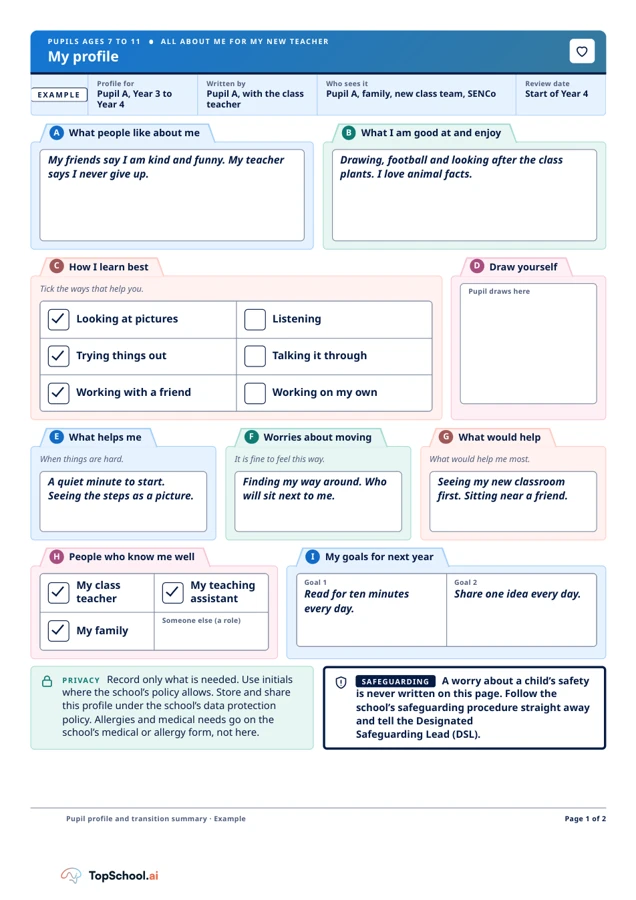
Help a pupil describe what they enjoy, how they learn, what may feel difficult and what could help in a new class. One page shows an example and the other is a blank profile. The form includes explicit privacy, medical-information and safeguarding boundaries.
Read the material
Help a pupil describe what they enjoy, how they learn, what may feel difficult and what could help in a new class. One page shows an example and the other is a blank profile. The form includes explicit privacy, medical-information and safeguarding boundaries.
Complete resource. Use the preview for diagrams and layout.
Page 1
E X A M P L E
Profile for
Pupil A, Year 3 to
Year 4
Written by
Pupil A, with the class
teacher
Who sees it
Pupil A, family, new class team, SENCo
Review date
Start of Year 4
Tick the ways that help you.
When things are hard.
It is fine to feel this way.
What would help me most.
PRIVACY Record only what is needed. Use initials
where the school’s policy allows. Store and share
this profile under the school’s data protection
policy. Allergies and medical needs go on the
school’s medical or allergy form, not here.
SAFEGUARDING
 A worry about a child’s safety
is never written on this page. Follow the
school’s safeguarding procedure straight away
and tell the Designated
Safeguarding Lead (DSL).
Pupil profile and transition summary · Example
Page 1 of 2
PUPILS AGES 7 TO 11
ALL ABOUT ME FOR MY NEW TEACHER
My profile
My friends say I am kind and funny. My teacher
says I never give up.
Drawing, football and looking after the class
plants. I love animal facts.
Looking at pictures
Listening
Trying things out
Talking it through
Working with a friend
Working on my own
Pupil draws here
A quiet minute to start.
Seeing the steps as a picture.
Finding my way around. Who
will sit next to me.
Seeing my new classroom
first. Sitting near a friend.
My class
teacher
My teaching
assistant
My family
Someone else (a role)
Goal 1
Read for ten minutes
every day.
Goal 2
Share one idea every day.
A
What people like about me
B
What I am good at and enjoy
C
How I learn best
D
Draw yourself
E
What helps me
F
Worries about moving
G
What would help
H
People who know me well
I
My goals for next year
Page 2
Profile for (initials)
Written by (pupil, adult)
Who sees it
Pupil, family, new class team, SENCo
Review date
Tick the ways that help you.
When things are hard.
It is fine to feel this way.
What would help me most.
PRIVACY Record only what is needed. Use initials
where the school’s policy allows. Store and share
this profile under the school’s data protection
policy. Allergies and medical needs go on the
school’s medical or allergy form, not here.
SAFEGUARDING
 A worry about a child’s safety
is never written on this page. Follow the
school’s safeguarding procedure straight away
and tell the Designated
Safeguarding Lead (DSL).
Pupil profile and transition summary · Blank template
Page 2 of 2
BLANK PROFILE
PUPILS AGES 7 TO 11
My profile
Looking at pictures
Listening
Trying things out
Talking it through
Working with a friend
Working on my own
Pupil draws here
My class
teacher
My teaching
assistant
My family
Someone else (a role)
Goal 1
Goal 2
A
What people like about me
B
What I am good at and enjoy
C
How I learn best
D
Draw yourself
E
What helps me
F
Worries about moving
G
What would help
H
People who know me well
I
My goals for next year
A teaching sequence
Share pupil-selected strengths, learning preferences, transition worries and practical goals identified by the pupil to help a new class team prepare relevant support.
Explore the fictional profile example
Use the example page to explain the kinds of topics pupils may choose to share, without copying its personal details as a real profile.
Which topics might the pupil choose to share without copying Pupil A's details?
Record the pupil's chosen strengths and supports
Complete the blank profile with the pupil's own strengths, interests, learning preferences and what may help in the new class.
What does the pupil say helps in the new class?
Invite a practical transition request
Invite the pupil to identify a worry or practical support request and people they want included, following school policy.
Does this belong on the profile or in the school's medical or safeguarding system?
Agree goals, review and authorised sharing
Set goals for next year and a review date. Share the profile only with the roles stated in the school's approved process.
Who may see this profile and when will the goals be revisited?
Before you teach
Look for the thinking behind an answer, choose the support your class needs and leave room for an independent response.
What to look for
Look for a profile that reflects the pupil's own choices and names practical support that the new team can consider. Ask, “What would help you feel ready for the new class?” If the pupil raises a safety worry, do not record it here; follow the safeguarding direction printed on the form.
Give a little support
Offer choices such as pointing, drawing or dictating rather than requiring a written response. Let the pupil skip a question. Keep health and allergy details on the school's designated forms, as the profile instructs.
Take the idea further
Ask the pupil to choose one support preference and explain when it might help during the transition. The new class team can discuss how to check whether the support is useful and revisit the profile on its review date.
Things to keep in mind
This form contains sensitive pupil information. The sample is explicitly about Pupil A and is not evidence about a real pupil. The sheet says not to record allergies or medical needs here and not to record safeguarding worries; follow the school's approved systems for both.
Keep the idea. Make it yours.
Bring your topic, learning goal and class context to PLAI™, then review what you create.
Ideas for using this resource
Sample teaching perspectives on what to try, what to adapt and what to watch for.
Meet The Creators
Meet the creators whose teaching interests connect with this template. Find an approach to try with your class.

Priya Patel
A predictable visual, calm instructions and clear steps can support a group, while adults adjust the activity to the purpose of the plan.
Meet the creator
Hannah Zielinski
I make inclusion plans understandable to families and organise access evidence around the decision it supports, with clear language, reliable records and appropriate boundaries for personal information.
Meet the creator
Five More Minutes
This two-page transition profile is framed as pupil-authored with teacher support, for a move from Year 3 to Year 4. It asks what helps, what can feel hard and what would help most, and names the pupil, family, new class team and SENCo as possible readers.
Tea at Breaktime
The prompts centre pupil-selected strengths, learning preferences and practical transition support rather than asking a new teacher to infer needs. The example also states that only necessary information should be recorded.
Paperclip Perspective
Complete the profile with the pupil and let them choose wording and relevant details. Use initials only where policy allows, agree who will receive it and store or share it under the school's data-protection policy.
Page-Turner Planner
This example is not an assessed profile or a substitute for a school's agreed transition or medical plan. Treat allergies and medical information with the stated privacy controls and include only information needed for support.