
Wellbeing and personal development
Portfolio conference guide
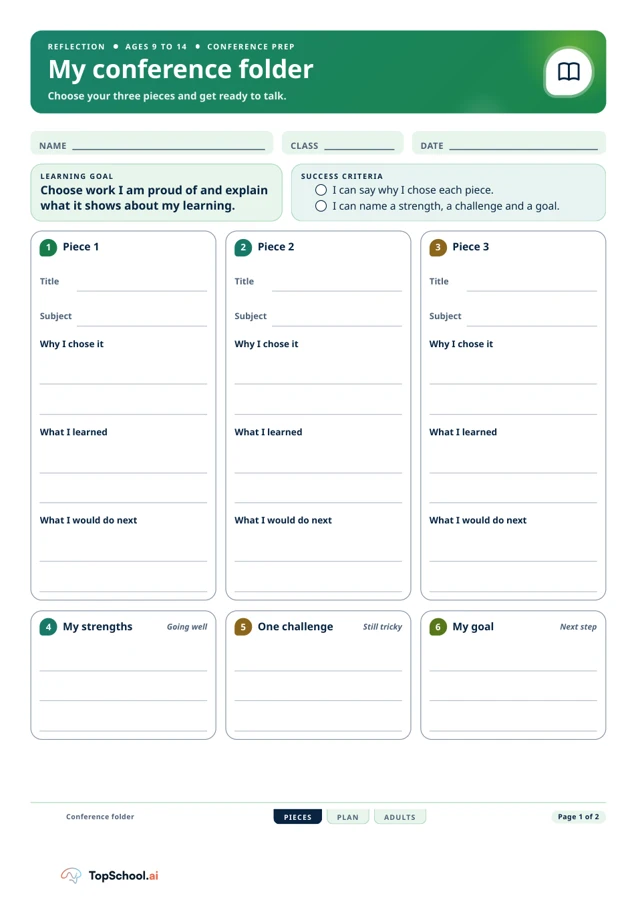
Choose three pieces of work to discuss, explain what each shows about learning and prepare a goal or question for a conference. The two pages help pupils name a strength, a challenge and a next step, then rehearse what they want to say.
Read the material
Choose three pieces of work to discuss, explain what each shows about learning and prepare a goal or question for a conference. The two pages help pupils name a strength, a challenge and a next step, then rehearse what they want to say.
Complete resource. Use the preview for diagrams and layout.
Page 1
NAME
CLASS
DATE
LEARNING GOAL
Choose work I am proud of and explain
what it shows about my learning.
SUCCESS CRITERIA
I can say why I chose each piece.
I can name a strength, a challenge and a goal.
Conference folder
PIECES
PLAN
ADULTS
Page 1 of 2
REFLECTION
AGES 9 TO 14
CONFERENCE PREP
My conference folder
Choose your three pieces and get ready to talk.
1
Piece 1
Title
Subject
Why I chose it
What I learned
What I would do next
2
Piece 2
Title
Subject
Why I chose it
What I learned
What I would do next
3
Piece 3
Title
Subject
Why I chose it
What I learned
What I would do next
4
My strengths
Going well
5
One challenge
Still tricky
6
My goal
Next step
Page 2
Conference folder
PIECES
PLAN
ADULTS
Page 2 of 2
REFLECTION
AGES 9 TO 14
CONFERENCE PLAN
My conference plan
1
What I will say
Finish each sentence
I am proud of
I chose this because
I found it hard to
I got better at
Next I will try
2
Ready for the day?
My three pieces are in my folder.
I have said my plan out loud once.
My questions are written down.
I know who is coming with me.
I have thought about one thing to
celebrate.
It is your meeting. You lead it, and it is fine to take your
time.
3
Questions to ask
Parent, carer or teacher
4
I want help with
A
B
C
D
5
Agreed targets
Fill in after, in your own words
My initials
Adult initials
Date
Review on
A teaching sequence
Select examples of work, explain what they show about learning and prepare a specific next step or question for a conference.
Select and describe three pieces
For each piece, record its title and subject, why it was chosen, what was learned and what the pupil might do next.
Why did the pupil choose this piece and what might they do next?
Name a strength, challenge and goal
Name a strength and one challenge, then write a goal as a practical next step.
Is the goal a practical next action the pupil can discuss?
Rehearse the meeting plan
Use the sentence starters on page 2 to plan what to say. Let the pupil rehearse the plan aloud once.
Which sentence starter helps the pupil explain their own choice?
Prepare questions and agree targets
Complete the readiness checklist, questions and requested support before the meeting. Afterwards, record agreed targets in the pupil's words and a date to review them.
What support does the pupil want, and when will the agreed target be revisited?
Before you teach
Look for the thinking behind an answer, choose the support your class needs and leave room for an independent response.
What to look for
Look for a pupil who can connect a piece of work with something learned and a possible next step. Ask, “What does this piece show you can do now?” If a pupil is unsure, help them choose one detail from the work rather than supply an answer for them.
Give a little support
Offer a choice of two pieces and use the printed prompts one at a time. A pupil can draw or talk through an answer before writing. Invite a trusted adult to help record the pupil's own words without replacing their choices.
Take the idea further
Ask the pupil to compare two pieces and explain how their approach changed. They can identify a question for the meeting that helps them decide what to try next, then revisit the agreed target on the review date.
Things to keep in mind
This is a reflection and meeting-preparation form, not a formal assessment of attainment. The pupil should be able to choose what to discuss and ask for help. Agree who will attend and how targets will be recorded with the school and family.
Keep the idea. Make it yours.
Bring your topic, learning goal and class context to PLAI™, then review what you create.
Ideas for using this resource
Sample teaching perspectives on what to try, what to adapt and what to watch for.
Meet The Creators
Meet a creator whose teaching interests connect with this template.
Little Lightbulbs
For ages 9 to 14, this two-page guide asks learners to choose three pieces of work, explain why they chose each, identify what they learned and prepare a strength, challenge, goal or question for a conference. The prompts connect selection to reflection.
Chalk Dust & Checklists
The folder plan helps a pupil bring concrete work into a conversation about learning. Asking what was learned and what to work on next supports a forward-looking discussion rather than a simple display of favourite pieces.
Good Question
Let pupils select from a small set of work and rehearse one explanation aloud before completing the plan. Adults can help with the title or subject fields while leaving the choice and reflection in the learner's voice.
Quietly Curious
A portfolio conference guide does not itself assess the quality of learning or guarantee that a conference takes place. Agree which work can be shared and make the next step concrete and manageable for the pupil.