
Science
Physics Peer Review and Lab Assessment Rubric
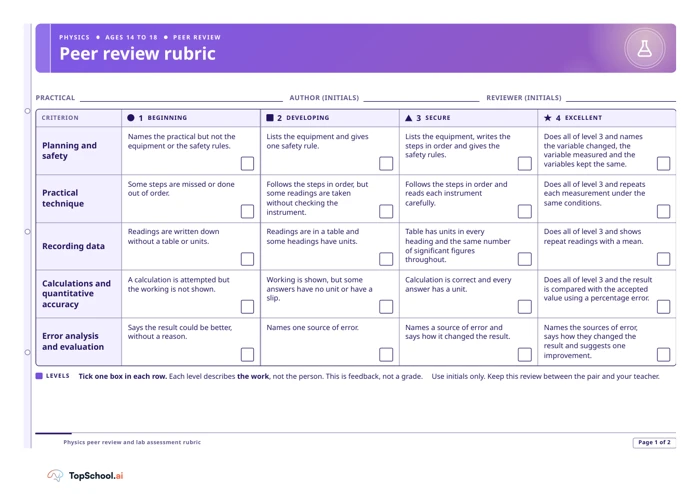
Review a physics practical against criteria for planning and safety, technique, data, calculations and evaluation. The second page provides structured peer feedback and a worked percentage-error example. The form says the review is feedback, not a grade, and asks users to keep it between the pair and teacher.
Read the material
Review a physics practical against criteria for planning and safety, technique, data, calculations and evaluation. The second page provides structured peer feedback and a worked percentage-error example. The form says the review is feedback, not a grade, and asks users to keep it between the pair and teacher.
Complete resource. Use the preview for diagrams and layout.
Page 1
PHYSICS
AGES 14 TO 18
PEER REVIEW
Peer review rubric
PRACTICAL
AUTHOR (INITIALS)
REVIEWER (INITIALS)
CRITERION
1 BEGINNING
2 DEVELOPING
3 SECURE
4 EXCELLENT
Planning and
safety
Names the practical but not the
equipment or the safety rules.
Lists the equipment and gives
one safety rule.
Lists the equipment, writes the
steps in order and gives the
safety rules.
Does all of level 3 and names
the variable changed, the
variable measured and the
variables kept the same.
Practical
technique
Some steps are missed or done
out of order.
Follows the steps in order, but
some readings are taken
without checking the
instrument.
Follows the steps in order and
reads each instrument
carefully.
Does all of level 3 and repeats
each measurement under the
same conditions.
Recording data
Readings are written down
without a table or units.
Readings are in a table and
some headings have units.
Table has units in every
heading and the same number
of significant figures
throughout.
Does all of level 3 and shows
repeat readings with a mean.
Calculations and
quantitative
accuracy
A calculation is attempted but
the working is not shown.
Working is shown, but some
answers have no unit or have a
slip.
Calculation is correct and every
answer has a unit.
Does all of level 3 and the result
is compared with the accepted
value using a percentage error.
Error analysis
and evaluation
Says the result could be better,
without a reason.
Names one source of error.
Names a source of error and
says how it changed the result.
Names the sources of error,
says how they changed the
result and suggests one
improvement.
LEVELS
Tick one box in each row. Each level describes the work, not the person. This is feedback, not a grade.
Use initials only. Keep this review between the pair and your teacher.
Physics peer review and lab assessment rubric
Page 1 of 2
Page 2
PHYSICS
AGES 14 TO 18
PEER REVIEW
Peer review feedback
PRACTICAL
AUTHOR (INITIALS)
REVIEWER (INITIALS)
E N T R Y
1
Two glows
What went well
Glow 1: I noticed that ...
Glow 2: I noticed that ...
E N T R Y
2
One grow
What to try next
Next time you could ...
E N T R Y
3
Percentage error
Worked example
m/s2
GAP
m/s2
Measured 9.5 m/s2, accepted 9.8 m/s2.
Difference = 0.3 m/s2.
0.3 ÷ 9.8 × 100 = about 3%
What this tells us about the result
E N T R Y
4
Kind and specific
WEAK
“It was fine.”
STRONG
“Your table had units in every heading, which made the
readings easy to follow.”
E N T R Y
5
Author reply
What I will change
A question I want to ask my reviewer
9.5
9.8
Our numbers
Measured
Accepted
Difference
difference ÷ accepted × 100 =
I NOTICED THAT ...
THIS HELPED BECAUSE ...
NEXT TIME YOU COULD ...
Physics peer review and lab assessment rubric
Page 2 of 2
A teaching sequence
Use the rubric to identify evidence in a practical report, give a specific improvement suggestion and reflect on a response to peer feedback.
Read the practical descriptors
Read the four levels for planning and safety, practical technique, recording data, calculations and error analysis.
Which criteria apply to this particular investigation?
Select levels through report evidence
Select a descriptor supported by the practical report. Note what the writer did rather than judging the writer.
What did the writer record or calculate to support this descriptor?
Write two glows and one grow
Use the second page to give two glows and one grow, then check that feedback is kind and specific.
Is each comment specific to an observable part of the report?
Reply with a change and a question
Complete the author reply by identifying one change to make and a question for the reviewer. Use observable details and agree a next step for the author.
What will the author change, and what needs clarification from the reviewer?
Before you teach
Look for the thinking behind an answer, choose the support your class needs and leave room for an independent response.
What to look for
Look for feedback linked to a criterion and an example from the report, such as units in table headings or repeated measurements. Ask, “What evidence supports this level?” The sample percentage-error calculation uses measured 9.5 m/s² and accepted 9.8 m/s², giving about 3 per cent.
Give a little support
Ask pupils to review one criterion at a time and use the worked feedback sentence as a model. Where percentage error is not relevant or no accepted value exists, skip that section rather than inventing a reference value.
Take the idea further
Ask pupils to explain how a source of error may change the result and propose one improvement. If repeated measurements are available, compare them under the same conditions and discuss what the mean adds to the interpretation.
Things to keep in mind
This peer rubric is not a validated grade or substitute for subject teacher assessment. The percentage-error section assumes an accepted value is available and suitable; do not apply it to every investigation. Check physics terminology, units and accepted values for the specific practical.
Keep the idea. Make it yours.
Bring your topic, learning goal and class context to PLAI™, then review what you create.
Ideas to try with your class
Sample teaching perspectives on what to try, what to adapt and what to watch for.
Meet The Creators
Meet a creator whose teaching interests connect with this template.

Helpful Highlighter
A peer scores a practical report across planning and safety, method, data, graphing, conclusion and evaluation, then suggests one improvement. Initials identify author and reviewer without requiring names on the sheet.
Paperclip Perspective
The four performance levels describe evidence such as naming variables, recording units and linking a conclusion to data. The response section asks the author to decide which feedback to act on, so peer review leads back to revision.
One More Question
Use one criterion at a time and point to a report line or table entry before selecting a level. If a level is uncertain, record the evidence and question rather than forcing a score.
Board Eraser
The rubric supports report feedback; it does not validate the practical method or replace the teacher's safety review. Interpret the criteria against the actual experiment and avoid treating the total as a measure of a pupil's scientific ability.