
Geography
Outdoor fieldwork: what is on the ground?
For Reception to Year 6 pupils with adult supervision, record ground-cover observations in four equal parts of a teacher-selected plot and compare two plots without disturbing wildlife.
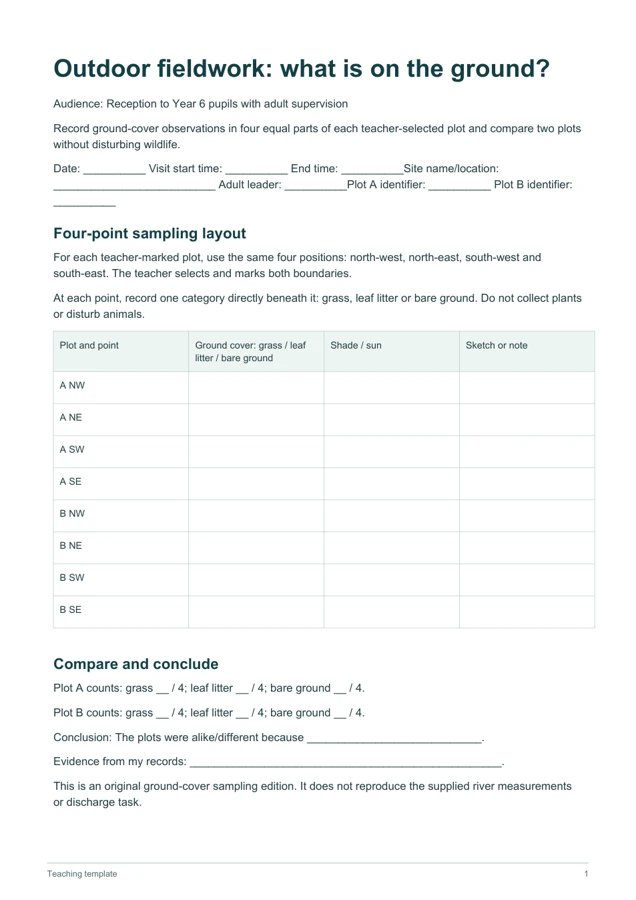
Read the material
For Reception to Year 6 pupils with adult supervision, record ground-cover observations in four equal parts of a teacher-selected plot and compare two plots without disturbing wildlife.
Pupil document. Use the preview for diagrams and layout.
Page 1
Teaching template
1
Outdoor fieldwork: what is on the ground?
Audience: Reception to Year 6 pupils with adult supervision
Record ground-cover observations in four equal parts of each teacher-selected plot and compare two plots
without disturbing wildlife.
Date: __________ Visit start time: __________ End time: __________Site name/location:
__________________________ Adult leader: __________Plot A identifier: __________ Plot B identifier:
__________
Four-point sampling layout
For each teacher-marked plot, use the same four positions: north-west, north-east, south-west and
south-east. The teacher selects and marks both boundaries.
At each point, record one category directly beneath it: grass, leaf litter or bare ground. Do not collect plants
or disturb animals.
Plot and point
Ground cover: grass / leaf
litter / bare ground
Shade / sun
Sketch or note
A NW
A NE
A SW
A SE
B NW
B NE
B SW
B SE
Compare and conclude
Plot A counts: grass __ / 4; leaf litter __ / 4; bare ground __ / 4.
Plot B counts: grass __ / 4; leaf litter __ / 4; bare ground __ / 4.
Conclusion: The plots were alike/different because ____________________________.
Evidence from my records: __________________________________________________.
This is an original ground-cover sampling edition. It does not reproduce the supplied river measurements
or discharge task.
A teaching sequence
Record ground-cover observations in four equal parts of a teacher-selected plot and compare two plots without disturbing wildlife.
Record site and plot details
Record the visit date, time, site and plot labels before starting.
Can you identify both teacher-selected plots before observing?
Use four consistent positions
With an adult, use the same four positions in each teacher-marked plot.
Are north-west, north-east, south-west and south-east used in both plots?
Observe without disturbing
Record one ground-cover category at each point without collecting or disturbing anything.
Which one category lies directly beneath this point?
Compare supported counts
Compare the two plots and write or say a conclusion supported by counts.
What do the four-point counts support without describing the whole site?
Before you teach
Look for the thinking behind an answer, choose the support your class needs and leave room for an independent response.
What to look for
A useful conclusion names a difference found in the eight recorded points and gives the count that supports it. Example: “Plot A had grass at three points; Plot B had grass at one point.”
Give a little support
For younger pupils, an adult can mark the four positions and offer the three category words as picture cards.
Take the idea further
Older pupils can calculate the fraction of points in each category and compare plots.
Things to keep in mind
This is a standalone ground-cover sampling edition, not river-measurement fieldwork. An educator must select the site, supervise access and approve observation conditions.
Keep the idea. Make it yours.
Bring your topic, learning goal and class context to PLAI™, then review what you create.
Ideas to try with your class
Sample teaching perspectives on what to try, what to adapt and what to watch for.
Meet The Creators
Meet a creator whose teaching interests connect with this template.
Notes Between Bells
The plot record uses the same four marked positions (north-west, north-east, south-west and south-east) in both teacher-selected plots. Pupils record grass, leaf litter or bare ground, then compare counts and cite their own entries.
Page-Turner Planner
For Reception to Year 6 with adult supervision, this is a focused ground-cover sample, distinct from river measurement or discharge. Fixed plot boundaries and positions make the two observations more comparable.
Clear Example
A teacher selects and marks the boundaries, while pupils can record one category and shade/sun at each point. The final sentence frame connects the comparison to evidence from the sampling table.
Spare Pencil
Do not collect plants or disturb animals; the sheet states this directly. Four points in two selected plots provide a small sample, not a complete description of the wider site.