
Languages and literacy
Media vocabulary: describe, compare and explain
Explore six media terms through matching and two fictional versions of a garden-opening report. A pupil sheet asks learners to compare headline emphasis, identify an inference and rewrite without adding facts. The companion supplies term matches and a comparison model; pupil and teacher HTML alternatives are also available.
Read the material
Explore six media terms through matching and two fictional versions of a garden-opening report. A pupil sheet asks learners to compare headline emphasis, identify an inference and rewrite without adding facts. The companion supplies term matches and a comparison model; pupil and teacher HTML alternatives are also available.
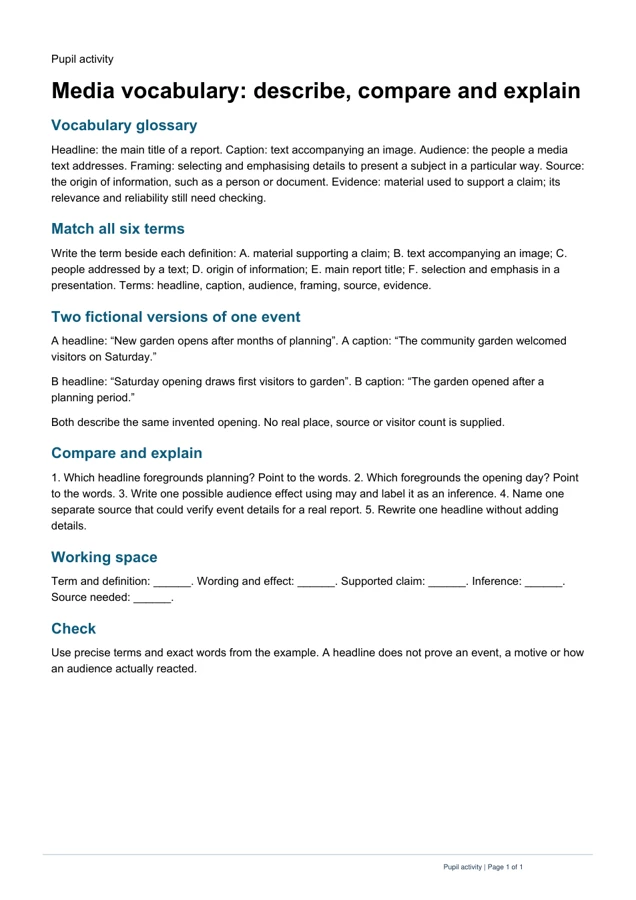
Pupil worksheet. Use the preview for diagrams and layout.
Page 1
Pupil activity
Media vocabulary: describe, compare and explain
Vocabulary glossary
Headline: the main title of a report. Caption: text accompanying an image. Audience: the people a media
text addresses. Framing: selecting and emphasising details to present a subject in a particular way. Source:
the origin of information, such as a person or document. Evidence: material used to support a claim; its
relevance and reliability still need checking.
Match all six terms
Write the term beside each definition: A. material supporting a claim; B. text accompanying an image; C.
people addressed by a text; D. origin of information; E. main report title; F. selection and emphasis in a
presentation. Terms: headline, caption, audience, framing, source, evidence.
Two fictional versions of one event
A headline: “New garden opens after months of planning”. A caption: “The community garden welcomed
visitors on Saturday.”
B headline: “Saturday opening draws first visitors to garden”. B caption: “The garden opened after a
planning period.”
Both describe the same invented opening. No real place, source or visitor count is supplied.
Compare and explain
1. Which headline foregrounds planning? Point to the words. 2. Which foregrounds the opening day? Point
to the words. 3. Write one possible audience effect using may and label it as an inference. 4. Name one
separate source that could verify event details for a real report. 5. Rewrite one headline without adding
details.
Working space
Term and definition: ______. Wording and effect: ______. Supported claim: ______. Inference: ______.
Source needed: ______.
Check
Use precise terms and exact words from the example. A headline does not prove an event, a motive or how
an audience actually reacted.
Pupil activity | Page 1 of 1
Page 1
Teacher companion
Media vocabulary: describe, compare and explain
Matching key
A evidence; B caption; C audience; D source; E headline; F framing.
Comparison model
A foregrounds planning through “after months of planning”; B foregrounds Saturday and first visitors. The
wording may direct attention to different details, but does not measure actual audience response. A dated
opening record or a responsible organiser could help verify details in a real report.
Review
Accept interpretations tied to wording. Check revised headlines preserve the invented facts. Do not infer a
real place, visitor number, motive or source reliability from this pair.
Teacher companion | Page 1 of 1
A teaching sequence
Pupils should use the six terms accurately, cite wording that foregrounds planning or opening day, and label a possible audience effect as an inference. A revised headline should preserve the supplied facts and identify a separate source needed for real reporting.
Match media terms precisely
Check the six matches and discuss the difference between a source and evidence supporting a claim. Ask what reliability or relevance still needs checking after naming a source.
Why does naming a source not establish its reliability?
Compare headline emphasis
Compare the headline wording, pointing to “after months of planning” and “Saturday opening”. Keep the event constant while discussing the detail each version emphasises.
Which exact words foreground planning or the opening day?
Label a possible audience effect
Write a possible audience effect using “may” and label it as inference. Identify a separate record or responsible organiser who could verify details if this were a real report.
Is the effect an inference using may rather than a measured reaction?
Rewrite within the evidence
Rewrite one headline and use the working space to check supported claims against added details. Remove an invented count, motive or reaction and explain why it exceeds the supplied evidence.
Have you added a visitor count, motive or reaction that was never supplied?
Before you teach
Look for the thinking behind an answer, choose the support your class needs and leave room for an independent response.
What to look for
A useful comparison says version A foregrounds planning through “after months of planning”, while B foregrounds opening day. “This may direct attention to preparation” is a possible inference, not a measured reaction. If a pupil says the headline proves success, ask which independent record would support that judgement.
Give a little support
Colour-code the headline and caption, then compare one phrase from each version. Use “The words… emphasise…” for observation and “This may…” for a possible effect. Keep those statements in separate working-space fields so an inference does not become an asserted fact.
Take the idea further
Write two headlines that foreground different supplied details without changing the invented event. Ask a partner to identify the emphasised words and any added assumption. Revise one headline after that review, then state what evidence would be needed to use it in a real report.
Things to keep in mind
The pair establishes no real place, audience response, visitor count or organiser’s motive.
Keep the idea. Make it yours.
Bring your topic, learning goal and class context to PLAI™, then review what you create.
Ideas to try with your class
Sample teaching perspectives on what to try, what to adapt and what to watch for.
Meet The Creators
Meet the creators whose teaching interests connect with this template. Find an approach to try with your class.

Claire Dunmore
Drafting gives pupils a chance to shape an idea, test what they mean and make a revision with a purpose.
Meet the creator
Claire Hopwood
English and Media have to offer a common academic challenge while recognising that pupils may approach the language of a task from different starting points.
Meet the creator
One More Question
This one-page pupil activity defines six media terms and compares two fictional headlines about a school bike shelter. Pupils must quote wording, label an audience effect as an inference and preserve the supplied facts when revising a headline.
Organised Pile
The prompts distinguish what the text says from what a reader might infer. Requiring a separate source for real reporting also makes the boundary between a classroom example and verified news clear.
The Curious Pencil
Start by highlighting the exact words that foreground planning or opening day. Then use a sentence frame that separates “the headline says” from “a reader may infer,” and keep the supplied facts alongside the rewrite.
Pocketful of Stories
Both headlines are fictional, and no real audience response is measured. A revised headline cannot establish that the shelter exists; real reporting needs a separate verified source.