
Languages and literacy
I can write my name: trace and practise
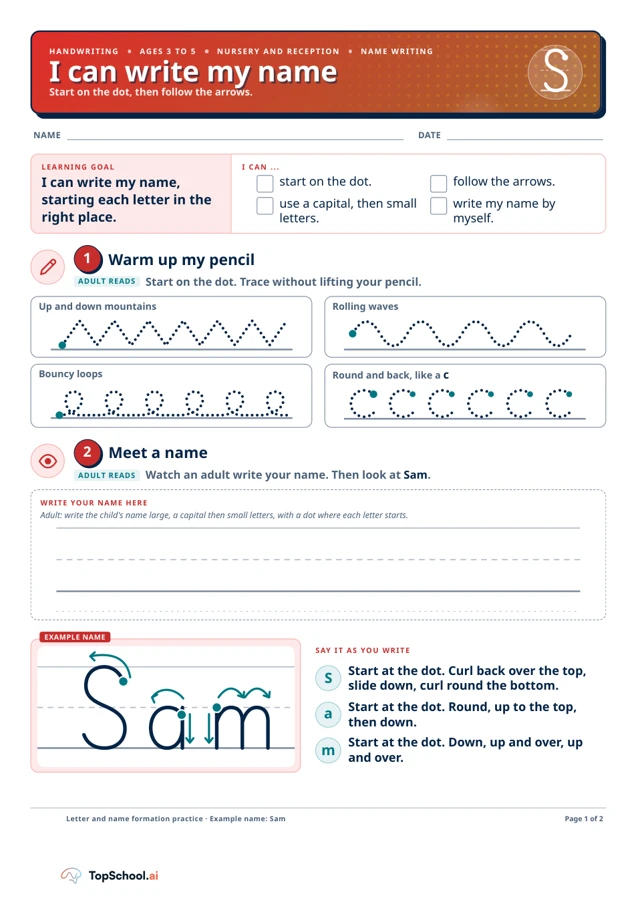
Practise early name writing through warm-up marks, a model name and several ways to trace or write. Adults personalise the sheet with the child’s name, add starting dots and support the child to find letters in a group of examples.
Read the material
Practise early name writing through warm-up marks, a model name and several ways to trace or write. Adults personalise the sheet with the child’s name, add starting dots and support the child to find letters in a group of examples.
Shared activity record. Use the preview for diagrams and layout.
Page 1
NAME
DATE
LEARNING GOAL
I can write my name,
starting each letter in the
right place.
I CAN ...
start on the dot.
follow the arrows.
use a capital, then small
letters.
write my name by
myself.
1
Warm up my pencil
ADULT READS
Start on the dot. Trace without lifting your pencil.
Up and down mountains
Rolling waves
Bouncy loops
Round and back, like a c
2
Meet a name
ADULT READS
Watch an adult write your name. Then look at Sam.
SAY IT AS YOU WRITE
S
Start at the dot. Curl back over the top,
slide down, curl round the bottom.
a
Start at the dot. Round, up to the top,
then down.
m
Start at the dot. Down, up and over, up
and over.
Letter and name formation practice · Example name: Sam
HANDWRITING
AGES 3 TO 5
NURSERY AND RECEPTION
NAME WRITING
I can write my name
I can write my name
Start on the dot, then follow the arrows.
WRITE YOUR NAME HERE
Adult: write the child's name large, a capital then small letters, with a dot where each letter starts.
EXAMPLE NAME
Page 1 of 2
Page 2
3
Trace Sam, then my name
ADULT READS
Start on each dot. Then write your own name.
A
DARK
DOTS
B
START
DOTS
ONLY
Now my own name.
Adult: write the child's name in row C in highlighter, with start dots.
C
TRACE
OVER
D
BY
MYSELF
4
Find the letters
ADULT READS
Circle every S, a and m. Leave the other letters.
I wrote my
name!
Colour the star.
Letter and name formation practice · Example name: Sam
I CAN WRITE MY NAME
AGES 3 TO 5
Trace it, find it, write it
Trace it, find it, write it
Page 2 of 2
A teaching sequence
Explore pencil movement and practise forming familiar letters in a child’s name.
Warm up relaxed pencil movement
Try the warm-up paths on page 1, starting at the marked dots and following the arrows. Encourage relaxed movement rather than speed.
Can you follow the path from the dot without rushing?
Watch your own name model
The adult writes the child’s name in a large, clear style using a capital followed by lower-case letters, with a starting dot for each letter.
Does the adult model use your name and its appropriate writing system?
Choose a tracing route
Use Sam to model the spoken movement while tracing, recognising that another name has different paths. Select dark-dot or start-dot support before an adult adds the child's name for optional tracing.
Which starting dots or trace-over support feel useful?
Try, find letters or stop
Invite the child to write their name independently if they want to, then find the matching letters in the letter group and colour the star. Follow the child’s choice and notice letters found.
Would you like to trace, write or stop?
Before you teach
Look for the thinking behind an answer, choose the support your class needs and leave room for an independent response.
What to look for
Notice whether the child can begin a mark, follow a path or recognise letters in their name. Offer encouragement for effort and choice. Do not treat one worksheet as a measure of handwriting readiness or require repeated tracing when the child is tired or uninterested.
Give a little support
Use a comfortable writing position and a tool the child can hold or control. Offer large marks, finger tracing, adapted grip or an alternative way to indicate letters. Respect the child’s name, pronunciation and preferred writing system.
Take the idea further
Invite the child to write a name in a different place or with a different tool, such as chalk or a large brush. They can identify a familiar first letter in other words or decorate a name without needing to copy it repeatedly.
Things to keep in mind
Early writing develops at different rates and can be shown in many ways. The sheet uses a Latin-letter example and should be adapted for the child’s name and writing system. It is a playful practice page, not a handwriting assessment.
Keep the idea. Make it yours.
Bring your topic, learning goal and class context to PLAI™, then review what you create.
Ideas for using this resource
Sample teaching perspectives on what to try, what to adapt and what to watch for.
Meet The Creators
Meet a creator whose teaching interests connect with this template.

Pencil Case Pal
The two-page handwriting practice starts with pencil warm-ups, models “Sam”, then offers a pupil’s own name in dotted and highlighted forms before independent writing. The adult instruction specifies a capital followed by lowercase letters and start dots.
Good Question
For ages 3 to 5, the sequence moves from tracing a motion to observing a name, practising it and finding its letters in print. The child sees each letter’s start point and direction rather than copying an undifferentiated line.
Steady Marker
An adult can write the child’s chosen name large and add start dots, then use the highlighter row as a bridge to writing alone. The “find the letters” task offers a recognition option alongside pencil practice.
Glue Stick Club
“Sam” is only the example name, and letter paths differ across names and handwriting styles. Use the child’s actual name and an agreed formation model; do not treat tracing one example as evidence of all-letter mastery.