
History and social studies
Was it significant? Judge with the 5 Rs
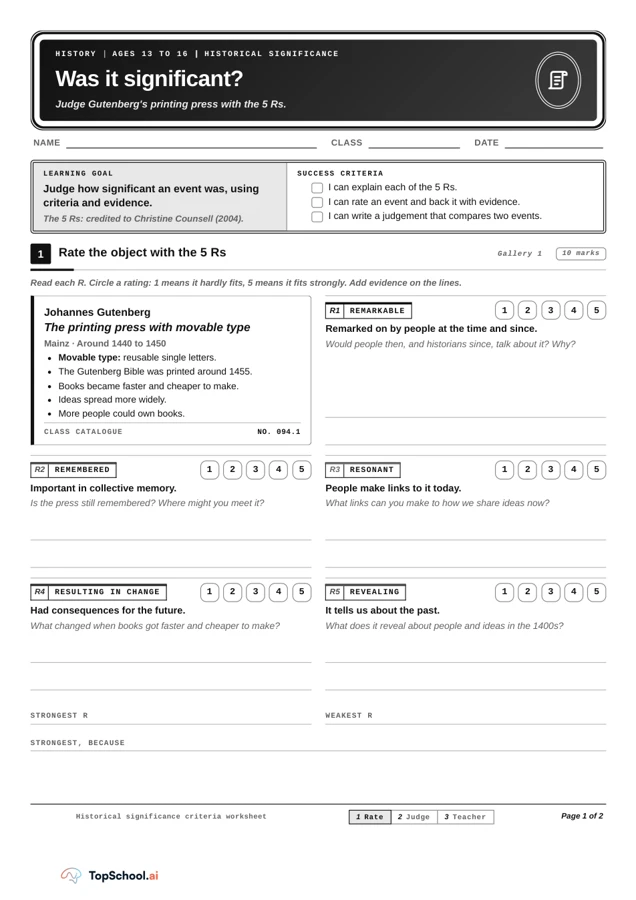
Use five criteria to build an evidence-based judgement about historical significance. The worksheet applies the 5 Rs to Gutenberg’s movable-type printing press, asks pupils to compare it with a second studied event and finish with a reasoned conclusion.
Read the material
Use five criteria to build an evidence-based judgement about historical significance. The worksheet applies the 5 Rs to Gutenberg’s movable-type printing press, asks pupils to compare it with a second studied event and finish with a reasoned conclusion.
Activity. Use the preview for diagrams and layout.
Page 1
NAME
CLASS
DATE
LEARNING GOAL
Judge how significant an event was, using
criteria and evidence.
The 5 Rs: credited to Christine Counsell (2004).
SUCCESS CRITERIA
I can explain each of the 5 Rs.
I can rate an event and back it with evidence.
I can write a judgement that compares two events.
Read each R. Circle a rating: 1 means it hardly fits, 5 means it fits strongly. Add evidence on the lines.
Johannes Gutenberg
The printing press with movable type
Mainz · Around 1440 to 1450
Movable type: reusable single letters.
The Gutenberg Bible was printed around 1455.
Books became faster and cheaper to make.
Ideas spread more widely.
More people could own books.
CLASS CATALOGUE
NO. 094.1
R1
REMARKABLE
1
2
3
4
5
Remarked on by people at the time and since.
Would people then, and historians since, talk about it? Why?
R2
REMEMBERED
1
2
3
4
5
Important in collective memory.
Is the press still remembered? Where might you meet it?
R3
RESONANT
1
2
3
4
5
People make links to it today.
What links can you make to how we share ideas now?
R4
RESULTING IN CHANGE
1
2
3
4
5
Had consequences for the future.
What changed when books got faster and cheaper to make?
R5
REVEALING
1
2
3
4
5
It tells us about the past.
What does it reveal about people and ideas in the 1400s?
STRONGEST R
WEAKEST R
STRONGEST, BECAUSE
Historical significance criteria worksheet
H I S T O R Y
A G E S 1 3 T O 1 6
H I S T O R I C A L S I G N I F I C A N C E
Was it significant?
Judge Gutenberg's printing press with the 5 Rs.
1
Rate the object with the 5 Rs
Gallery 1
10 marks
2 Judge
3 Teacher
1 Rate
Page 1 of 2
Page 2
Choose any event, movement or person you have studied. Copy your page 1 ratings, then rate your choice.
CRITERION
PRESS
OBJECT 2
R1 Remarkable
R2 Remembered
R3 Resonant
R4 Resulting in change
R5 Revealing
Total out of 25
OBJECT 2
WHEN
a Which R shows the biggest difference? Why?
b Does the higher total always win? Explain.
Historical significance criteria worksheet
H I S T O R Y
T H E P R I N T I N G P R E S S
C O M P A R E A N D J U D G E
Compare, then judge
2
Compare with a second event
Gallery 2
6 marks
3
Your significance judgement
Studio
8 marks
How significant was Gutenberg's printing press? Compare it with object 2.
Key idea: significance is argued, not just stated. Do not stop at “it was important”: name the R and give evidence.
SENTENCE STARTERS
a The press was significant
because ...
b My strongest evidence is ...
c Compared with object 2, ...
d However, it is weaker on ...
e Overall, I judge that ...
GO FURTHER
Can an event be
significant if few people
remember it? Discuss
with a partner.
1 Rate
3 Teacher
2 Judge
Page 2 of 2
Page 1
Was it significant? Judge with the 5 Rs
Teacher companion
History | Pupils aged 13 to 16
Use with the exact 2-page original file. Keep pupil or staff activity pages separate from this teacher companion.
When to use it
Use after pupils have studied the historical event or person they will compare with the
example. Introduce each criterion and model how to support a rating with evidence rather
than treating the total score as a definitive ranking.
Purpose
Apply significance criteria, support ratings with evidence and compare the significance of two
historical subjects.
Start here
Read the five Rs and the brief Gutenberg context, then choose a rating and evidence for each
criterion.
A teaching sequence
1. Rate Gutenberg’s movable-type printing press against the 5 Rs: remarkable, remembered,
resonant, resulting in change and revealing. Record evidence for each rating.
2. Identify the strongest and weakest criteria, then choose a second studied event, movement
or person and rate it using the same prompts.
3. Compare the ratings and consider whether a higher total always means greater
significance, including whose perspectives are remembered.
4. Write a judgement comparing both subjects, strongest criterion and evidence. Ask, “Which
criterion has the strongest evidence?” Weigh reasons rather than relying on a score.
Checking guidance
Look for evidence linked to each criterion, an explicit comparison and a judgement that
weighs reasons rather than reporting only a score. Check that the selected comparison is
supported by what pupils have studied and that the historical context and attribution are
accurate.
A useful judgement names a strongest criterion, gives evidence and considers a perspective
the scoring table may overlook. Higher totals alone do not settle historical significance.
Support
Pre-teach each criterion and provide a short source or class notes about the event. Pupils can
discuss one R at a time and use sentence starters to connect a claim with evidence. Clarify
that a rating is a reasoned judgement, not a factual measurement.
Take it further
Ask pupils to test whether the criteria work equally well for an event that is not widely
remembered. They can compare whose perspectives shape collective memory and identify
evidence that might challenge their first rating.
Things to keep in mind
Historical significance is debated and depends on the question, evidence and perspective. The
5 Rs are an organising framework, not an objective score. The brief Gutenberg timeline and
criteria attribution should be checked against the class’s historical sources.
Was it significant? Judge with the 5 Rs
Teacher companion | Page 1
A teaching sequence
Apply significance criteria, support ratings with evidence and compare the significance of two historical subjects.
Rate through the five significance criteria
Rate Gutenberg’s movable-type printing press against the 5 Rs: remarkable, remembered, resonant, resulting in change and revealing. Record evidence for each rating.
What evidence supports each rating for the printing press?
Choose a second studied subject
Identify the strongest and weakest criteria, then choose a second studied event, movement or person and rate it using the same prompts.
Which criterion is strongest or weakest for each subject?
Compare ratings and remembered perspectives
Compare the ratings and consider whether a higher total always means greater significance, including whose perspectives are remembered.
Why might the higher total not settle significance for this question?
Write a comparative judgement through evidence
Write a judgement comparing both subjects, strongest criterion and evidence. Weigh reasons rather than relying on a score.
Which strongest criterion and limitation support the final view?
Before you teach
Look for the thinking behind an answer, choose the support your class needs and leave room for an independent response.
What to look for
Look for evidence linked to each criterion, an explicit comparison and a judgement that weighs reasons rather than reporting only a score. Check that the selected comparison is supported by what pupils have studied and that the historical context and attribution are accurate. A useful judgement names a strongest criterion, gives evidence and considers a perspective the scoring table may overlook. Higher totals alone do not settle historical significance.
Give a little support
Pre-teach each criterion and provide a short source or class notes about the event. Pupils can discuss one R at a time and use sentence starters to connect a claim with evidence. Clarify that a rating is a reasoned judgement, not a factual measurement.
Take the idea further
Ask pupils to test whether the criteria work equally well for an event that is not widely remembered. They can compare whose perspectives shape collective memory and identify evidence that might challenge their first rating.
Things to keep in mind
Historical significance is debated and depends on the question, evidence and perspective. The 5 Rs are an organising framework, not an objective score. The brief Gutenberg timeline and criteria attribution should be checked against the class’s historical sources.
Keep the idea. Make it yours.
Bring your topic, learning goal and class context to PLAI™, then review what you create.
Ideas to try with your class
Sample teaching perspectives on what to try, what to adapt and what to watch for.
Meet The Creators
Meet a creator whose teaching interests connect with this template.

Tea at Breaktime
The two-page worksheet applies Counsell’s five Rs (remarkable, remembered, resonant, resulting in change and revealing) to Gutenberg’s press. Each rating has a question for evidence, followed by a strongest/weakest R judgement.
Notes Between Bells
For ages 13 to 16, the task asks pupils to connect the object’s effects on book production and idea-sharing to criteria for historical significance. Comparing it with a second subject on page 2 extends beyond rating one example.
Book and Biscuit
The printed questions translate each R into a distinct line of enquiry, such as who remembers the event or what it reveals about people in the 1400s. Pupils can record a fact beside each score before ranking the criteria.
Kind Check-In
The 1 to 5 scores are reasoned judgements, not objective measurements of significance. Check the historical evidence and compare explanations; the worksheet’s brief summary cannot establish every consequence of printing technology.