
Wellbeing and personal development
My habit tracker: plan, notice and reflect
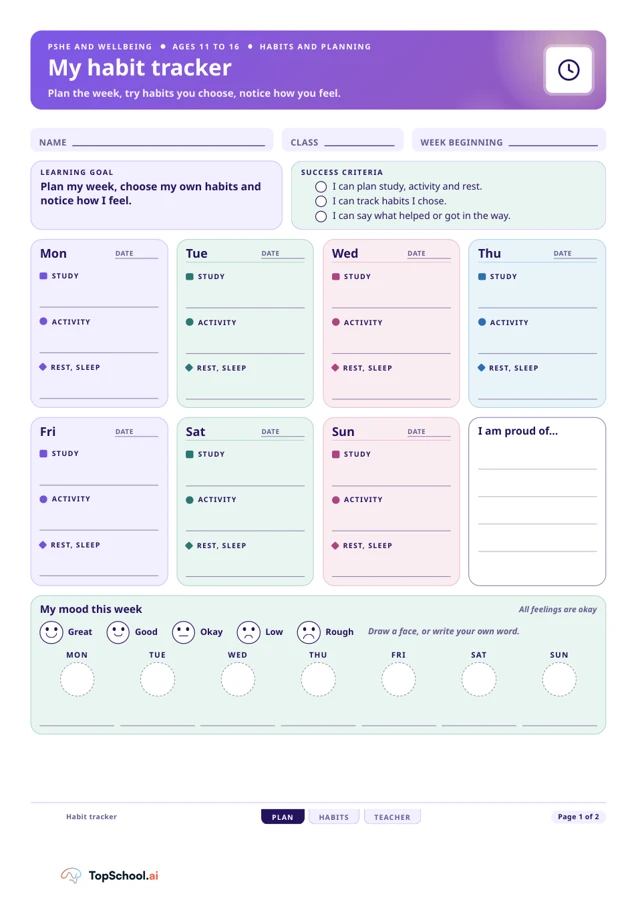
Plan study, activity and rest across a week, choose habits to track and reflect on mood and what helped. The second page includes five habit grids, a streak path, a small menu of ideas and prompts to make a new habit part of an existing routine.
Read the material
Plan study, activity and rest across a week, choose habits to track and reflect on mood and what helped. The second page includes five habit grids, a streak path, a small menu of ideas and prompts to make a new habit part of an existing routine.
Complete resource. Use the preview for diagrams and layout.
Page 1
NAME
CLASS
WEEK BEGINNING
LEARNING GOAL
Plan my week, choose my own habits and
notice how I feel.
SUCCESS CRITERIA
I can plan study, activity and rest.
I can track habits I chose.
I can say what helped or got in the way.
Habit tracker
PLAN
HABITS
TEACHER
Page 1 of 2
PSHE AND WELLBEING
AGES 11 TO 16
HABITS AND PLANNING
My habit tracker
Plan the week, try habits you choose, notice how you feel.
Mon
DATE
STUDY
ACTIVITY
REST, SLEEP
Tue
DATE
STUDY
ACTIVITY
REST, SLEEP
Wed
DATE
STUDY
ACTIVITY
REST, SLEEP
Thu
DATE
STUDY
ACTIVITY
REST, SLEEP
Fri
DATE
STUDY
ACTIVITY
REST, SLEEP
Sat
DATE
STUDY
ACTIVITY
REST, SLEEP
Sun
DATE
STUDY
ACTIVITY
REST, SLEEP
I am proud of...
My mood this week
All feelings are okay
Great
Good
Okay
Low
Rough
Draw a face, or write your own word.
MON
TUE
WED
THU
FRI
SAT
SUN
Page 2
Habit tracker
PLAN
HABITS
TEACHER
Page 2 of 2
PSHE AND WELLBEING
AGES 11 TO 16
MY HABITS
My habits and reflection
1
Shade a dot a day
M
T
W
T
F
S
S
2
Shade a dot a day
M
T
W
T
F
S
S
3
Shade a dot a day
M
T
W
T
F
S
S
4
Shade a dot a day
M
T
W
T
F
S
S
5
Shade a dot a day
M
T
W
T
F
S
S
Streak board
Shade a step for each day in a row
Habit 1
1
2
3
4
5
6
7
8
9
10
Habit 2
1
2
3
4
5
6
7
8
9
10
Habit 3
1
2
3
4
5
6
7
8
9
10
Habit 4
1
2
3
4
5
6
7
8
9
10
Habit 5
1
2
3
4
5
6
7
8
9
10
Missed a day? That is fine. Start a new streak and carry on.
Ideas if you are stuck
Drink water
Move around for a while
Read for pleasure
Tidy my bag
A screen-free hour before bed
Choose any of these, or your own. Your
habits, your choice.
What worked
What was hard
One tweak
Tiny habits menu
Attach a new habit to one you already do
Example: After I brush my teeth, I will drink a glass of water. Now write your own.
After I...
I will...
After I...
I will...
After I...
I will...
A teaching sequence
Choose personal habits, track them over a week and notice what helped or got in the way.
Choose a weekly plan and habits
Sketch study, activity and rest for the week; add a mood only if wanted. Name up to five chosen habits on the tracker.
Which habit fits your circumstances and is your own choice?
Record progress if useful
Shade a dot on days you choose to record progress. A missed day is fine; restart the streak if useful.
What will you do if a day is missed?
Reflect and connect to a routine
Reflect on what worked, what was hard and one tweak. Use the sentence stem to connect a habit to an existing routine.
What helped, and which existing routine could support the next try?
Decide what to keep or change
Decide whether to keep, change or pause the habit. Let the pupil choose a realistic next step.
Is keeping, changing or pausing the habit the realistic next step?
Before you teach
Look for the thinking behind an answer, choose the support your class needs and leave room for an independent response.
What to look for
Look for a habit the pupil selected, a way to notice progress and a reflection that helps decide a next step. A streak is only one way to track; it should not be treated as a score or a test of commitment. Respect a pupil’s choice not to record mood or sleep details.
Give a little support
Offer examples that are small and flexible, such as reading for pleasure or tidying a school bag. Let pupils choose fewer than five habits, use symbols instead of writing and omit mood or sleep details. Avoid prescribing study, movement or sleep targets without considering individual circumstances.
Take the idea further
Ask pupils to test one small change for a week and describe whether it made the habit easier to remember. They can adapt the cue, review barriers or use a different kind of tracker without treating consistency as a measure of personal worth.
Things to keep in mind
This is a planning prompt, not health advice or a measure of wellbeing. Sleep, mood and activity can be sensitive and depend on factors outside a pupil’s control. Follow school procedures if a pupil chooses to raise a health or safeguarding concern.
Keep the idea. Make it yours.
Bring your topic, learning goal and class context to PLAI™, then review what you create.
Ideas to try with your class
Sample teaching perspectives on what to try, what to adapt and what to watch for.
Meet The Creators
Meet a creator whose teaching interests connect with this template.

Extra Page
The tracker invites pupils to choose habits across study, activity and rest/sleep, record a week and notice mood, with all feelings accepted. Its streak board explicitly says a missed day is fine and a new streak can start.
After the Bell
The two-page format links planning and reflection without prescribing a fixed habit. Options such as reading for pleasure or moving around help a pupil choose something that fits their week.
Board Eraser
Five habit rows allow a pupil to select personal goals, and mood can be shown with a face or the pupil’s own word. Skipping or restarting after a missed day preserves the focus on noticing rather than perfection.
Gentle Reminder
A streak is a visual prompt, not a measure of wellbeing or personal discipline. Keep the habit choices voluntary and private, and do not interpret mood labels as clinical information.