
Science
Floating and sinking: test shape as well as material
For Year 5 pupils, predict and record what eight objects do in water, compare plasticine in two shapes and write a conclusion from the results.
Read the material
For Year 5 pupils, predict and record what eight objects do in water, compare plasticine in two shapes and write a conclusion from the results.
Pupil worksheet. Use the preview for diagrams and layout.
Page 1
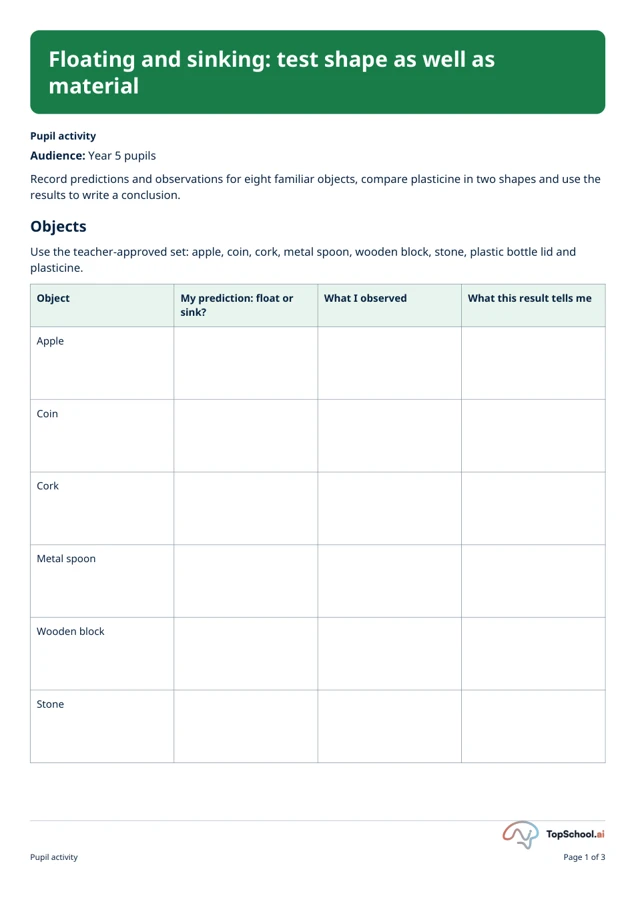
Floating and sinking: test shape as well as
material
Pupil activity
Audience: Year 5 pupils
Record predictions and observations for eight familiar objects, compare plasticine in two shapes and use the
results to write a conclusion.
Objects
Use the teacher-approved set: apple, coin, cork, metal spoon, wooden block, stone, plastic bottle lid and
plasticine.
Object
My prediction: float or
sink?
What I observed
What this result tells me
Apple
Coin
Cork
Metal spoon
Wooden block
Stone
Pupil activity
Page 1 of 3
Page 2
Floating and sinking: test shape as well as material
Object
My prediction: float or
sink?
What I observed
What this result tells me
Plastic bottle lid
Plasticine ball
Compare the shape
With the teacher's direction, use the same amount of plasticine in both tests.
Shape
Prediction
Observation
What stayed the same?
Ball
Material and amount
Boat
Material and amount
Use your results
1. How many of the eight objects floated? ______ How many sank? ______
2. Name one object whose observation matched your prediction and one that did not.
3. What happened to the same plasticine in the two shapes?
Pupil activity
Page 2 of 3
Page 3
Floating and sinking: test shape as well as material
4. Write: “In my test, ____. My table shows ____. I cannot conclude ____ from this test alone.”
Pupil activity
Page 3 of 3
Page 1
Floating and sinking: test shape as well as
material
Teacher key and guidance supporting this exact edition
Teacher check
Do not mark predictions as observations. A valid conclusion uses the pupil's actual table. If the plasticine ball
sank and the boat floated, the result suggests shape affected the outcome while material and amount stayed
the same; ask which observed rows support that statement.
Teacher companion
Page 1 of 1
A teaching sequence
Record predictions and observations for eight familiar objects, compare plasticine in two shapes and use the results to write a conclusion.
Predict before testing
Record a prediction for each of the eight objects before the teacher-led test.
Which prediction have you recorded before observing the object?
Keep observation separate
Observe each item and record float or sink without changing your prediction.
What actually happened without rewriting your prediction?
Compare plasticine shapes
With teacher direction, compare the same plasticine as a ball and as a boat.
What stayed the same when the ball became a boat?
Conclude from your table
Count and compare the results, then write one evidence-based conclusion.
What does your test support, and what can it not establish alone?
Before you teach
Look for the thinking behind an answer, choose the support your class needs and leave room for an independent response.
What to look for
Keep prediction and observation separate. For example, if the plasticine ball sinks but the same amount shaped as a boat floats, shape changed while material and amount stayed the same. Ask, “Which row supports your conclusion?”
Give a little support
Model table headings and test one object together; offer float/sink/unsure picture labels.
Take the idea further
Plan a repeat boat test while keeping the plasticine amount and container the same.
Things to keep in mind
Use a teacher-selected container and approved materials. The task does not claim that an object floats solely because of its material or size.
Keep the idea. Make it yours.
Bring your topic, learning goal and class context to PLAI™, then review what you create.
Ideas to try with your class
Sample teaching perspectives on what to try, what to adapt and what to watch for.
Meet The Creators
Meet a creator whose teaching interests connect with this template.

Margin Note
This Year 5 edition records predictions and observations for the same eight objects, then compares a ball and boat made from the same amount of plasticine. Its conclusion frame asks what the result cannot establish from this test alone.
Steady Marker
The three pages make shape a controlled comparison while holding plasticine amount constant, unlike a general float/sink prediction activity. Pupils then count floats and sinks and use evidence to write a bounded conclusion.
After the Bell
The first table supports an object-by-object record; the second prompts pupils to state what stayed the same between plasticine shapes. The teacher-directed wording helps keep the amount of material consistent.
Planning List
The material itself is not the only factor when shape changes. Follow teacher direction, use an approved object set and avoid concluding that all plasticine floats or sinks based on these two forms.