
Maths
Money maths: interest, sale prices and budgets
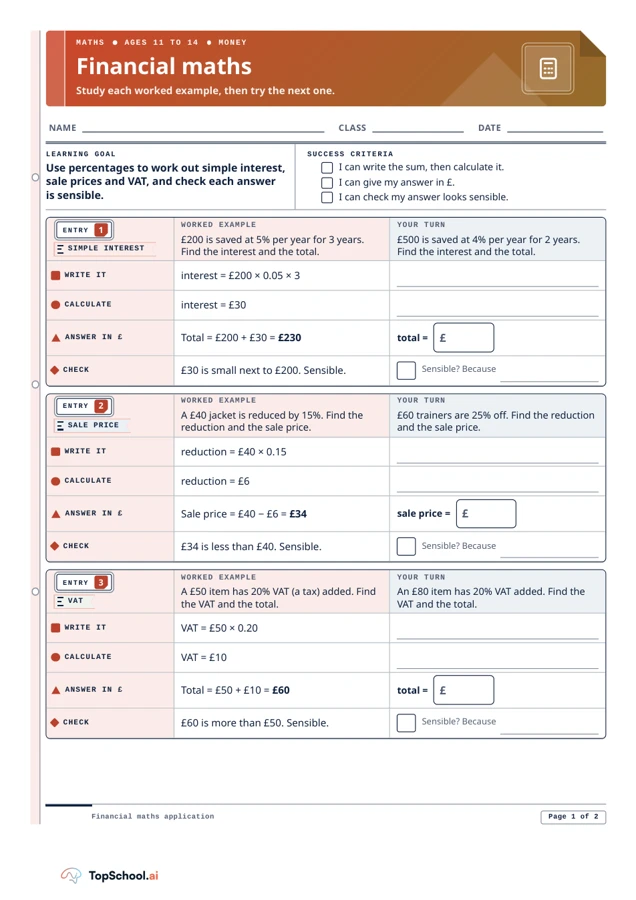
Practise percentages and everyday calculations with savings, sale prices, VAT, currency conversion and a club-trip budget. Worked examples show how to set out a calculation and check whether the result is sensible before pupils try a related problem.
Read the material
Practise percentages and everyday calculations with savings, sale prices, VAT, currency conversion and a club-trip budget. Worked examples show how to set out a calculation and check whether the result is sensible before pupils try a related problem.
Complete resource. Use the preview for diagrams and layout.
Page 1
MATHS
AGES 11 TO 14
MONEY
Financial maths
Study each worked example, then try the next one.
NAME
CLASS
DATE
LEARNING GOAL
Use percentages to work out simple interest,
sale prices and VAT, and check each answer
is sensible.
SUCCESS CRITERIA
I can write the sum, then calculate it.
I can give my answer in £.
I can check my answer looks sensible.
E N T R Y
WORKED EXAMPLE
£200 is saved at 5% per year for 3 years.
Find the interest and the total.
YOUR TURN
£500 is saved at 4% per year for 2 years.
Find the interest and the total.
WRITE IT
interest = £200 × 0.05 × 3
CALCULATE
interest = £30
ANSWER IN £
Total = £200 + £30 = £230
total =
£
CHECK
£30 is small next to £200. Sensible.
Sensible? Because
1
SIMPLE INTEREST
E N T R Y
WORKED EXAMPLE
A £40 jacket is reduced by 15%. Find the
reduction and the sale price.
YOUR TURN
£60 trainers are 25% off. Find the reduction
and the sale price.
WRITE IT
reduction = £40 × 0.15
CALCULATE
reduction = £6
ANSWER IN £
Sale price = £40 − £6 = £34
sale price =
£
CHECK
£34 is less than £40. Sensible.
Sensible? Because
2
SALE PRICE
E N T R Y
WORKED EXAMPLE
A £50 item has 20% VAT (a tax) added. Find
the VAT and the total.
YOUR TURN
An £80 item has 20% VAT added. Find the
VAT and the total.
WRITE IT
VAT = £50 × 0.20
CALCULATE
VAT = £10
ANSWER IN £
Total = £50 + £10 = £60
total =
£
CHECK
£60 is more than £50. Sensible.
Sensible? Because
3
VAT
Financial maths application
Page 1 of 2
Page 2
MATHS
AGES 11 TO 14
MONEY
Currency and budgets
NAME
CLASS
DATE
E N T R Y
Currency
TIMES
TIMES
DIVIDE
NOTES TO SELF
RATE
A made-up rate for
practice: £1 = €1.20
WHICH WAY?
Going £ to € gives more euros.
Going € to £ gives fewer
pounds.
4
WORKED EXAMPLE
£150
SUM 150 × 1.20 = €180
YOUR TURN
£35
SUM
=
€
NOW GO BACK
€90
SUM
=
£
E N T R Y
Percentage increase
A game costs £80. Next month it costs £92. Fill in each step.
THEN
SO
5
INCREASE
£92 − £80 =
£
DIVIDE BY THE START
increase ÷ £80 =
AS A PERCENTAGE
× 100 =
%
E N T R Y
Budget
A club trip
Complete the totals. Then see whether the money left balances.
INCOME
£
Fundraising
80
Gift
40
Total income
SPENDING
£
Hall hire
45
Snacks
30
Equipment
25
Prizes
15
Total spending
6
MONEY LEFT income − spending =
£
WHAT IF? The hall costs £50. Spending
£
money left
£
E N T R Y
Go further. In Entry 5, why is the answer 15% and not £12? Write in sentences.
7
Financial maths application
Page 2 of 2
A teaching sequence
Calculate simple interest, percentage reductions and additions, currency amounts and a basic budget, showing working and units.
Calculate interest and reductions
Calculate simple interest from starting savings, yearly rate and years, then add it to the original amount. For sale prices, subtract the calculated reduction and check that the result is lower.
Should your sale price be below the starting price?
Add the stated practice VAT
For VAT, calculate the stated 20% amount and add it to the original price. Check that the total is higher.
Does the final total exceed the original price by the calculated tax amount?
Use the fictional exchange rate
Use the printed made-up rate to convert between pounds and euros. Decide whether to multiply or divide by describing which currency amount should be larger.
Does multiplying or dividing match the direction of conversion?
Review percentage and budget changes
Calculate percentage increase from the starting value and complete the club's income, spending and money left. Estimate, then test the changed hall-hire cost and explain its effect.
Why is the increase a percentage of the starting value rather than a currency amount?
Before you teach
Look for the thinking behind an answer, choose the support your class needs and leave room for an independent response.
What to look for
Check that the percentage is written in a usable form, the operation matches the question and the answer includes pounds or euros where needed. For the budget, total income minus total spending should equal money left. Ask pupils to make a rough estimate before accepting an exact answer.
Give a little support
Use a calculator or percentage grid if arithmetic is not the lesson focus. Ask pupils to underline the starting amount, circle the rate and write the intended operation before calculating. Work through the exchange-rate direction with a simple estimate.
Take the idea further
Ask pupils to change one budget item and calculate how much fundraising would be needed to reach a chosen total. They can compare a percentage increase with a fixed cash increase and explain how the starting amount affects the result.
Things to keep in mind
The numbers are practice examples, not financial advice. The exchange rate is explicitly made up, the interest example assumes simple interest and the stated VAT rate is used only for arithmetic practice. Check current local tax or currency information separately when discussing real purchases.
Keep the idea. Make it yours.
Bring your topic, learning goal and class context to PLAI™, then review what you create.
Ideas to try with your class
Sample teaching perspectives on what to try, what to adapt and what to watch for.
Meet The Creators
Meet a creator whose teaching interests connect with this template.

Clear Example
The two-page worksheet models simple interest, a sale reduction and VAT before changing the values for practice. A made-up £1-to-€1.20 rate supports the currency task, with a later budget section.
Good Question
For ages 11 to 14, each example pairs working with a reasonableness check: interest should be small beside principal, a sale price below the original, and a VAT total above it. The check asks pupils to explain why.
Calm Table
The repeated “write it, calculate, answer in £, check” structure helps keep method and unit together. Complete one worked example before the pupil attempts the parallel values.
Spare Pencil
The exchange rate is explicitly made up, and the interest examples use simple interest only. Do not present the figures as current rates, financial advice or a full account of tax calculations.