
Worksheet
Command words: understand the task
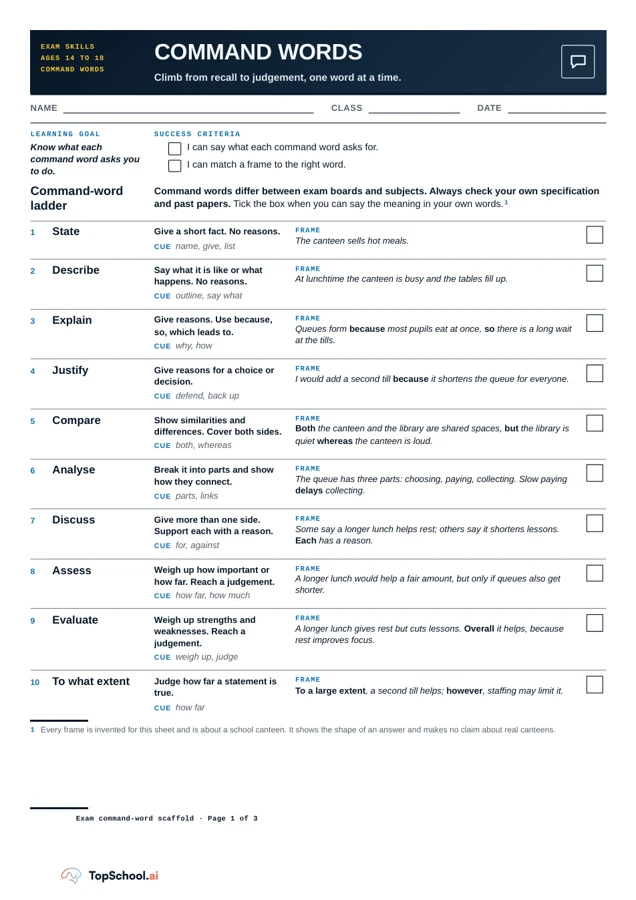
Build an answer to an exam question by matching command words to the kind of thinking they ask for. The resource compares ten common verbs, models explain, analyse and evaluate structures, and gives a checklist for reviewing an evaluative response.
Read the material
Build an answer to an exam question by matching command words to the kind of thinking they ask for. The resource compares ten common verbs, models explain, analyse and evaluate structures, and gives a checklist for reviewing an evaluative response.
Complete resource. Use the preview for diagrams and layout.
Page 1
NAME
CLASS
DATE
LEARNING GOAL
Know what each
command word asks you
to do.
SUCCESS CRITERIA
I can say what each command word asks for.
I can match a frame to the right word.
Command-word
ladder
Command words differ between exam boards and subjects. Always check your own specification
and past papers. Tick the box when you can say the meaning in your own words.1
1
State
Give a short fact. No reasons.
CUE name, give, list
FRAME
The canteen sells hot meals.
2
Describe
Say what it is like or what
happens. No reasons.
CUE outline, say what
FRAME
At lunchtime the canteen is busy and the tables fill up.
3
Explain
Give reasons. Use because,
so, which leads to.
CUE why, how
FRAME
Queues form because most pupils eat at once, so there is a long wait
at the tills.
4
Justify
Give reasons for a choice or
decision.
CUE defend, back up
FRAME
I would add a second till because it shortens the queue for everyone.
5
Compare
Show similarities and
differences. Cover both sides.
CUE both, whereas
FRAME
Both the canteen and the library are shared spaces, but the library is
quiet whereas the canteen is loud.
6
Analyse
Break it into parts and show
how they connect.
CUE parts, links
FRAME
The queue has three parts: choosing, paying, collecting. Slow paying
delays collecting.
7
Discuss
Give more than one side.
Support each with a reason.
CUE for, against
FRAME
Some say a longer lunch helps rest; others say it shortens lessons.
Each has a reason.
8
Assess
Weigh up how important or
how far. Reach a judgement.
CUE how far, how much
FRAME
A longer lunch would help a fair amount, but only if queues also get
shorter.
9
Evaluate
Weigh up strengths and
weaknesses. Reach a
judgement.
CUE weigh up, judge
FRAME
A longer lunch gives rest but cuts lessons. Overall it helps, because
rest improves focus.
10
To what extent
Judge how far a statement is
true.
CUE how far
FRAME
To a large extent, a second till helps; however, staffing may limit it.
1 Every frame is invented for this sheet and is about a school canteen. It shows the shape of an answer and makes no claim about real canteens.
Exam command-word scaffold · Page 1 of 3
EXAM SKILLS
AGES 14 TO 18
COMMAND WORDS
COMMAND WORDS
Climb from recall to judgement, one word at a time.
Page 2
INVENTED TOPIC
A town should keep its public library. This topic is fictional and used for practice only. Read each
worked example, then write your own.
1
Explain
PEEL: Point, Evidence,
Explain, Link.
Your turn: explain one
more reason a town might
keep its library.
POINT
A library helps people who cannot afford books.
EVIDENCE
For example, families can borrow books for free.
EXPLAIN
This matters because reading then costs nothing, so more children can practise.
LINK
Keeping the library therefore supports learning in the town.
EXPLAIN
2
Analyse
PEA: Point, Evidence,
Analyse.
Your turn: analyse one
other part of a library, such
as its staff or its events.
POINT
A library is more than a shelf of books.
EVIDENCE
It offers computers, quiet study space and clubs.
ANALYSE
Each part serves a different group, and together they make the library a meeting place.
ANALYSE
Spot the
difference
Compare your two
paragraphs.
HOW IS
ANALYSE
DIFFERENT
FROM EXPLAIN?
Exam command-word scaffold · Page 2 of 3
EXAM SKILLS
AGES 14 TO 18
COMMAND WORDS
PARAGRAPH STRUCTURES
Page 3
INVENTED TOPIC
A town should keep its public library. This topic is fictional and used for practice only. Use the same
topic. Read the worked example, then write your own.
3
Evaluate
Claim, for, against,
judgement with a reason.
Your turn: evaluate the
claim above.
CLAIM
Keeping the library is a good use of money.
FOR
It gives free access to books and study space.
AGAINST
It costs money that could fund other services.
JUDGE
Overall, keep it, because free access helps people who have no other choice.
EVALUATE
Mark scheme
criteria
Typical, not any one
board’s. Tick what your
Evaluate answer has.
Accurate knowledge: facts and terms
are correct
Development: each point is explained,
not just listed
Use of evidence: an example or fact
backs each point
Judgement: a clear decision with a
reason
Clear writing: ideas in order, easy to
follow
Go further
Make your judgement
depend on a condition.
Rewrite your judgement so it begins: It holds only if …
Next time
ONE THING I
WILL IMPROVE
Exam command-word scaffold · Page 3 of 3
EXAM SKILLS
AGES 14 TO 18
COMMAND WORDS
EVALUATE AND CHECK
A teaching sequence
Interpret a question’s command word and select a response structure that matches the requested thinking.
Read the command word's demand
Read what each of the ten command words asks a response to do, using its cues and frame. Identify point, evidence, explanation and link in the invented library example, then add a further reason.
What must this response do beyond stating a fact?
Connect the parts in analysis
Compare the analyse example with the explain paragraph. Note how analysis shows connections among parts rather than only giving a reason.
How does your analysis show a relationship between parts?
Weigh both sides in evaluation
On page 3, read the evaluate model and identify the claim, supporting case, opposing case and judgement. Use the checklist to review a practice answer.
Where is the reason supporting your judgement?
Make the judgement conditional
Rewrite the judgement so that it begins with the stated condition, then choose one specific improvement for next time. Find the matching part in the current exam-board criteria.
Which current course criterion confirms what this task word requires?
Before you teach
Look for the thinking behind an answer, choose the support your class needs and leave room for an independent response.
What to look for
Ask pupils to name the task the command word sets and point to the matching part of their answer. For explain, look for developed reasons; for analyse, look for links between parts; for evaluate, look for weighed arguments and a reasoned judgement. Compare the answer with the exam board’s own criteria.
Give a little support
Ask pupils to underline the command word, circle the topic and write a short plan before drafting. Use one example at a time and model how the response changes when the verb changes. Keep a glossary for subject vocabulary alongside this sheet.
Take the idea further
Take one topic and write three questions using different command words. Compare how the evidence and structure would change for each, and test a judgement by changing the condition on which it depends.
Things to keep in mind
The examples use one invented public-library topic and simplified paragraph structures. Command words and mark schemes can differ by subject, qualification and exam board, so the sheet cannot replace the current specification or a teacher’s explanation.
Keep the idea. Make it yours.
Bring your topic, learning goal and class context to PLAI™, then review what you create.
Ideas to try with your class
Sample teaching perspectives on what to try, what to adapt and what to watch for.
Meet The Creators
Meet the creators whose teaching interests connect with this template. Find an approach to try with your class.

Idris Rahman
Keeping a class in my week matters when I discuss assessment workload or how a timetable decision affects teaching; those choices have to work inside real lessons.
Meet the creator
Sadia Chowdhury
I turn mock-assessment analysis into a named teaching or revision step, identifying the knowledge or skill needing attention while keeping examination planning close to Year 11 Business.
Meet the creator
Open Book Pause
The three-page ladder contrasts command words with cues and sample frames, from stating a fact to assessing importance and reaching a judgement. It explicitly warns that wording differs by exam board and subject.
Kind Check-In
The canteen examples make the shift from describing a queue to explaining why it forms concrete. Pupils then compare, analyse, discuss or assess using a structure that matches the requested thinking.
Little Lightbulbs
Ticking a command word only after explaining it in the pupil’s own words offers a retrieval check. A teacher can have pupils compare two frames and identify which one gives reasons or covers both sides.
One More Question
The ladder is a general aid, not an authoritative glossary for every specification. Check current subject guidance and past papers before using a frame in assessed work, especially where command words have discipline-specific meaning.