
Science
Find the error: chemistry calculations
Pupils inspect Sam’s chemistry calculations, correct faulty working and explain the reason for each correction. Two activity pages include formula mass, amount, mass and reaction ratios, plus a deliberately correct mean to discuss. A separate companion supplies the working and guidance for handling an unusual reading.
Read the material
Pupils inspect Sam’s chemistry calculations, correct faulty working and explain the reason for each correction. Two activity pages include formula mass, amount, mass and reaction ratios, plus a deliberately correct mean to discuss. A separate companion supplies the working and guidance for handling an unusual reading.
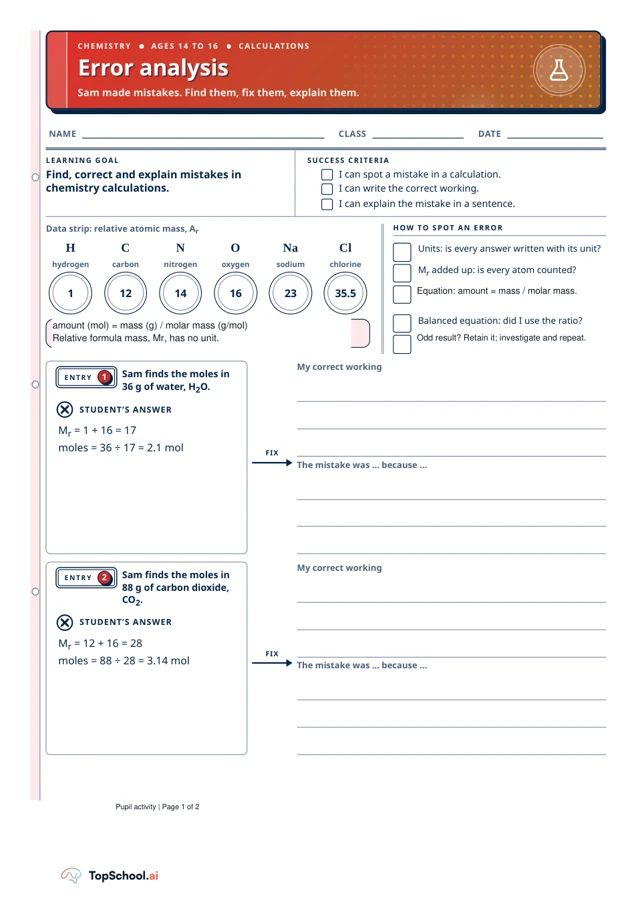
Pupil worksheet. Use the preview for diagrams and layout.
Page 1
CHEMISTRY
AGES 14 TO 16
CALCULATIONS
Error analysis
Error analysis
Sam made mistakes. Find them, fix them, explain them.
NAME
CLASS
DATE
LEARNING GOAL
Find, correct and explain mistakes in
chemistry calculations.
SUCCESS CRITERIA
I can spot a mistake in a calculation.
I can write the correct working.
I can explain the mistake in a sentence.
Data strip: relative atomic mass, Ar
H
hydrogen
C
carbon
N
nitrogen
O
oxygen
Na
sodium
Cl
chlorine
HOW TO SPOT AN ERROR
Units: is every answer written with its unit?
Mr added up: is every atom counted?
Balanced equation: did I use the ratio?
1
12
14
16
23
35.5
FIX
My correct working
The mistake was ... because ...
E N T R Y
1
Sam finds the moles in
36 g of water, H2O.
STUDENT’S ANSWER
Mr = 1 + 16 = 17
moles = 36 ÷ 17 = 2.1 mol
FIX
My correct working
The mistake was ... because ...
E N T R Y
2
Sam finds the moles in
88 g of carbon dioxide,
CO2.
STUDENT’S ANSWER
Mr = 12 + 16 = 28
moles = 88 ÷ 28 = 3.14 mol
amount (mol) = mass (g) / molar mass (g/mol)
Relative formula mass, Mr, has no unit.
Equation: amount = mass / molar mass.
Odd result? Retain it; investigate and repeat.
Pupil activity | Page 1 of 2
Page 2
CHEMISTRY
AGES 14 TO 16
MORE ERRORS
Find and fix more
Find and fix more
NAME
CLASS
DATE
FIX
My correct working
The mistake was ... because ...
E N T R Y
3
Sam finds the mass of
0.5 mol of sodium
chloride, NaCl.
STUDENT’S ANSWER
Mr = 23 + 35.5 = 58.5
mass = moles ÷ Mr
= 0.5 ÷ 58.5 = 0.0085 g
FIX
My correct working
The mistake was ... because ...
E N T R Y
4
The equation is 2H2 + O2
→ 2H2O.
STUDENT’S ANSWER
“4 mol of H2 makes 2 mol of H2O
because there is a 2 in front.”
FIX
My correct working
The mistake was ... because ...
E N T R Y
5
Four repeats of a
reaction. Temperature
rise in °C.
STUDENT’S ANSWER
mean = (5.0 + 5.2 + 9.8 + 5.1) ÷ 4
= 6.3 °C
°C
°C
°C
°C
5.0
5.2
9.8
5.1
E N T R Y
6
Make a mistake for a partner
You must know the right answer
SWAP
The right answer is (cover when you swap):
Not yet
Getting there
Got it
My one-line calculation, with one planted error
My partner’s correction
This mean may be correct. Check it, then
discuss the unusual result.
Pupil activity | Page 2 of 2
Page 1
Teacher companion
Find the error: chemistry calculations
Q1 and Q2
Q1 Mr(H2O) = 2 × 1 + 16 = 18; molar mass 18 g/mol. Amount = 36/18 = 2 mol. Sam omitted one H. Q2
Mr(CO2) = 12 + 2 × 16 = 44; molar mass 44 g/mol. Amount = 88/44 = 2 mol. Sam omitted one O.
Q3 and Q4
Q3 mass = amount × molar mass = 0.5 × 58.5 = 29.25 g. Mr is unitless; molar mass is in g/mol. Sam divided
instead of multiplying. Q4 H2:H2O ratio is 2:2, so 4 mol H2 can produce 4 mol H2O when oxygen is
sufficient.
Q5
The sum is 25.1 °C and the mean of all four readings is 6.275 °C, rounded to 6.3 °C. That arithmetic is
correct. 9.8 °C is a possible anomaly, not a proven error. Retain every raw reading, investigate the method
and repeat. Exclude only with a stated justified reason and report the effect on the mean.
Q6 and review
Check the peer-written calculation has one identified error and a valid correction. Accept appropriate
significant figures and units. This is an error-analysis task with one deliberately correct arithmetic case, not
a claim that every student answer is wrong.
Teacher companion | Page 1 of 1
A teaching sequence
Pupils should identify omitted atoms, an incorrect calculation operation and a misread reaction ratio, then show corrected working with appropriate units. They should distinguish a valid mean from a possible anomaly and create one explainable error for a partner.
Count every atom
Work through water and carbon dioxide. Ask which atoms Sam omitted, then connect each corrected formula mass with the molar mass used to divide the given mass.
Which subscript changes the formula mass of water or carbon dioxide?
Check operations and mole ratios
Correct the sodium-chloride operation and inspect the hydrogen-to-water ratio. Ask pupils to explain why the balanced equation gives a 2:2 ratio rather than halving the amount of product.
Why does the balanced equation give a 2:2 hydrogen-to-water ratio?
Retain and investigate unusual data
Recalculate the mean of all four temperature rises. Retain 9.8°C in the raw data and discuss what method checks or repeats would investigate it before any justified exclusion.
Is the mean calculation wrong, or is one reading unusual?
Create an unambiguous planted error
Create a one-line calculation with one planted error and a known correct answer. Swap it, compare the partner’s explanation with the intended error and revise any ambiguous example.
Does the partner's explanation identify the error you intended?
Before you teach
Look for the thinking behind an answer, choose the support your class needs and leave room for an independent response.
What to look for
Useful corrections include 36 ÷ 18 = 2 mol for water and 0.5 × 58.5 = 29.25 g for sodium chloride. The mean is 6.275°C, rounding to 6.3°C, so Sam’s arithmetic there is correct. If a pupil deletes 9.8°C immediately, ask what evidence would justify excluding it and retain the original reading.
Give a little support
Annotate the formula before calculating: mark each atom count and connect it to the data strip. Offer the stem “The mistake was… because…”, then require the corrected working beside it. Keep Mr, which has no unit, separate from molar mass in g/mol.
Take the idea further
Compare the mean using all four readings with the mean that would result from excluding 9.8°C. Explain how the conclusion changes and what investigation would be needed to justify exclusion. Report both the original data and any reasoned decision rather than silently removing the unusual value.
Things to keep in mind
An unusual reading is not automatically an error. Retain raw data and justify any exclusion.
Keep the idea. Make it yours.
Bring your topic, learning goal and class context to PLAI™, then review what you create.
Ideas to try with your class
Sample teaching perspectives on what to try, what to adapt and what to watch for.
Meet The Creators
Meet a creator whose teaching interests connect with this template.

Glue Stick Club
The chemistry pages mix omitted atoms, wrong operations and reaction ratios, with formula-mass data and unit checks. The first examples distinguish H₂O’s two hydrogens and CO₂’s two oxygens before pupils correct Sam’s mole calculations.
Steady Marker
The task extends beyond finding a wrong line: pupils explain the correction, retain an odd result for investigation and later consider a mean, an anomaly and a partner-created error. That supports reasoning about data as well as arithmetic.
Open Book Pause
Use the data strip and the “Mr added up” prompt to count atoms before calculating. Keeping formula mass unitless while writing amount in mol helps pupils separate the intermediate value from the answer’s unit.
Paperclip Perspective
The sheet contains deliberate errors and some results that must be retained for investigation rather than rounded away. Check the reaction ratio and units in each example; a mean alone does not determine whether a result is an anomaly.