
Geography
Decision evaluation matrix: Saltmarsh Bay
Compare three fictional coastal-management options, score their effects from environmental, economic and social viewpoints, then justify a recommendation. The three-page landscape A4 workbook includes a worked school-garden example, weighting and totals, a risk prompt and a space to explain what might change a decision.
Read the material
Compare three fictional coastal-management options, score their effects from environmental, economic and social viewpoints, then justify a recommendation. The three-page landscape A4 workbook includes a worked school-garden example, weighting and totals, a risk prompt and a space to explain what might change a decision.
Complete resource. Use the preview for diagrams and layout.
Page 1
NAME
CLASS
DATE
LEARNING GOAL
Weigh three options fairly, then
decide.
SUCCESS CRITERIA
I can score an option from three viewpoints and justify my recommendation.
I can weight what matters most and work out a total.
1
The scenario
This place is fictional, invented for
this sheet.
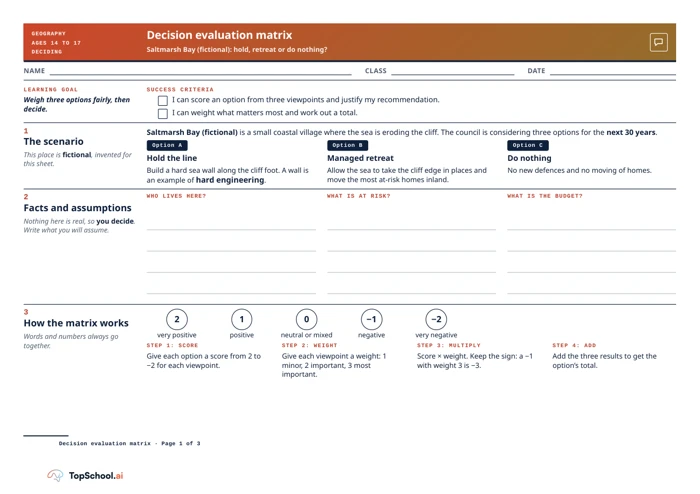
Saltmarsh Bay (fictional) is a small coastal village where the sea is eroding the cliff. The council is considering three options for the next 30 years.
Option A
Hold the line
Build a hard sea wall along the cliff foot. A wall is
an example of hard engineering.
Option B
Managed retreat
Allow the sea to take the cliff edge in places and
move the most at-risk homes inland.
Option C
Do nothing
No new defences and no moving of homes.
2
Facts and assumptions
Nothing here is real, so you decide.
Write what you will assume.
WHO LIVES HERE?
WHAT IS AT RISK?
WHAT IS THE BUDGET?
3
How the matrix works
Words and numbers always go
together.
2
very positive
1
positive
0
neutral or mixed
−1
negative
−2
very negative
STEP 1: SCORE
Give each option a score from 2 to
−2 for each viewpoint.
STEP 2: WEIGHT
Give each viewpoint a weight: 1
minor, 2 important, 3 most
important.
STEP 3: MULTIPLY
Score × weight. Keep the sign: a −1
with weight 3 is −3.
STEP 4: ADD
Add the three results to get the
option’s total.
Decision evaluation matrix · Page 1 of 3
GEOGRAPHY
AGES 14 TO 17
DECIDING
Decision evaluation matrix
Saltmarsh Bay (fictional): hold, retreat or do nothing?
Page 2
NAME
CLASS
DATE
Do this. Weight each viewpoint first. Read each prompt and write your score in the dashed circle, copy the weight, then multiply. Scores: 2 very positive, 1 positive, 0 neutral or mixed, −1 negative,
−2 very negative.
WEIGHT
A: HOLD THE LINE
B: MANAGED RETREAT
C: DO NOTHING
WORKED EXAMPLE: SCHOOL GARDEN
Environmental
land, shore, wildlife
how much
does it matter?
How does a wall change the beach and
shore wildlife?
×
=
What land and habitats change if the
sea moves in?
×
=
What does natural erosion do to the
cliff and shore?
×
=
Garden gives wildlife a home and less
paving.
2
×
1
=
2
Economic
money, jobs, property
how much
does it matter?
Who pays for the wall, and for how
long?
×
=
What would moving homes cost? What
is lost?
×
=
What might homes, shops and land
lose in value?
×
=
Cheap to build, but needs a gardener.
1
×
2
=
2
Social
people, safety,
community
how much
does it matter?
Who feels safer? Who might feel left
out?
×
=
How would moved families and the
village feel?
×
=
Who is at risk, and how would people
cope?
×
=
Pupils can grow food and relax
together.
1
×
3
=
3
Total
add the three boxes
+
+
total =
+
+
total =
+
+
total =
2
+
2
+
3
total =
7
Worked example (fictional school): a school chose between a new pitch, a garden and a library space. The garden totalled 7, the pitch 3 and the library 4. Weights: environmental 1, economic 2, social 3.
Decision evaluation matrix · Page 2 of 3
GEOGRAPHY
AGES 14 TO 17
DECIDING
The matrix: Saltmarsh Bay
Page 3
NAME
CLASS
DATE
4
Check your totals
Copy them from page 2. A total is a
prompt for judgement, not
the answer.
A total
B total
C total
Same as my first instinct?
Yes
No
5
I recommend
Tick one, then argue for it.
A Hold the line
B Managed retreat
C Do nothing
BECAUSE
THE STRONGEST EVIDENCE IS
6
Risk and doubt
A good argument faces its
weak point.
THE MAIN RISK IS
ONE THING THAT WOULD CHANGE MY MIND
7
Weighing
Think about who gains and who
loses.
WHICH VIEWPOINT DID I WEIGHT HIGHEST, AND WHY?
Decision evaluation matrix · Page 3 of 3
GEOGRAPHY
AGES 14 TO 17
DECIDING
Your recommendation
Saltmarsh Bay (fictional): what should the council do?
A teaching sequence
Compare three coastal-management options using weighted environmental, economic and social criteria, then support a recommendation and identify a risk or uncertainty.
State your assumptions
Read each option and state assumptions about the people, places, budget and assets at risk.
Which claim about Saltmarsh Bay is an assumption you have chosen?
Weight the viewpoints
Set a weight for environmental, economic and social viewpoints before assigning option scores.
Why should this viewpoint carry more weight than another?
Calculate signed totals
Multiply each score by its weight, retain positive or negative signs and add the results for each option.
Does a negative score keep its sign after multiplication?
Defend the decision
Treat the total as a discussion prompt; recommend an option, name the strongest evidence, identify a risk and explain what could change your mind. Revisit a weight and explain beyond the total.
Would changing a weight alter the result or your recommendation?
Before you teach
Look for the thinking behind an answer, choose the support your class needs and leave room for an independent response.
What to look for
Look for a transparent scoring method, weights chosen before scores and a recommendation that explains who gains, who bears costs and what uncertainty remains. Ask: “Would the result change if a different viewpoint mattered most?” The fictional scenario has no real coastal data, and a numerical total does not replace judgement.
Give a little support
Complete one row together using the worked example, then give pupils the score definitions and multiplication steps as a visible reference. Discuss the meaning of negative values before asking for a total, and allow oral reasoning before written justification.
Take the idea further
Ask pupils to change one weight or add a new criterion and see how the recommendation changes. They can compare whether the matrix still reflects the stated assumptions and identify whose view is missing.
Things to keep in mind
Saltmarsh Bay and the worked school-garden comparison are explicitly fictional; their costs, impacts and resident assumptions are not evidence about real places. Weighted scores support discussion but do not determine a correct policy choice. Use current, local sources for actual coastal decisions.
Keep the idea. Make it yours.
Bring your topic, learning goal and class context to PLAI™, then review what you create.
Ideas to try with your class
Sample teaching perspectives on what to try, what to adapt and what to watch for.
Meet The Creators
Meet a creator whose teaching interests connect with this template.

Pocketful of Stories
The fictional Saltmarsh Bay task compares a sea wall, managed retreat and no new defence using environment, economy and social viewpoints. The scoring key runs from −2 to 2, then asks pupils to weight each viewpoint and multiply before adding totals.
Clear Example
This three-page Geography matrix makes the decision process visible: state assumptions about residents, risks and budget, score each option, then recommend with a risk or uncertainty. The arithmetic is tied to an explicit policy judgement rather than a single correct answer.
Chalk & Chai
Model one score and weight first, preserving the sign when multiplying a negative score. Ask pupils to justify the words and numbers together, since the sheet itself warns that a total without an explanation is not a fair comparison.
Open Book Pause
Saltmarsh Bay is fictional, and pupils choose assumptions about residents, risks and budget. Different assumptions and weights can change the recommendation, so a higher total does not make one coastal policy universally best.